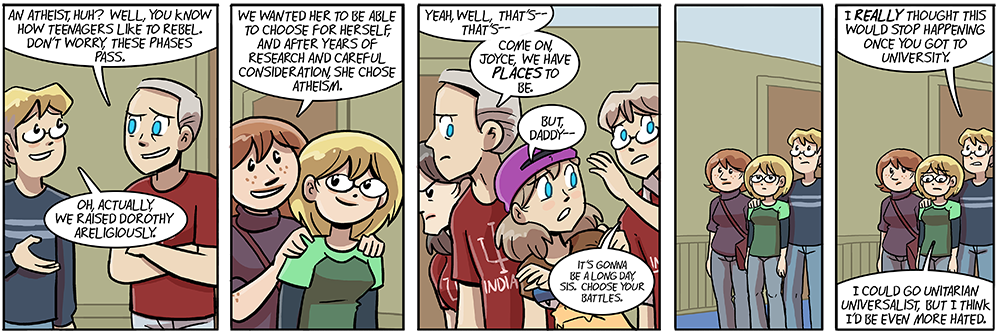
The Keeners would probably feel better if they knew how the Browns raised their kids…Feel better about being criticized by the Browns, at least.
But take an Opus the Penguin approach to dealing with your small-minded neighbors and fellow Americans, you’ll get Opus the Penguin results.
Seriously, The Keeners’ wide-eyed candidness about their intellectual outlook may not be as sad as Mrs. Browns desperate one-note dogma, but seeing good people set themselves up for avoidable heartache over their own unhealthy lack of skepticism is still sad….
Thats like saying “You look white. Why self identify as latino?” In my experience the candidness is something to be encureged to them. Especially with regards to introspection. The honest communication does make for healthier relationships.
Zach
TLDR- the candidness may be a matter of principal and a statement of integrity.
I understand Dorothy’s healthy emotional maturity for her age now.
Ivan
At the same time, it’s not a conversation of casual “and I like honey in my coffee instead of sugar!” type of topic, so intelligent people with common sense already know how to address this topic in a manner which draws the least criticism, debate, confrontation, commentary & condescension – especially from people they wouldn’t normally have any true respect for anyway, and nothing in common with, so there really isn’t a need to address it on the part of anyone just because someone else asks about their personal business – *because it’s the #1 topic on THEIR list of interests*.
.
If she could have lied to make Joyce’s mother happy, why not lie and say “I enjoy reading Anton LeVay, and I like his beard. It’s truly unfortunate that the man everyone thought was the true Satan on earth died of natural causes” (even if natural is by naturally putting a bullet in your head… you naturally die of bleeding and scrambled brains!).
btw… what does TLDR / TDDR mean??
Catullus
TL;DR is “too long; didn’t read.” Not sure about TDDR.
Yup agreed.
You also get pains explaining what it is.
While atheists obviously arnt as pushy – sometimes they think your “position” shouldn’t exist.
Really I blame the stupid word “Belief”.
Its too ambiguous.
Really we should all just state the probability we feel of a deity existing.
Atheists = anything under 50% down to zero.
Religious = high
Agnostics = Believe you cant even state a percentage likelyness due to too little information.
Jade Margery
Agnosticism and atheism aren’t mutually exclusive–in fact they usually go hand in hand.
‘Do you believe in god?’ is a yes or no question. You can be unsure, of course, or you can recognize that there is no scientific way to disprove the existence of deities, and that’s fine, but it doesn’t answer the question. Either you believe god(s) exist, or you don’t. If you’re an agnostic, then you probably don’t, and that makes you an agnostic atheist. Agnostic theists exist too but they are pretty rare in my experience.
Richard Dawkins, famous religion-bashing atheist that he is, is also an agnostic.
The reason claiming to be agnostic but not atheist annoys some atheists is because it is often accompanied by ignorance about what it means to BE an atheist.
Grimoire
I hate that question because insisting it to be yes/no is much the same as that dumb creationist question of ‘were you there’. It is a ‘lawyer’ question meant to manipulate and control. It doesn’t empower learning, it doesn’t empower learning, all it exists for is to force a label onto someone. A better question would be one that fosters discussion and learning. Just like how ‘Were you there’ would be better asked as ‘How do you Know’.
To be blunt my answer to ‘Do you believe there is a god’ is ‘I don’t know’ and there is nothing wrong with not knowing something. The only people who fear saying that they don’t know something are those afraid of learning or for some reason don’t want to admit that they may not know the answer. Now if I were answering ‘I can’t know’ one might be able to be derisive since that might be equivalent to throwing up your hands and giving up on finding an answer. However, that can also be a believe. A strong belief that they can’t know what to belief.
An answer can sometimes be hard to find, doubly so if it isn’t your number one priority to solve. Not having yet found an answer is no shame, not as long as you don’t give up.
The problem with such a question is that it assumes the answer is an open and shut case; that it isn’t something that could take a lifetime of searching to answer. It presumes that anyone who hasn’t yet found an answer are too lazy to try or are guilty of some other evasion and that if they just take 1 second to ‘think’ that they can answer yes or no.
Toad
The point is you aren’t being asked if you know. There are very few atheists out there who will claim that they know there is no god. You are asked if you believe. And most self-identified agnostics acknowledge that they do not believe, but can’t be certain. Which is an atheistic approach to the situation.
Zuche
Except that the question doesn’t have to have a negative or affirmative answer. Ask me how I know the colour of the invisible pink unicorn and I’ll direct you to Hasbro’s toy line. Ask me if I believe in a higher power and I’ll tell you, “Not the one I talk to all the time,” or, “Assuming it exists, then sure.”
Grimoire
I am not even sure where you are coming from. I was not discussing the question ‘Does God Exist?’ which is where it appears you are coming from.
I was stating that the question “‘Do you believe in god?’” doesn’t have to be yes/no. It is entirely possibly that person has thought it over and still don’t know where they stand and are still looking for ‘their’ answer. Perhaps that is where you misunderstood me since I worded it as ‘the answer’ since I didn’t want to type out ‘the answer to the question of Do you believe in god’ every time. Perhaps wording it their answer works better.
I disagree. At any given time, you either have a belief, or you don’t. If you don’t know whether you have a belief, then you don’t have one yet. “I don’t know where I stand” means “no”.
Far
Dawkins likes to lie about his belief. If God is a Delusion, then he Believes that God does not exist. If Blasphemy is a victimless crime, then Dawkins Believes God does not exist. Dawkins claims he believes both these statements are true. Thus he BELIEVES there is no God making he a hard-core Atheist.
HiEv
No.
It’s only rational to act as though something unlikely and unproven is untrue. When he says that blasphemy is a victimless crime, he means that it almost certainly is unless the relevant gods actually exist, however there isn’t any reason to believe that they do. However, that’s quite a mouthful to say every time, so he uses the far more reasonable shorthand of just saying what he does.
You’ve gone about your business your whole life as though there is no hairy-prarie hidebehind hiding behind you, but that doesn’t mean that you’ve had an active belief that hairy-prarie hidebehinds do not exist.
So you see, it’s entirely possible to honestly act as though something does not exist for perfectly rational reasons without having an active belief that that thing does not exist.
LiveWire
He believes “THAT” god (the one(s) created by humanity to explain the world) is a delusion. He says, though, that if any deity came down here tomorrow and gave evidence of godliness, he’d be perfectly happy to change positions.
Jack Finch
Agreed about belief. I’m about halfway through Pascal Boyer’s Religion Explained, and the problem is even worse for the term religion. In informal social usage we define the term vaguely by pointing at a small set of things that everyone believes are religions, like Christianity or Islam, but when you try to come up with a formal explanation of what makes something a religion, it gets a lot harder.
HiEv
You either believe something or you don’t believe it. You can’t “50% believe something”. You may believe that there is a 50/50 chance something is true, but you still either believe that it’s true or you don’t believe it’s true. If you can’t/won’t/don’t want to make a decision either way, then you don’t believe, in which case you’re an atheist.
Atheism simply means you don’t believe the claim that a god/goddess/gods exist. It does notonly mean that you claim gods do not exist.
Agnosticism, on the other hand, means you don’t know if a gods exist and/or you believe that knowing if gods exist is not possible.
You see, theism/atheism is a statement about belief, while gnosticism/agnosticism is a statement about knowledge. They’re two separate categories. This means that you can be both an agnostic and a theist or an agnostic and an atheist; the terms are not mutually exclusive in either case.
So, if your answer to the question, “Do you believe a god/goddess/gods exist?” is anything other than “yes”, then you’re an atheist too.
I’m an agnostic atheist myself.
Li
And here comes the silliness. No. I’m an agnostic agnostic. Sometimes I think there might be a god, sometimes I think there probably isn’t. I vacillate. I’m sorry that my willingness to accept uncertainty about something that doesn’t ultimately affect my life one way or the other is so frustrating for some atheists, but there you go.
Darwin2500
The point is, if you’re not sure there’s a god. Then you’re an atheist. Theists *are sure* that there’s a god.
All you’re doing is refusing to acknowledge the actual definitions of words that other people use. Your desire to self-identify as agnostic does not trump the actual definitions of the word ‘atheist’ or ‘theist’.
Li
Actually, my “desire to self-identify” absolutely does trump the dictionary definitions of atheism and theism, for which you should be grateful, since most dictionaries don’t use your preferred definition either.
Merriam-Webster, with their “b” definition that says atheism means the doctrine that there is no deity, not merely an absence of belief that there is.
Oxford English Dictionary, which updated their definitions to include deism as a separate thing from theism.
So. Yeah.
Li
To clarify my point: language is in flux. Dictionary definitions are especially in flux and have never, ever, ever been considered definitive sources for complicated subjects. Do not try to say “The dictionary defines racism as…” or “The dictionary defines Communism as…” or “The dictionary defines atheism as…” It’s not useful. It’s a nonstarter for complex, divisive, controversial topics. And it’s rude.
Your argument is also severely dependent on time period. Even if you’re willing to accept the above-linked definitions of atheism, would you have been willing to accept older definitions that included the commonly-held beliefs of the people at the time that atheists are devil-worshipers or otherwise morally-bankrupt? Would your desire to self-identify as not a devil-worshiper have also failed to trump what some old white Christian guys thought atheism meant?
Let’s try not to go too enthusiastically to bat for a thing that was until very recently calling homosexuality a moral perversion, hysteria a female disorder caused by the uterus, and brown people less evolved than whites, okay? 😉
Darwin2500
And their ‘a’ definition is “a disbelief in the existence of deity,” like I said.
Li
Yeah, maybe you should respond to the rest of what I said, or acknowledge that the word has two different meanings, which makes people who say atheism means “believing god doesn’t exist” still aren’t wrong.
Toad
I self-identify as chicken parm. By which I mean that I don’t know if there is a god.
Language is in flux, dictionaries are descriptive and not prescriptive, and so on, but there comes a point where insisting on using a word to mean one thing when it is commonly accepted to mean another, and it’s just unhelpful. Language should be useful. Very few atheists claim that god doesn’t exist with any sort of certainty. They are simply atheist. (“A-” not, “-theist” believer in a god.) If you do not actively believe in a god, then you are atheist.
(And yes, I acknowledge that my first line was an obvious strawman and an exaggeration and all that. It was rhetorical.)
Li
Nope, still an agnostic because sometimes I do have a belief in something like a god and sometimes I don’t. Also your comparison would be you know less pointless and insulting if chicken Parmesan was an accepted and commonly used term for atheist, the way that “believes god does not exist” is in fact an accepted and commonly used definition, even though it doesn’t describe all atheists.
Calling me an atheist is just inaccurate and unhelpful.
And I’m done with this conversation, my original point thoroughly and exhaustingly proven true.
partinobodycular
Being theistic doesn’t mean being sure about anything. Do I think there’s a god, or gods, or goddesses? Yes. Am I sure they exist? Not at all. Am I an atheist? Not at all. Theism and atheism are about belief, which has nothing to do with surety.
Chad from Canada
Atheism isn’t about belief. It’s about LACK of belief. I’m an atheist because I don’t believe in ANYTHING. This is the same as people who say atheism is a religion. A religion is a set of beliefs, and I believe in nothing, therefore it’s not a religion.
Also, for agnostics, or at least the ones I’ve met, I find a more correct term for what they are would be “Apathetic”. Which I do not mean as an insult, so please don’t be insulted. They don’t care if there is a deity or not. It’s a perfectly legitimate position, that deserves it’s own definition. It is separate from being an atheist or a theist in much the same way that being asexual is separate from being homosexual or heterosexual.
marr
Of the people I have met, Atheists are self proclaimed god deniers. They profess it would be stupid, based on quantifiable data to suppose the existence of God or any god.
The agnostics I know do cover a small range. Some believe in God, but not religion in any form. Some want to believe in God but feel they can’t. And other believe there could be a God, there could be many gods, there could have been gods who only exist due to belief (as in Terry Pratchett’s “Small Gods”) but feel we can never know for sure.
And there are others who believe religion doesn’t matter one way or the other. It helps some people get through their lives and other use it as an excuse to hate on others who aren’t of whatever group they think their holy book makes them a part of.
ICSM
Apathetic agnostic is actually the correct term for the people who take the position that you described. I am an Apathetic Agnostic myself, and described my thoughts on the matter at lenght some comments below.
There are such things as agnostic atheists and agnostic theists, however.
HiEv
If you vacillate, then you’re vacillating between being an atheist and being a theist, but you are never neither.
You see, there is the set of people who are the theists, and then there is everyone else, who are the atheists. “Atheism” includes everyone who isn’t in the set of “theists”.
You will be agnostic in either case, but you are still either agnostic theist or agnostic atheist at any given moment.
Heck, there’s a split brain patient who is atheist on one half of his brain and theist on the other half, and even he isn’t an “agnostic agnostic”. 😛 (Amusing side note: I asked some theists if this guy goes to Heaven, Hell, or both and not one of them could answer.)
Tan
I take it you mean you asked some flavor of Protestants.
For non-Christians, some religions do not have a heaven or hell (e.g. Hinduism), some believe that there is only heaven (or equivalent), some require only being a good person to get into the good afterlife, some require being part of their specific religion to get into the good one.
Long story short, if you can supply the information “Is this person a good person?” and “What religion do they belong to?” there are plenty of theists out there who can give a clear and unequivocal answer where they’re going in the afterlife.
David
I don’t think you actually read the Papal Infallibility article.
I.care.0
Well, the pope DID say that good people go to heaven, regardless of belief. It has led to some interesting and funny results.
Orrrrr you could let me use the terminology that I feel most accurately describes my religious beliefs, I’ll let you use yours, and we’ll both go on to live happy productive lives. Again, sorry that it annoys atheists, but no, you don’t get to control my labels. See my (currently pending moderation) reply) to Darwin2500.
Darwin2500
The problem is that your label automatically casts aspersions on other people labels. When you say ‘I’m not an atheist because I don’t believe you can PROVE there’s no God’, then you are obviously implying that all atheists DO believe this, even though the majority do not. This is why they get mad – your nonstandard labeling not only makes a strong and incorrect implication about their beliefs, it also muddies the waters of the larger discussion of these topics.
The distinction that ‘atheist/theist’ refers to active beliefs or lack of belief, and ‘agnostic/gnostic’ refers to beliefs about the possibility of certain knowledge, is a commonly used piece of terminology which is agreed upon by both prominent thinkers/writers in this area, and large communities of those who discuss and care about these issues. It’s not about dictionary definitions, it’s about preserving the integrity of precise definitions in a very difficult and fluid ongoing dialogue. When you come in and loudly insist on using different definitions than everyone else, and then demand respect for your definitions, you mess up everyone else’s conversations, and naturally draw ire.
David
Folks not wanting to be called “Atheist” despite not believing in a god sound too much to me like folks not wanting to be called “Feminist” despite believing in equal rights. Even though they technically fall within the definition, they heard Bad Things About Them On Cable News, so they avoid the label. To me, it feels kind of cowardly. It’s sort of a Fuck You to those who put their necks out.
Li
Gee, thanks, Mr. Willis.
Unfortunately, it’s not that in my case, so none of this applies. I am genuinely uncertain, and frankly being told I’m a coward for not wanting to pretend otherwise does not make me want to join your club house.
David
If you’re genuinely uncertain or apathetic, I’m pretty sure that makes you agnostic by the textbook definition. It’s those who do not believe in a god (as I specifically said) but attempt to maneuver their way out of being called Atheist that bug me. If sometimes you think God might exist, then I was not describing you.
Li
@Darwin2500: Except that I’m not doing any of that.
I think it’s unfortunate and obnoxious that atheists get pulled into the same false dichotomy that scientists do — where religious people try to pretend that an absence of religious faith is just another kind of faith, that “Darwinists” and “evolutionists” are a thing — but it has nothing to do with my personal use of the word agnostic, which I feel is just a better descriptor of my complete lack of commitment either way.
It certainly does seem to get across my beliefs to atheists very well, since they always respond with, “But how can you NOT KNOW whether you have a belief in a deity or not? All you need to do is say no and you’re an atheist! You don’t need to be sure, you just need that lack of faith.”
When they tell me that, I have to say: no. I’m actually not even that sure. Sometimes I do have belief, sometimes I don’t, and most of all I don’t really care.
This, to me, makes it clear that I am not actually an atheist even by the broadest definition of agnostic atheist.
But neither am I sticking my nose into scholarly discussions of atheism to tell them they’re wrong about how they use the word atheist, or writing papers on the subject or arguing with anyone about their use of language. All I am doing is saying that agnostic better describes me.
@David: Oh, and despite how much my hackles have been gotten up by this entire discussion, I also don’t hate atheists or think they suck, the way that people who prefer “humanist” hate feminists and think they suck. I think atheism is a perfectly valid position and I believe strongly in the separation of Church and State and I think the way atheists get treated is really scummy. I’ll hold up all the signs you want and “stick my neck out” as much as you want me to. I just genuinely find the word atheist to be a poor descriptor of me.
@Li: If it makes it feel better, I agree with you.
@Everyone else: I’m not sure if the Divine exists, but I strongly hope it does. (The rational part of me just hasn’t seen much evidence for it. Kind of like how I hope that I will live a long and happy life despite medical evidence to the contrary.) Does that make me an atheist? You can call me that if you want, but I still don’t think of myself as such.
@Willis: Do you honestly think I am a coward because of the above?
HiEv
I’m not “controlling your labels”, I’m pointing out what the labels mean and explaining how and when they apply.
Regarding the dictionary definitions, as Darwin2500 pointed out, definition 2a from Merriam-Webster is the definition most people use, and 2b is actually just a sub-category of 2a. And as for deism being a third category in some dictionaries, I almost mentioned that some define it that way, but I was worried it would just muddy the waters since it’s not as widespread a definition.
In any case, you can refuse to call yourself a hominid, for example, all you want, but if you’re actually a hominid then you aren’t “controlling your label”, you’re just wrong (as has already Toad tried to point out to you). If you want to communicate with other people clearly, then you should try to use the common definitions of words for the context that you’re using them. The point of dictionaries is to help us do that.
Now, I’m not saying you have to call yourself a part-time atheist or anything, I’m just pointing out that that’s what you describe yourself to be, regardless of claims to the contrary. Calling yourself an agnostic works just fine, I don’t have a problem with that. Just don’t deny sometimes being an atheist while also stating that sometimes you don’t believe gods exist, as that’s self-contradictory, confusing, and suggests you don’t understand what the word “atheist” means.
Li
Nnnnnnope. I’ve actually never had a problem communicating what I mean by “agnostic” to anyone. Even atheists who get their panties in a bunch over it still know what I mean.
In my experience, calling myself an atheist implies a degree of certainty to most people.
This is probably because I spend most of my time in the layperson community, not the atheist community, which — like any group — has its own much more technical understanding of its relevant terms.
I vacillate between atheist and theist, but the agnostic part remains consistent and most of all I am, yes, unconcerned by it. An “apathetic agnostic”; I liked that suggestion. Agnostic is shorthand, since “I’m an agnostic atheist/theist” is unwieldy, as well as being self-contradictory and confusing.
And, uh, you must realize that you sound like someone insisting that bisexual people don’t exist, right? “You’re sometimes straight, sometimes gay, but never anything else! To pretend you’re not just sometimes straight makes it sound like you don’t understand what straight means!”
Anyway, I’ve said my piece. I’ve explained this over and over again and I’m pretty blue in the face now but it doesn’t seem to be doing me any good. So you may take your concern-trolling elsewhere.
(If you’re unfamiliar with the term, concern-trolling is what you do when you pretend that you have no problem with my choices but are deeply concerned about how an imaginary third-party might react to them, and you just want to spare me the embarrassment of future encounters.)
HiEv
I’ve already agreed that “agnostic” is a perfectly acceptable label for you. My only bone of contention is that you rejected the label “atheist” during the times when you don’t believe in gods. You are having a problem communicating when you do that.
And no, I don’t sound like someone refusing to admit that bisexuals exist. Bisexuals exist because you can simultaneously be attracted to both/all genders. On the other hand you cannot simultaneously believe A and NOT A, i.e. having a belief gods exist and not having a belief that gods exist. So this is a false analogy.
If anything, I sound like a guy pointing out that, at any particular moment, you can only be in the group that accepts A or the group that does not. You refusing to put yourself in either category, even temporarily, wouldn’t make any sense.
Now that you admit you vacillate between atheist and theist while still being an agnostic, meaning that you cannot be purely an agnostic without also being either an atheist or theist as was earlier implied, you’ve agreed to the only point that I was trying to make about how the terms are defined.
As such I was not “concern-trolling”, I was merely annoyed at the incorrect usage of the terms.
Thanks for the insult though, they tend help sway people towards my side of the argument. 😉
Li
1) Still not. Sometimes I am definitely just square in the middle and it always averages out to that. 8D
2) Good to know that being called out on concern-trolling is “an insult” that somehow gets other people to want to be atheists, because all this hilarious bullying and condescension has so far only made me want to pretend I Always Have A Belief to get further away from you.
HiEv
How can you be “square in the middle” of a A or Not A position?
And yes, calling anyone a troll, especially when it involves incorrectly telling other people what is going on in the mind of a stranger, is, in fact, an insult. I wasn’t “concern-trolling” at all, I was merely clarifying some oft-misunderstood definitions, not even directed at you originally mind you, which somehow upset you, and then you laid into me.
And I wasn’t suggesting that you insulting me was going to make people want to be an atheist. I’m just pointing out that generally the side that acts insultingly tends to appear to be the losing side to people reading the discussion.
Calling what I did “bullying” is rather hilarious indeed. 😀
marr
I don’t vacillate. I don’t care. Whether or not God exists has no impact on my life and how I live it, other than have to explain to the believer or the deniers why I’m not on either team.
I do good things because the only thing I am sure of is that here and now what I do and how I treat people can make this world a better or worse place. Even if it is in some small way.
I don’t care about what happens after. This is all I can be sure of.
HiEv
In other words you don’t have a belief that gods do or do not exist, correct? If so, you’re not only an apatheist, you’re also an atheist. Regardless of why you don’t have a belief that gods exist, simply not having that belief makes you an atheist.
ICSM
I think that a god/supernatural being/etc MAY exist, because while it is impossible to prove that it does not exist nor never existed, because it is impossible to produce a negative proof of a generic fact, no one has ever proven that it existed through verifiable means. Regardless, it will not affect my life, so I dont care.
Im agnostic, but neither theist nor atheist, since I think that the mere discussion about the existance of a being is irrelevant in itself.
Darwin2500
That’s sort of silly, since most religions have some form of eternal afterlife, and your actions now could impact your future for infinite years. Unless you feel that you can know for sure that there’s no afterlife, but not that there’s no God.
ICSM
Not really. Society itself has its own rules and morals and incentives you to be a good person. Not killing, not stealing etc.
If you are a good person, what you should, regardless of fear of reprisal, you wont be punished in the afterlife unless god is a navel—gazing asshole that is bothered more about himself than with goodness. And if he IS an asshole, that is not a god that I would praise.
darwin2500
Except many/most images of God *do* fit that description, insomuch as their requirements for a good afterlife don’t accidentally happen to match your personal definition of ‘a good life’.
I doubt that you’re literally saying you would choose to spend eternity burning in fire rather than suck up to an omnipotent being, so the only other way I can interpret your nonchalance is to simply assume that you’re pretty sure you *won’t* be burning for eternity, meaning you’re pretty much an atheist.
I.care.0
“I doubt that you’re literally saying you would choose to spend eternity burning in fire rather than suck up to an omnipotent being”
That is, in fact, exactly what I was saying. The way I see it, actions, results and intent beat procedures. If someone, is willing to do good regardless of incentive to do so, only because he believes it to be the rigt thing to do, he is at the very least as good of a person as someone that only do so because, the law says so, or becase it is written in a holy book.
If god doens’t agree with this, and actively punishes good people of another culture for not followng his rituals the same way he would punish a murderous rapist, then he is not concerned with people trying to do the good thing, he is concerned with people obeying him or not, therefore being a tyrant.
Ya, that’s kind of a ridiculous position to take, with this hipothetical god being omnipotent and whatnot, but that’s me.
I.care.0
You see, “being a good person” is a cultural thing. Being a good person a thousand years ago in some weird, isolate tribe in the polinesia isn’t the same thing as being a good person now, and is utterly impossible to discert which way to “be a good person” is the correct one.
Forcing someone to guess, not only is less important than the fact that the person in question is actually trying to be good, but is utter madness, because, a) no person can know for sure the correct way without direct divine intervention, and b) many, MANY people will never know that there are other ways, due to socio-economic reasons, and, in the past, due to technologial reasons. If The Correct Way was some random way prophetized by a guy in Asia, for example, every single native american ever born before the 16th century will be in some hell by default, due to having being born in the wrong place. That is aggravated by the fact that everyone is naturally inclined to choose the belief of their parents/culture/society.
No sane god would make you spin a loaded dice to decide if you go to hell for eternity.
David
Sort of. Paul says in Romans 1:18-20 that nobody has an excuse to not believe in God, because He is evident in Creation, just from looking around. So it’s really the fault of those pre-Columbian Native Americans for not paying attention enough!
This is very reasonable.
Li
I agree with everything except that, as a moral objectivist, I do think that being a good person a thousand years ago = being a good person today. Just because people’s definitions of good change doesn’t mean that the definition of good changes. In other words, slavery was still shitty and awful even though at one point it was popularly considered to be fine and dandy.
Just because we can’t possibly know for sure what goodness is doesn’t mean there isn’t a right and a wrong answer.
But yeah, if there’s a force out there that created us and expects us to be good people, that force is not going to be the kind of force behind any of the religions I’m familiar with, with their arbitrary, human-corrupted checklists of good and bad behavior.
Somebody
I have to disagree. Some ways were obviously wrong and isn’t all “cultural”. Things change primarily because of knowledge. People back then didn’t understand the world enough, although humanity has managed not to render itself extinct even at that.
To say that a value exists regardless of whether or not everyone thinks so, is rather nonsensical…but that doesn’t mean everything is relative or arbitrary. We can say with confidence that witch hunts are wrong…belief to the country exists because of ignorance and/or malicious exploitation of superstitious people.
I.care.0
Not everything is completely arbitrary, but a LOT of small things on your daily life are. I agree that some things like slavery, witch hunting, treating women as cattle, and flaying anone that doesn’t share your beliefs aren’t cool. As a rule of thumb, anything that messes with a person free will, or stripes them of their basic human rights without their consent isn’t cool. A person should have the right to decide his future. The rest is up in the air.
I feel that I don’t have the right to put my worldview on an altar, say that my morals are the best, and judge everyone elses based off my standards. That was exactly the sort or thinking that led to holy wars in the past. I am certain that the inquisitors believed that they knew what was right and what was wrong, much in the same way that we think that we know now. Yeah, we improved quite a lot due to knowledge, but whos to say that we can’t improve much more?
I.care.0
Plus, what about the “small” things? The stuff that doesn’t involve killing innocents? Is it wrong to have mutiple wifes? Catholics seems to think so, but it is pretty common with the muslins. It is an abomination to wear wool and linen together? If a Jeovah witness refuses to get a blood transfusion and dies, are we to judge his choice based off our culture? Will we go to hell if we get a coronary artery bypass surgery in which was used an artery from a pig?
All that stuff may grant you ticket to hell if you choose wrong. Who is in the right and who is in the wrong of the matter? It is possible to know?
I.care.0
@willis
Ya, the bible has some nasty stuff, specially in Deuteronomy. I wouldn’t let my children touch that book with a 10 foot pole without supervision.
Li
People back then didn’t understand the world enough, although humanity has managed not to render itself extinct even at that.
Fallacy: Implies that people today understand the world, and that in another hundred years they won’t be laughing at our stupidity.
Also implies that societal progress is some kind of linear thing, and we know for a fact that it is not; each decade is generally a reaction to the decade before it, but we’re very shortsighted and like to pretend that “the 50s were more conservative than the 60s, which were more conservative than the 70s, which were more conservative than the 80s…” and it’s bullshit. History is muuuch more a case of “three steps forward, four steps back, five steps forward”, moving back and forth in drips and drabs, and we are in a much more conservative place right now than we were in the 90s, which itself was more conservative than the 70s.
(This contribution brought to you by: my college philosophy classes.)
leor613
@l.care.0: I’m willing to wager 5,000 quatloos that you have never actually studied Deuteronomy. You may prove you have by typing the second paragraph of the Shma.
Overwise, I expect those quatloos. :p
I.care.0
I read the thing that is in the bible. There is more to it? If you can actually prove that it isn’t just that shitload of insanity that it appears to be, I’ll be glad.
leor613
@l.care.0: The Sh’ma has three paragraphs, two taken from Deuteronomy and one from Numbers. If you’d actually read Deutreronomy you’d know what I was talking about. You clearly are a troll, you’ve never read Deuteronomy, and you owe me some money. Pay up: 5,000 quatloos.

452 thoughts on “Areligious”
Squall
This makes me sad…
thecanvashat
Just remember: Fifty. McNuggets.
Tom Speelman
It’s always a comforting thought!
erros
I tried this one. I was ill…
…and naive.
Viredae
Nah, you just need a stronger stomach lining.
DudeMyDadOwnsADealership
The Keeners would probably feel better if they knew how the Browns raised their kids…Feel better about being criticized by the Browns, at least.
But take an Opus the Penguin approach to dealing with your small-minded neighbors and fellow Americans, you’ll get Opus the Penguin results.
Seriously, The Keeners’ wide-eyed candidness about their intellectual outlook may not be as sad as Mrs. Browns desperate one-note dogma, but seeing good people set themselves up for avoidable heartache over their own unhealthy lack of skepticism is still sad….
Zach
Thats like saying “You look white. Why self identify as latino?” In my experience the candidness is something to be encureged to them. Especially with regards to introspection. The honest communication does make for healthier relationships.
Zach
TLDR- the candidness may be a matter of principal and a statement of integrity.
JBO
TDDR: Act with integrity, no regrets.
Jack Finch
I understand Dorothy’s healthy emotional maturity for her age now.
Ivan
At the same time, it’s not a conversation of casual “and I like honey in my coffee instead of sugar!” type of topic, so intelligent people with common sense already know how to address this topic in a manner which draws the least criticism, debate, confrontation, commentary & condescension – especially from people they wouldn’t normally have any true respect for anyway, and nothing in common with, so there really isn’t a need to address it on the part of anyone just because someone else asks about their personal business – *because it’s the #1 topic on THEIR list of interests*.
.
If she could have lied to make Joyce’s mother happy, why not lie and say “I enjoy reading Anton LeVay, and I like his beard. It’s truly unfortunate that the man everyone thought was the true Satan on earth died of natural causes” (even if natural is by naturally putting a bullet in your head… you naturally die of bleeding and scrambled brains!).
btw… what does TLDR / TDDR mean??
Catullus
TL;DR is “too long; didn’t read.” Not sure about TDDR.
Skilltagz
Too dumb didn’t read? It’s all that comes to mind
Seer of Rage
To Dumb Didn’t Respond
marr
Trying being Agnostic. You get hated by the Atheist and Religious just for admitting you don’t know for sure either way what is true.
Plasma Mongoose
This fact I found out several weeks ago on this very forum(?).
Darkflame
Yup agreed.
You also get pains explaining what it is.
While atheists obviously arnt as pushy – sometimes they think your “position” shouldn’t exist.
Really I blame the stupid word “Belief”.
Its too ambiguous.
Really we should all just state the probability we feel of a deity existing.
Atheists = anything under 50% down to zero.
Religious = high
Agnostics = Believe you cant even state a percentage likelyness due to too little information.
Jade Margery
Agnosticism and atheism aren’t mutually exclusive–in fact they usually go hand in hand.
‘Do you believe in god?’ is a yes or no question. You can be unsure, of course, or you can recognize that there is no scientific way to disprove the existence of deities, and that’s fine, but it doesn’t answer the question. Either you believe god(s) exist, or you don’t. If you’re an agnostic, then you probably don’t, and that makes you an agnostic atheist. Agnostic theists exist too but they are pretty rare in my experience.
Richard Dawkins, famous religion-bashing atheist that he is, is also an agnostic.
The reason claiming to be agnostic but not atheist annoys some atheists is because it is often accompanied by ignorance about what it means to BE an atheist.
Grimoire
I hate that question because insisting it to be yes/no is much the same as that dumb creationist question of ‘were you there’. It is a ‘lawyer’ question meant to manipulate and control. It doesn’t empower learning, it doesn’t empower learning, all it exists for is to force a label onto someone. A better question would be one that fosters discussion and learning. Just like how ‘Were you there’ would be better asked as ‘How do you Know’.
To be blunt my answer to ‘Do you believe there is a god’ is ‘I don’t know’ and there is nothing wrong with not knowing something. The only people who fear saying that they don’t know something are those afraid of learning or for some reason don’t want to admit that they may not know the answer. Now if I were answering ‘I can’t know’ one might be able to be derisive since that might be equivalent to throwing up your hands and giving up on finding an answer. However, that can also be a believe. A strong belief that they can’t know what to belief.
An answer can sometimes be hard to find, doubly so if it isn’t your number one priority to solve. Not having yet found an answer is no shame, not as long as you don’t give up.
The problem with such a question is that it assumes the answer is an open and shut case; that it isn’t something that could take a lifetime of searching to answer. It presumes that anyone who hasn’t yet found an answer are too lazy to try or are guilty of some other evasion and that if they just take 1 second to ‘think’ that they can answer yes or no.
Toad
The point is you aren’t being asked if you know. There are very few atheists out there who will claim that they know there is no god. You are asked if you believe. And most self-identified agnostics acknowledge that they do not believe, but can’t be certain. Which is an atheistic approach to the situation.
Zuche
Except that the question doesn’t have to have a negative or affirmative answer. Ask me how I know the colour of the invisible pink unicorn and I’ll direct you to Hasbro’s toy line. Ask me if I believe in a higher power and I’ll tell you, “Not the one I talk to all the time,” or, “Assuming it exists, then sure.”
Grimoire
I am not even sure where you are coming from. I was not discussing the question ‘Does God Exist?’ which is where it appears you are coming from.
I was stating that the question “‘Do you believe in god?’” doesn’t have to be yes/no. It is entirely possibly that person has thought it over and still don’t know where they stand and are still looking for ‘their’ answer. Perhaps that is where you misunderstood me since I worded it as ‘the answer’ since I didn’t want to type out ‘the answer to the question of Do you believe in god’ every time. Perhaps wording it their answer works better.
Robin Lionheart
I disagree. At any given time, you either have a belief, or you don’t. If you don’t know whether you have a belief, then you don’t have one yet. “I don’t know where I stand” means “no”.
Far
Dawkins likes to lie about his belief. If God is a Delusion, then he Believes that God does not exist. If Blasphemy is a victimless crime, then Dawkins Believes God does not exist. Dawkins claims he believes both these statements are true. Thus he BELIEVES there is no God making he a hard-core Atheist.
HiEv
No.
It’s only rational to act as though something unlikely and unproven is untrue. When he says that blasphemy is a victimless crime, he means that it almost certainly is unless the relevant gods actually exist, however there isn’t any reason to believe that they do. However, that’s quite a mouthful to say every time, so he uses the far more reasonable shorthand of just saying what he does.
You’ve gone about your business your whole life as though there is no hairy-prarie hidebehind hiding behind you, but that doesn’t mean that you’ve had an active belief that hairy-prarie hidebehinds do not exist.
So you see, it’s entirely possible to honestly act as though something does not exist for perfectly rational reasons without having an active belief that that thing does not exist.
LiveWire
He believes “THAT” god (the one(s) created by humanity to explain the world) is a delusion. He says, though, that if any deity came down here tomorrow and gave evidence of godliness, he’d be perfectly happy to change positions.
Jack Finch
Agreed about belief. I’m about halfway through Pascal Boyer’s Religion Explained, and the problem is even worse for the term religion. In informal social usage we define the term vaguely by pointing at a small set of things that everyone believes are religions, like Christianity or Islam, but when you try to come up with a formal explanation of what makes something a religion, it gets a lot harder.
HiEv
You either believe something or you don’t believe it. You can’t “50% believe something”. You may believe that there is a 50/50 chance something is true, but you still either believe that it’s true or you don’t believe it’s true. If you can’t/won’t/don’t want to make a decision either way, then you don’t believe, in which case you’re an atheist.
Atheism simply means you don’t believe the claim that a god/goddess/gods exist. It does not only mean that you claim gods do not exist.
Agnosticism, on the other hand, means you don’t know if a gods exist and/or you believe that knowing if gods exist is not possible.
You see, theism/atheism is a statement about belief, while gnosticism/agnosticism is a statement about knowledge. They’re two separate categories. This means that you can be both an agnostic and a theist or an agnostic and an atheist; the terms are not mutually exclusive in either case.
So, if your answer to the question, “Do you believe a god/goddess/gods exist?” is anything other than “yes”, then you’re an atheist too.
I’m an agnostic atheist myself.
Li
And here comes the silliness. No. I’m an agnostic agnostic. Sometimes I think there might be a god, sometimes I think there probably isn’t. I vacillate. I’m sorry that my willingness to accept uncertainty about something that doesn’t ultimately affect my life one way or the other is so frustrating for some atheists, but there you go.
Darwin2500
The point is, if you’re not sure there’s a god. Then you’re an atheist. Theists *are sure* that there’s a god.
All you’re doing is refusing to acknowledge the actual definitions of words that other people use. Your desire to self-identify as agnostic does not trump the actual definitions of the word ‘atheist’ or ‘theist’.
Li
Actually, my “desire to self-identify” absolutely does trump the dictionary definitions of atheism and theism, for which you should be grateful, since most dictionaries don’t use your preferred definition either.
Merriam-Webster, with their “b” definition that says atheism means the doctrine that there is no deity, not merely an absence of belief that there is.
Oxford English Dictionary, which updated their definitions to include deism as a separate thing from theism.
So. Yeah.
Li
To clarify my point: language is in flux. Dictionary definitions are especially in flux and have never, ever, ever been considered definitive sources for complicated subjects. Do not try to say “The dictionary defines racism as…” or “The dictionary defines Communism as…” or “The dictionary defines atheism as…” It’s not useful. It’s a nonstarter for complex, divisive, controversial topics. And it’s rude.
Your argument is also severely dependent on time period. Even if you’re willing to accept the above-linked definitions of atheism, would you have been willing to accept older definitions that included the commonly-held beliefs of the people at the time that atheists are devil-worshipers or otherwise morally-bankrupt? Would your desire to self-identify as not a devil-worshiper have also failed to trump what some old white Christian guys thought atheism meant?
Let’s try not to go too enthusiastically to bat for a thing that was until very recently calling homosexuality a moral perversion, hysteria a female disorder caused by the uterus, and brown people less evolved than whites, okay? 😉
Darwin2500
And their ‘a’ definition is “a disbelief in the existence of deity,” like I said.
Li
Yeah, maybe you should respond to the rest of what I said, or acknowledge that the word has two different meanings, which makes people who say atheism means “believing god doesn’t exist” still aren’t wrong.
Toad
I self-identify as chicken parm. By which I mean that I don’t know if there is a god.
Language is in flux, dictionaries are descriptive and not prescriptive, and so on, but there comes a point where insisting on using a word to mean one thing when it is commonly accepted to mean another, and it’s just unhelpful. Language should be useful. Very few atheists claim that god doesn’t exist with any sort of certainty. They are simply atheist. (“A-” not, “-theist” believer in a god.) If you do not actively believe in a god, then you are atheist.
(And yes, I acknowledge that my first line was an obvious strawman and an exaggeration and all that. It was rhetorical.)
Li
Nope, still an agnostic because sometimes I do have a belief in something like a god and sometimes I don’t. Also your comparison would be you know less pointless and insulting if chicken Parmesan was an accepted and commonly used term for atheist, the way that “believes god does not exist” is in fact an accepted and commonly used definition, even though it doesn’t describe all atheists.
Calling me an atheist is just inaccurate and unhelpful.
And I’m done with this conversation, my original point thoroughly and exhaustingly proven true.
partinobodycular
Being theistic doesn’t mean being sure about anything. Do I think there’s a god, or gods, or goddesses? Yes. Am I sure they exist? Not at all. Am I an atheist? Not at all. Theism and atheism are about belief, which has nothing to do with surety.
Chad from Canada
Atheism isn’t about belief. It’s about LACK of belief. I’m an atheist because I don’t believe in ANYTHING. This is the same as people who say atheism is a religion. A religion is a set of beliefs, and I believe in nothing, therefore it’s not a religion.
Also, for agnostics, or at least the ones I’ve met, I find a more correct term for what they are would be “Apathetic”. Which I do not mean as an insult, so please don’t be insulted. They don’t care if there is a deity or not. It’s a perfectly legitimate position, that deserves it’s own definition. It is separate from being an atheist or a theist in much the same way that being asexual is separate from being homosexual or heterosexual.
marr
Of the people I have met, Atheists are self proclaimed god deniers. They profess it would be stupid, based on quantifiable data to suppose the existence of God or any god.
The agnostics I know do cover a small range. Some believe in God, but not religion in any form. Some want to believe in God but feel they can’t. And other believe there could be a God, there could be many gods, there could have been gods who only exist due to belief (as in Terry Pratchett’s “Small Gods”) but feel we can never know for sure.
And there are others who believe religion doesn’t matter one way or the other. It helps some people get through their lives and other use it as an excuse to hate on others who aren’t of whatever group they think their holy book makes them a part of.
ICSM
Apathetic agnostic is actually the correct term for the people who take the position that you described. I am an Apathetic Agnostic myself, and described my thoughts on the matter at lenght some comments below.
There are such things as agnostic atheists and agnostic theists, however.
HiEv
If you vacillate, then you’re vacillating between being an atheist and being a theist, but you are never neither.
You see, there is the set of people who are the theists, and then there is everyone else, who are the atheists. “Atheism” includes everyone who isn’t in the set of “theists”.
You will be agnostic in either case, but you are still either agnostic theist or agnostic atheist at any given moment.
Heck, there’s a split brain patient who is atheist on one half of his brain and theist on the other half, and even he isn’t an “agnostic agnostic”. 😛 (Amusing side note: I asked some theists if this guy goes to Heaven, Hell, or both and not one of them could answer.)
Tan
I take it you mean you asked some flavor of Protestants.
For Catholics, the Pope has said that if they are a good person, they go to heaven, regardless of belief. http://en.wikipedia.org/wiki/Papal_infallibility
For non-Christians, some religions do not have a heaven or hell (e.g. Hinduism), some believe that there is only heaven (or equivalent), some require only being a good person to get into the good afterlife, some require being part of their specific religion to get into the good one.
Long story short, if you can supply the information “Is this person a good person?” and “What religion do they belong to?” there are plenty of theists out there who can give a clear and unequivocal answer where they’re going in the afterlife.
David
I don’t think you actually read the Papal Infallibility article.
I.care.0
Well, the pope DID say that good people go to heaven, regardless of belief. It has led to some interesting and funny results.
http://www.belfasttelegraph.co.uk/news/world-news/popes-proclamation-that-atheists-will-go-to-heaven-has-led-to-a-rebuke-from-officials-who-declared-they-will-go-to-hell-29303740.html
Squall
I misread that as Papal Inflatability
Somebody
Infallibility is nonsense regardless.
McFidget
And then the Pope’s handlers “clarified” that those evil heathens will still burn for eternity. http://www.independent.co.uk/news/world/europe/catholic-church-confirms-atheists-still-go-to-hell-after-pope-francis-suggests-they-might-go-to-heaven-8634479.html
GrrArg42
But… I’M a heathen!!!
ALL HAIL BANJO!
Li
Orrrrr you could let me use the terminology that I feel most accurately describes my religious beliefs, I’ll let you use yours, and we’ll both go on to live happy productive lives. Again, sorry that it annoys atheists, but no, you don’t get to control my labels. See my (currently pending moderation) reply) to Darwin2500.
Darwin2500
The problem is that your label automatically casts aspersions on other people labels. When you say ‘I’m not an atheist because I don’t believe you can PROVE there’s no God’, then you are obviously implying that all atheists DO believe this, even though the majority do not. This is why they get mad – your nonstandard labeling not only makes a strong and incorrect implication about their beliefs, it also muddies the waters of the larger discussion of these topics.
The distinction that ‘atheist/theist’ refers to active beliefs or lack of belief, and ‘agnostic/gnostic’ refers to beliefs about the possibility of certain knowledge, is a commonly used piece of terminology which is agreed upon by both prominent thinkers/writers in this area, and large communities of those who discuss and care about these issues. It’s not about dictionary definitions, it’s about preserving the integrity of precise definitions in a very difficult and fluid ongoing dialogue. When you come in and loudly insist on using different definitions than everyone else, and then demand respect for your definitions, you mess up everyone else’s conversations, and naturally draw ire.
David
Folks not wanting to be called “Atheist” despite not believing in a god sound too much to me like folks not wanting to be called “Feminist” despite believing in equal rights. Even though they technically fall within the definition, they heard Bad Things About Them On Cable News, so they avoid the label. To me, it feels kind of cowardly. It’s sort of a Fuck You to those who put their necks out.
Li
Gee, thanks, Mr. Willis.
Unfortunately, it’s not that in my case, so none of this applies. I am genuinely uncertain, and frankly being told I’m a coward for not wanting to pretend otherwise does not make me want to join your club house.
David
If you’re genuinely uncertain or apathetic, I’m pretty sure that makes you agnostic by the textbook definition. It’s those who do not believe in a god (as I specifically said) but attempt to maneuver their way out of being called Atheist that bug me. If sometimes you think God might exist, then I was not describing you.
Li
@Darwin2500: Except that I’m not doing any of that.
I think it’s unfortunate and obnoxious that atheists get pulled into the same false dichotomy that scientists do — where religious people try to pretend that an absence of religious faith is just another kind of faith, that “Darwinists” and “evolutionists” are a thing — but it has nothing to do with my personal use of the word agnostic, which I feel is just a better descriptor of my complete lack of commitment either way.
It certainly does seem to get across my beliefs to atheists very well, since they always respond with, “But how can you NOT KNOW whether you have a belief in a deity or not? All you need to do is say no and you’re an atheist! You don’t need to be sure, you just need that lack of faith.”
When they tell me that, I have to say: no. I’m actually not even that sure. Sometimes I do have belief, sometimes I don’t, and most of all I don’t really care.
This, to me, makes it clear that I am not actually an atheist even by the broadest definition of agnostic atheist.
But neither am I sticking my nose into scholarly discussions of atheism to tell them they’re wrong about how they use the word atheist, or writing papers on the subject or arguing with anyone about their use of language. All I am doing is saying that agnostic better describes me.
@David: Oh, and despite how much my hackles have been gotten up by this entire discussion, I also don’t hate atheists or think they suck, the way that people who prefer “humanist” hate feminists and think they suck. I think atheism is a perfectly valid position and I believe strongly in the separation of Church and State and I think the way atheists get treated is really scummy. I’ll hold up all the signs you want and “stick my neck out” as much as you want me to. I just genuinely find the word atheist to be a poor descriptor of me.
There is NOTHING wrong with it.
MichaelHaneline
@Li: If it makes it feel better, I agree with you.
@Everyone else: I’m not sure if the Divine exists, but I strongly hope it does. (The rational part of me just hasn’t seen much evidence for it. Kind of like how I hope that I will live a long and happy life despite medical evidence to the contrary.) Does that make me an atheist? You can call me that if you want, but I still don’t think of myself as such.
@Willis: Do you honestly think I am a coward because of the above?
HiEv
I’m not “controlling your labels”, I’m pointing out what the labels mean and explaining how and when they apply.
Regarding the dictionary definitions, as Darwin2500 pointed out, definition 2a from Merriam-Webster is the definition most people use, and 2b is actually just a sub-category of 2a. And as for deism being a third category in some dictionaries, I almost mentioned that some define it that way, but I was worried it would just muddy the waters since it’s not as widespread a definition.
In any case, you can refuse to call yourself a hominid, for example, all you want, but if you’re actually a hominid then you aren’t “controlling your label”, you’re just wrong (as has already Toad tried to point out to you). If you want to communicate with other people clearly, then you should try to use the common definitions of words for the context that you’re using them. The point of dictionaries is to help us do that.
Now, I’m not saying you have to call yourself a part-time atheist or anything, I’m just pointing out that that’s what you describe yourself to be, regardless of claims to the contrary. Calling yourself an agnostic works just fine, I don’t have a problem with that. Just don’t deny sometimes being an atheist while also stating that sometimes you don’t believe gods exist, as that’s self-contradictory, confusing, and suggests you don’t understand what the word “atheist” means.
Li
Nnnnnnope. I’ve actually never had a problem communicating what I mean by “agnostic” to anyone. Even atheists who get their panties in a bunch over it still know what I mean.
In my experience, calling myself an atheist implies a degree of certainty to most people.
This is probably because I spend most of my time in the layperson community, not the atheist community, which — like any group — has its own much more technical understanding of its relevant terms.
I vacillate between atheist and theist, but the agnostic part remains consistent and most of all I am, yes, unconcerned by it. An “apathetic agnostic”; I liked that suggestion. Agnostic is shorthand, since “I’m an agnostic atheist/theist” is unwieldy, as well as being self-contradictory and confusing.
And, uh, you must realize that you sound like someone insisting that bisexual people don’t exist, right? “You’re sometimes straight, sometimes gay, but never anything else! To pretend you’re not just sometimes straight makes it sound like you don’t understand what straight means!”
Anyway, I’ve said my piece. I’ve explained this over and over again and I’m pretty blue in the face now but it doesn’t seem to be doing me any good. So you may take your concern-trolling elsewhere.
(If you’re unfamiliar with the term, concern-trolling is what you do when you pretend that you have no problem with my choices but are deeply concerned about how an imaginary third-party might react to them, and you just want to spare me the embarrassment of future encounters.)
HiEv
I’ve already agreed that “agnostic” is a perfectly acceptable label for you. My only bone of contention is that you rejected the label “atheist” during the times when you don’t believe in gods. You are having a problem communicating when you do that.
And no, I don’t sound like someone refusing to admit that bisexuals exist. Bisexuals exist because you can simultaneously be attracted to both/all genders. On the other hand you cannot simultaneously believe A and NOT A, i.e. having a belief gods exist and not having a belief that gods exist. So this is a false analogy.
If anything, I sound like a guy pointing out that, at any particular moment, you can only be in the group that accepts A or the group that does not. You refusing to put yourself in either category, even temporarily, wouldn’t make any sense.
Now that you admit you vacillate between atheist and theist while still being an agnostic, meaning that you cannot be purely an agnostic without also being either an atheist or theist as was earlier implied, you’ve agreed to the only point that I was trying to make about how the terms are defined.
As such I was not “concern-trolling”, I was merely annoyed at the incorrect usage of the terms.
Thanks for the insult though, they tend help sway people towards my side of the argument. 😉
Li
1) Still not. Sometimes I am definitely just square in the middle and it always averages out to that. 8D
2) Good to know that being called out on concern-trolling is “an insult” that somehow gets other people to want to be atheists, because all this hilarious bullying and condescension has so far only made me want to pretend I Always Have A Belief to get further away from you.
HiEv
How can you be “square in the middle” of a A or Not A position?
And yes, calling anyone a troll, especially when it involves incorrectly telling other people what is going on in the mind of a stranger, is, in fact, an insult. I wasn’t “concern-trolling” at all, I was merely clarifying some oft-misunderstood definitions, not even directed at you originally mind you, which somehow upset you, and then you laid into me.
And I wasn’t suggesting that you insulting me was going to make people want to be an atheist. I’m just pointing out that generally the side that acts insultingly tends to appear to be the losing side to people reading the discussion.
Calling what I did “bullying” is rather hilarious indeed. 😀
marr
I don’t vacillate. I don’t care. Whether or not God exists has no impact on my life and how I live it, other than have to explain to the believer or the deniers why I’m not on either team.
I do good things because the only thing I am sure of is that here and now what I do and how I treat people can make this world a better or worse place. Even if it is in some small way.
I don’t care about what happens after. This is all I can be sure of.
HiEv
In other words you don’t have a belief that gods do or do not exist, correct? If so, you’re not only an apatheist, you’re also an atheist. Regardless of why you don’t have a belief that gods exist, simply not having that belief makes you an atheist.
ICSM
I think that a god/supernatural being/etc MAY exist, because while it is impossible to prove that it does not exist nor never existed, because it is impossible to produce a negative proof of a generic fact, no one has ever proven that it existed through verifiable means. Regardless, it will not affect my life, so I dont care.
Im agnostic, but neither theist nor atheist, since I think that the mere discussion about the existance of a being is irrelevant in itself.
Darwin2500
That’s sort of silly, since most religions have some form of eternal afterlife, and your actions now could impact your future for infinite years. Unless you feel that you can know for sure that there’s no afterlife, but not that there’s no God.
ICSM
Not really. Society itself has its own rules and morals and incentives you to be a good person. Not killing, not stealing etc.
If you are a good person, what you should, regardless of fear of reprisal, you wont be punished in the afterlife unless god is a navel—gazing asshole that is bothered more about himself than with goodness. And if he IS an asshole, that is not a god that I would praise.
darwin2500
Except many/most images of God *do* fit that description, insomuch as their requirements for a good afterlife don’t accidentally happen to match your personal definition of ‘a good life’.
I doubt that you’re literally saying you would choose to spend eternity burning in fire rather than suck up to an omnipotent being, so the only other way I can interpret your nonchalance is to simply assume that you’re pretty sure you *won’t* be burning for eternity, meaning you’re pretty much an atheist.
I.care.0
“I doubt that you’re literally saying you would choose to spend eternity burning in fire rather than suck up to an omnipotent being”
That is, in fact, exactly what I was saying. The way I see it, actions, results and intent beat procedures. If someone, is willing to do good regardless of incentive to do so, only because he believes it to be the rigt thing to do, he is at the very least as good of a person as someone that only do so because, the law says so, or becase it is written in a holy book.
If god doens’t agree with this, and actively punishes good people of another culture for not followng his rituals the same way he would punish a murderous rapist, then he is not concerned with people trying to do the good thing, he is concerned with people obeying him or not, therefore being a tyrant.
Ya, that’s kind of a ridiculous position to take, with this hipothetical god being omnipotent and whatnot, but that’s me.
I.care.0
You see, “being a good person” is a cultural thing. Being a good person a thousand years ago in some weird, isolate tribe in the polinesia isn’t the same thing as being a good person now, and is utterly impossible to discert which way to “be a good person” is the correct one.
Forcing someone to guess, not only is less important than the fact that the person in question is actually trying to be good, but is utter madness, because, a) no person can know for sure the correct way without direct divine intervention, and b) many, MANY people will never know that there are other ways, due to socio-economic reasons, and, in the past, due to technologial reasons. If The Correct Way was some random way prophetized by a guy in Asia, for example, every single native american ever born before the 16th century will be in some hell by default, due to having being born in the wrong place. That is aggravated by the fact that everyone is naturally inclined to choose the belief of their parents/culture/society.
No sane god would make you spin a loaded dice to decide if you go to hell for eternity.
David
Sort of. Paul says in Romans 1:18-20 that nobody has an excuse to not believe in God, because He is evident in Creation, just from looking around. So it’s really the fault of those pre-Columbian Native Americans for not paying attention enough!
This is very reasonable.
Li
I agree with everything except that, as a moral objectivist, I do think that being a good person a thousand years ago = being a good person today. Just because people’s definitions of good change doesn’t mean that the definition of good changes. In other words, slavery was still shitty and awful even though at one point it was popularly considered to be fine and dandy.
Just because we can’t possibly know for sure what goodness is doesn’t mean there isn’t a right and a wrong answer.
But yeah, if there’s a force out there that created us and expects us to be good people, that force is not going to be the kind of force behind any of the religions I’m familiar with, with their arbitrary, human-corrupted checklists of good and bad behavior.
Somebody
I have to disagree. Some ways were obviously wrong and isn’t all “cultural”. Things change primarily because of knowledge. People back then didn’t understand the world enough, although humanity has managed not to render itself extinct even at that.
To say that a value exists regardless of whether or not everyone thinks so, is rather nonsensical…but that doesn’t mean everything is relative or arbitrary. We can say with confidence that witch hunts are wrong…belief to the country exists because of ignorance and/or malicious exploitation of superstitious people.
I.care.0
Not everything is completely arbitrary, but a LOT of small things on your daily life are. I agree that some things like slavery, witch hunting, treating women as cattle, and flaying anone that doesn’t share your beliefs aren’t cool. As a rule of thumb, anything that messes with a person free will, or stripes them of their basic human rights without their consent isn’t cool. A person should have the right to decide his future. The rest is up in the air.
I feel that I don’t have the right to put my worldview on an altar, say that my morals are the best, and judge everyone elses based off my standards. That was exactly the sort or thinking that led to holy wars in the past. I am certain that the inquisitors believed that they knew what was right and what was wrong, much in the same way that we think that we know now. Yeah, we improved quite a lot due to knowledge, but whos to say that we can’t improve much more?
I.care.0
Plus, what about the “small” things? The stuff that doesn’t involve killing innocents? Is it wrong to have mutiple wifes? Catholics seems to think so, but it is pretty common with the muslins. It is an abomination to wear wool and linen together? If a Jeovah witness refuses to get a blood transfusion and dies, are we to judge his choice based off our culture? Will we go to hell if we get a coronary artery bypass surgery in which was used an artery from a pig?
All that stuff may grant you ticket to hell if you choose wrong. Who is in the right and who is in the wrong of the matter? It is possible to know?
I.care.0
@willis
Ya, the bible has some nasty stuff, specially in Deuteronomy. I wouldn’t let my children touch that book with a 10 foot pole without supervision.
Li
People back then didn’t understand the world enough, although humanity has managed not to render itself extinct even at that.
Fallacy: Implies that people today understand the world, and that in another hundred years they won’t be laughing at our stupidity.
Also implies that societal progress is some kind of linear thing, and we know for a fact that it is not; each decade is generally a reaction to the decade before it, but we’re very shortsighted and like to pretend that “the 50s were more conservative than the 60s, which were more conservative than the 70s, which were more conservative than the 80s…” and it’s bullshit. History is muuuch more a case of “three steps forward, four steps back, five steps forward”, moving back and forth in drips and drabs, and we are in a much more conservative place right now than we were in the 90s, which itself was more conservative than the 70s.
(This contribution brought to you by: my college philosophy classes.)
leor613
@l.care.0: I’m willing to wager 5,000 quatloos that you have never actually studied Deuteronomy. You may prove you have by typing the second paragraph of the Shma.
Overwise, I expect those quatloos. :p
I.care.0
I read the thing that is in the bible. There is more to it? If you can actually prove that it isn’t just that shitload of insanity that it appears to be, I’ll be glad.
leor613
@l.care.0: The Sh’ma has three paragraphs, two taken from Deuteronomy and one from Numbers. If you’d actually read Deutreronomy you’d know what I was talking about. You clearly are a troll, you’ve never read Deuteronomy, and you owe me some money. Pay up: 5,000 quatloos.