I can’t seem to find the Sapphic origin online, though. Can you point me to a source? Nothing in wiktionary or wikipedia (at least not written in English).
It appears in one of her poems, but I forget which one.
Thank you!
Interesting!
“Glyko” would then be a cognate of “Glucose,” or common sugar, and also adds meaning to the name of the Japanese company “Glico,” which makes Pocky among other sweets…
I don’t think it’s always so clear-cut. A short-term, immediate ceasefire between people who aren’t truly on opposite sides, is still a net positive. The longer-term, more difficult resolution can sometimes wait and happen as it comes, bit by bit.
What’s your thoughts on that smile? Think it comes from happiness, a desire to make an effort and do the socially appropriate thing by mirroring the other’s facial expression, something else? All of the above?
One thing I deal with in my job is sheer empathy burnout. Like, no more empathy. Zip. Zilch. None. So I often fall back on the “techniques” I’ve learned to *convey* empathy and make a person *feel* sympathized with, even though my mirror neurons aren’t firing painfully at them as they previously might have done. (Hence, being all burnt out.)
I’m never sure what comes across as fake or not. But mirroring the other is a big part of how to “fake it ’til you make it.” It doesn’t always come from cynicism. Sometimes it’s a genuine attempt to relate skillfully.
Honestly, I think the smile is one of mutual understanding and both of them seeing a path forward for the two of them. It’s a good thing for both of them, having some of that bad blood exorcised.
Aye, this reads as genuine as they come. Even more so than massive over the top smiles/excitement, because this seems a contented smile, and contentment indicates not just happiness, but also trust.
Yes. Some neurodivergents have to expend energy to make facial expressions, but that does not mean the emotions they intend to convey with them are any less genuine.
This is true. I’ve got Resting Surly Face and a very intense speaking cadence that’s easily mistaken for sarcasm, so people can’t always tell if I’m being entirely genuine with my positive reactions. I sometimes will consciously change my facial expression to something that’s (hopefully) more reflective of the internal emotion I’m trying to convey, and then go right back to deadpan the instant I think people are done scrutinising my face muscles.
You see my alien hoodie? I have GOT to eventually invent and popularize a version with a digital face that automatically makes eye contact and facial expressions for you. It would make life SO much easier.
That would be false, though. As fake as a mask with a static painted-on expression, or a completely blank one.
People seek eye contact and look for expressions because they want to interact with you.
Sure, but a lot of the time, “you” isn’t enough. People want “you”, except actually “them” with your character model. A projection that matches their expected expression of your genuine response,which you do in fact mean but can’t necessarily convey to everyone’s personal standards, I don’t think it can be considered as fake as a static mask. And a standard product with easily-recognised, universal responses may lose some nuance, but people would know what you were trying to express far more often than they might with a “real” face.
Yeah, this.
Human adults tell their children that it doesn’t matter what a person looks like, that “it’s what’s inside that counts”.
In either case, they seldom live up to that value, so with the digital face idea, what do we really have to lose?
Re: interacting with me, my hoodie pretty much IS me, or rather an essential part of me, the same way Dina’s hat is an essential part of her, so there you go.
Even without the digital face: you chose your hoodie, while your so-called “real appearance” is just whatever life happened to give you. Why should it be assumed that the latter would somehow represent you better than the former?
The article describes adaptive computer-assisted glasses that folks can use as a short-term intervention to help them build skills as they learn more about recognizing faces and reading emotions in faces. It’s hard work!
Long ago, back in fall 1996, I had a fascinating chance conversation at with Steve Mann, sometimes called the “father of wearable technology” back when he was a grad student at MIT. The conversation was about his wearable computer and augmented-reality glasses, which assisted his ability to analyze and record and livestream what was happening around him.
He used his “wearcam” as adaptive technology and had a letter of medical necessity for it. I don’t know whether the adaptation was for his vision or for a neurodevelopmental difference. Maybe both.
Fascinating man — I think you’d like him, NG. You and he both have that same kind of “I don’t like a situation so I’m gonna fix it” DIY approach.
I sometimes forget that most people don’t. I try to develop a deep understanding of facial muscles and facial expressions (I’m a biology student with acting experience,) and then rely more on skill than effort. It helps prevent burnout. I’m pretty good at understated expressions and I’m high empathy so that helps as well.
I viewed it as Dina kinda clicking that they were similar in a way. They both mean well but don’t always understand when they are being rude, so are grateful for honest communication.
In past interactions that have mildly clashed with each other because one or the other was unknowing was rude to the other.
I think it’s genuine, Joyce is making a sincere effort to listen and understand and it makes sense that is pleasing. Or it could be that Dina has decided Joyce deserves a social smile as a gift for offering Joe-like levels of thoughtful and honest communication.
Thank you all for helping me read it. Reason I asked was that, if you cover up the mouths, the eye shapes for both of them don’t appear to change much between panel 3 and panel 5. Dina had just been talking about how Joyce’s smiling felt performative, and the alt-text talked about a smile that was not misplaced. But something can be both performative AND in place. That is to say, it can be intentional and planned, at the same time as being genuine and heartfelt in the moment, even if it’s not completely “unforced”.
I took a class long ago on how to read faces (something I still have trouble with) and one of the tips was to look at the shapes of eyes, to see whether a person’s eyes looked different while smiling vs. when pensive or troubled or in a more neutral position.
Of course, it’s also just a cartoon. Eyes are eyes. Not too many ways to draw them.
Yeah. I used to study the photo directory every day before class so I could recognize people. Didn’t help, though, because the photos were black and white and people kept changing hairstyles. I need name tags to avoid angering my friends by calling them the wrong names or mixing them up with someone who had similar hair. Even good old friends, I often cannot match with faces when I see them.
But yes, the tool is called the METT/SETT training tool. It’s available online but it’s way too expensive for me. The book is called Emotions Revealed, by Paul Eckman. I didn’t read the whole thing — I should review it more.
Wrongplanet and a few other autism-specific sites have free online quizzes — like a computer game — where you can use faces as flash cards to try to recognize the emotions. There was also a training tool that taught face recognition but now I can no longer recall the website. And there were a few “test your EQ” (emotional intelligence) online self tests I used to practice with. Those were free.
Lumosity also has a few “face reading” computer games, in their “Experimental” section. Not free but not too expensive, if you already wanted to use Lumosity as a brain training tool for skills like memory, attention, flexibility, etc.
Willis mentioned somewhere (I think in the commentary on a Joyce and Walky! rerun?) that they’ve been drawing Joyce’s nose more pointy since she started wearing glasses, so it tracks that this change would probably make her look more like Jocelyne since the latter has been wearing them all along.
I mean the Browns have a pretty strong family resemblance. Joyce and Jocelyne are almost twins and both of them look a lot like Hank. The glasses only add to the resemblance between them.
If you cover up the bottom of Joyce’s hair, yeah, the resemblance between her and Jocelyne really pops. I wonder if how her bangs are shaped is playing a factor.
As much as I love watching these characters make mistakes over and over, that also makes it all the more satisfying when they really do make progress in their relationships. I’m sure there’s still gonna be some tension between these two, but it’s nice to see them genuinely bonding.
I do like this. I think it’s an important step for Joyce and Dina both, but especially Joyce in finding another person who probably won’t condescend to her anymore.
Yes, perhaps they have made a truce and a promise to no longer infantilize/stereotype the other. But in that case Dina would have to stop holding that sex secret over Joyce.
Why would she have to tell her that? It’s shitty that they’ve decided to make it a point to tell everyone BUT Joyce (More of Becky’s doing than Dina’s) but they’re not obligated to tell her.
Joyce is not entitled to know about Dina’s sex life. It’s Becky who is not only 50% responsible for the secret but also the person demanding the secret be kept in the first place. Dina is entirely neutral on Joyce knowing about their sex life, and why would loyalty from a new found friendship with Joyce override her loyalty to Becky?
I was optimistic that they’d find an understanding, but I am overjoyed it was this soon. It’s even better than I hoped for, too, and I love that they’re both being pretty gracious about it. Joyce wasn’t asking for that from Dina, but Dina freely offers the same, that Joyce let her know when she is unkind. That’s big of her, recognizing that she’s not faultless in this, either, and could have been kinder at points.
This ended fairly well. I’m happy for them. Sometimes we connect not by trying to focus on similarities (because, while both are likely autistic, their experiences have been very different and are not the same), but by having compassion for those differences.
I think Dina watched closely the interplay between Joyce and Becky in yesterday’s strip, and coming immediately after the Joyce/Dina conversation the day before, may have recognized some parallels with the ways people treated her.
Dina may have some strong words for her girlfriend soon. She won’t be harsh, but Becky may be less than receptive to the idea that she might be bullying and/or infantilizing Joyce.
I hope so. Dina’s probably the only one Becky might listen to on the topic of ‘perhaps constantly mocking and belittling your alleged friends is a bad look’.
This reminds me of when I would say “hi” or “good morning” every day to my fellow theater student that was much more autistic than I am, not really expecting anything back, and then getting a “hello” back at the end of the year.
Aw. Nice. This lesson also works with surely teenagers. Eventually they grow up and become a tad bit friendlier if you stay patient and self-disciplined enough to not be reactive.
Nope, nope I refuse to have hot takes tonight. This is adorable. All the more so because the sunshine comes after rain. Have a lovely evening everyone and sleep well.
As an autistic person, with a LOT of compounded trauma, some specifically related to masking in order to survive (literally as well as figuratively), this makes me so extremely happy
Oh man, it took me literally 4 years to realize that a particular pair of kids were bullying me in middle/high school. “Man it sure is weird that every conversation I have with these guys involves them reminding me of something embarrassing I did or said, and it’s super weird when they ask me to recreate it. Ah well, I guess that’s just how conversations go.” It wasn’t until I explicitly asked them to stop, and they didn’t, that I realized they were fucking with me on purpose.
Good lesson for a lifetime. If you make it quite clear someone is hurting your feelings and annoying you, but they don’t listen, the problem is with them. Very nice. Many people stay in harmful marriages for decades not understanding this.
Yeah, I developed a lot of issues around trust because of that particularly malicious type of bullying teenage girls do where they bully you while pretending not to be bullying you. It’s taken years to be able to interact with people without being on alert.
I knew I was being bullied in middle school, but I’ve come to realize now, several years later, that I was probably bullied a lot more than I thought in both middle and high school. And that some of the people I thought were my friends in middle school and high school were probably bullying me back then, and I wasn’t aware of it at the time.
Aw there we go. These lovable dorks. I hate it when they hurt each other but Joyce is either resilient or oblivious. I’m not so sure Dorothy is though, after that very similar and bruising rejection. Such interesting parallels.
On the one hand, as someone who was hyping up the possibilities of how their mutual drive-by misunderstanding of each other’s experience could lead to interesting long-term conflict not 36 hours ago, the egg sure is on my face right now.
On the other, after the past year of Long Term Joyce Conflict, watching a matter get settled quickly and amicably the minute it comes up is the freshest goddamn breath of air.
And I do appreciate this as a strong character moment. Beneath all of her flaws, Joyce wants so deeply to be good and kind to others, and a lot of her early struggles came from the conflict of what her upbringing told her was Good and Kind and what feels good and kind in the moment.
She confronts her own failures faster than a lot of 18-year-olds I’ve known, and that shows a lot. For all that everyone around her treats her like a puppy constantly throwing a temper tantrum, she shows a great deal of emotional maturity in this regard.
And it’s a nice little moment for Dina, as well! I think someone mentioned two pages ago that Dina, as someone whose special interest lies in paleontology (a field where the knowledge we have at hand and the tools with which to learn it is everchanging), is very acclimatized to the idea of revising her view of the world with new data on the fly, and thinking back on it I think they made a very good point that I overlooked when analyzing her dynamic with Joyce. ‘Cause yeah, that mindset doesn’t lend itself well to holding a grudgr against a persom’s past self. Yeah, Joyce has been A Lot, especially from Dina’s perspective, and her dislike of Joyce’s past behavior has been absolutely warranted. But Joyce wants to be better than that past behavior, and Dina’s willing to recognize and engage with that willingness. Which is both neat and as in-character as her lack of desire to engage two strips ago was.
And goodness knows Dina’s very good at cutting through layers of social norms and calling bullshit for what it is.
Related, but I love that smile at the end, because Dina doesn’t “perform” expressions (which I relate to – I can’t make my face line up with the emotions I’m actually feeling, much less the emotioms I’m not). That smile is 100% a Genuine Dina Reaction, and that’s nice.
Sorry if none of this makes sense, it’s 11:30 here and I’m literally trying not to doze off as I write this.
True, we rarely see Dina smile. If she were performing a social smile out of pity for Joyce it would be uncanny valley like Jones in Gunnerkrieg Court.
Dina smiles an awful lot. She spent the near-entirety of Trial and Sarah happy as a clam while doing Sexy Science with Becky. What she doesn’t do is smile “on-command” so to speak — she did manage a pretty good replication of Joyce’s triangle grin at the end of TaS, but we’ve also seen in the past that she’s not great at smiling deliberately without the necessary genuine emotion fueling it. This small little 🙂 is nice not because it’s rare, but because it’s something Dina only does sincerely.
In a wild and wacky twist, I managed to accidentally flag my own comment while trying to respond to another. Dang mobile phone and its weird site-loading delays.
I committed the great sin of being wrong in my assessment of how a story would go but being happy with the result anyway.
Truly, there is no greater taboo among nerdy internet commentators. My refusal to pitch a tantrum when things don’t go exactly how I expect has branded me a traitor in the eyed of fandom. Star Wars twitter is giving me my last rites as we speak.
She did (jokingly) make Joyce promise to marry and “do sexy things” with Dina in the event of Becky’s death. So the idea of Joyce and Dina sexing it up has crossed her mind at least once.
I honestly wouldn’t be surprised if she entertained the fantasy exactly once before the jumble of interest, shame and jealousy made her bury it under her Pile o’ ex-Fundie Sexual Shame forever. I have no proof for this headcanon, it just seems like something that would have popped up in Becky’s brain at one point.
Can we start a GoFundMe to un-melt Throwatron? Every year, thousands of people are melted. With just a small donation, you can make their fight that little bit easier.
There used to be a video on YouTube in which me and a friend “murdered” a guy by rustling bags of chips at him, and then the camera zoomed in with that song playing. That was my first exposure to it, so the attached visual is just that guy laying face-down in a public park.
I was gonna say something snide, but honestly I just… don’t have the energy for it anymore, so instead I went with a random emoji. Maybe it’s surreal or funny or something, I dunno.
I mean she’s been unkind to Dina, even if not meaning to. She probably picked up on the robot thing. This is just a thing people do when they’re trying to patch up a rocky relationship. Why is it upsetting you so much
For another, it feels like a really random statement from Joyce. When they stepped away from each other it felt like they weren’t going to talk again for a bit. Maybe Joyce could vent about it to someone else. (Joe? Maybe even Amber on garbage roof?) and coming to the conclusion she should apologize to Dina for what she said and try to actually talk.
I don’t know how to put it into words, but this strip just isn’t giving me the warm fuzzies it seems like it ignited in everyone else.
It feels like a platitude, like once again Joyce is having to turn around and take the high road to someone who was just rude to her. (to a certain extent understandable trying to convey they have been treated differently based on their autism, that veered into intentionally putting Joyce down because she didn’t perceive her autism as any real suffering. Smiling and Chicken Fingers, etc.)
I say this as an autistic person who is also considered by neurotypicals as ‘high functioning’ (gag)
I dunno. Pacing wise it feels off, and it still feels like it’s harkoning back to Joyce Is Wrong and Bad, because she just randomly says she should be kinder after sympathizing with Dina over her being bullied. As if she somehow intentionally bullied Dina.
Which is not perceivably the case, but the narrative is continuing to push it as being so.
Wait, I’m confused. Which of the two are we supposed to setup as a blameless saint and make the other the unspeakable evil per long comment threads from recent comic posts?
Dina’s smile is more noticeable and an effort. Joyce’s profile smile is hard to spot and doesn’t count. I had to scroll back to see that she smiled. Dina good, Joyce wicked.
How about we turn it inward? The blameless saints are the ones not characterizing every disagreement this way, and the unspeakable evil is the concept of this nonexistent saints-versus-evil holy war in and of itself.
I get what you’re trying to say, but I’d generally chill with that comparison, if only because college students are much more capable and nuanced in their thinking then they’re given credit for.
IT HAPPENED!!! I WAS WAITING FOR THIS!!! I was always bothered by how rude Joyce was to Dina, and vice versa! (mostly bothered by Joyce’s Abelism) AND NOW THIS IS HAPPENING!!!! I’m so happy!!!! I hope they can become friends in the future, they’re more similar than they’d like to admit
I wish I had been unaware. I was 6 foot tall before i left grade school so there was no physical bullying for the most part, but my undiagnosed aspergers left me open to a lot of cruel teasing. Like the time I came back from being sick and my nose was still cloged and I got a nosebleed, and they started telling me I was having my period.
Actually, with Dina recognizing that she wasn’t always cognizant of being bullied at the time, I wonder if she’ll recognize Joyce as having been bullied by her family and not having been cognizant of it at the time (or necessarily even yet). It looks much more likely today than it did a few days ago (or a few minutes ago, in comic.)
in this context, I have to ask how Joyce’s life has really been different or better? Because she was indoctrinated into a massively controlling cult that she was enthusiastically involved with until it repeatedly bit her in the bum? You cannot tell me everyone loved her and got along with her, her fear of everything from sexual expression to swear words suggest she was heavily regulated both in and outside of her family and likely by peers as well.
I just have been in ND circles for over a decade now and have noticed a lot of reactive ableism that assumes just because someone expresses their neurodivergence differently that they must have had an easier time in neurotypical society than you – whereas Joyce, clearly, has not. University shows she is not better received by her peers than Dina, if anything she is actually treated like she is less capable and more mentally strange than Dina, particularly over the last 5 or so real-world years of comics. It’s arguable if she would have been better or worse received by peers in christian-heavy circles, but signs point to no if they were indeed fully realized concepts rather than caricatures to fit a two dimensional narrative.
It may be a misconception, but I do feel some story arcs are a kind of self chastising that willis uses harmful notions he had in the past or has noted people to have, and uses them as a way to call himself or those people out. But realistically, joyce has too many neuroses and was too invested in the letter of christianity for most of her life to escape othering and even bullying by her peers, and clearly also adapted to that by always having a cheery and self-minimizing representation that prioritized being okay and being open to others over actually feeling her feelings and taking up space. Frankly, this exchange was to me another instance of that, of her minimizing herself because she saw it as her ignorance harming another, when that person was also ignorant of where she came from and her lived experience until now, and made frankly hostile assumptions regarding her life.
How has it been different? Well, by being different. She was indoctrinated into a massively controlling cult that she was enthusiastically involved with until it repeatedly bit her in the bum, and Dina wasn’t, so that’s a difference.
How has it been better? I dunno, who says it was? All Dina said was that it was different, and if she said it a bit dismissively, well, IMO someone who’s been called a robot is entitled to be a bit unfair if the same person is then “So, let’s talk about our shared situation. You know, the one I implied doesn’t emotionally affect you as much as me, which I still haven’t apologised for.”
I definitely agree with a lot of the points you make here, and I think there’s some intentional irony in Joyce thinking “Wow, Dina was bullied and didn’t even realise it. It sure must suck to have that happen to you, once you realise.”
But I don’t agree that she’s been “treated like she is less capable and more mentally strange than Dina”, a woman whose girlfriend was literally told “You can’t be in a relationship with her because she’s basically a child” right in front of her. What does appear to be the case is that, for various reasons, people react to Joyce’s issues differently to Dina’s. Probably not better or worse, in the long run and barring assholes like Raidah’s friend whose name I have mercifully forgotten, but differently.
Well, Becky’s debatable prodding yesterday helped facilitate better understanding between her two closest people, so that’s one silver lining I’ll happily take
Honestly hoping this strip gives credence to the idea of waiting a strip or two to get a characters true reaction to something especially when they don’t have all the facts.
Also this is incredibly adorable in an understated sort of way. It’s just cute and a breath of fresh air. It feels like Joyce/Joe strips sometimes do frankly. Emotionally anyway to me.
What do you know, figuring out who’s the most at fault and blaming them for everything to maintain our notions of unsurpassed righteousness is less useful in forming meaningful relationships than to reach out to each other in imperfect solidarity. (Thanks, Arundhati Roy.)
Now, ladies, this won’t do. You have to keep fighting! Otherwise, what else are the good people in this comments section going to write paragraphs upon paragraphs about? Think of the commenters!
Sssshhhh, let us have this brief reprieve. We need to save our energy for the next time Rachel or Malaya show up. Or the next time Becky opens her mouth. Only Willis truly knows whence bringeth the tides o’ time.
I’ve never actually had any trouble telling if someone was trying to bully me or just be friends to make fun of me (though this was only really an issue in high school). I say also say trying because the words of people I don’t care about have never been hurtful to me, only those of people close to me or who I considered ‘important’ like teachers.
My main high school bully literally did not say a single thing that actually hurt me even once. But a lot of people certainly did come to me concerned about it including older classmates, my peers and eventually a teacher.
So I’m kinda curious, is there any reason why Dina can’t go to the same specialist Joyce was referred to? Like share the same referral she got? Because it seems like they’d be less willing to ignore Dina on a racial or gender basis if we can conclude it’s the same one the gyno’s daughter went to. If we can assume gyno’s daughter is also of color like her mother, was taken seriously and got a diagnosis, then that’s two of the major barriers Dina faced in seeking a diagnosis that this specialist is considerate of.
If I’m not mistaken, she’s still undiagnosed, yeah? Do you specifically need a referral to go to a specialist or would Dina be able to make an appointment with the same specialist without one?

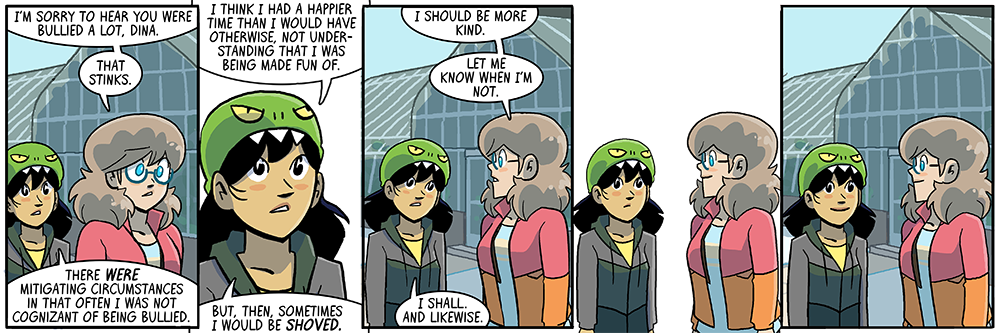
sympathy via mutual agreement
This kinda feels like a mini end-of-storyline…surely it’s not that simple though?
But very sweet. 🙂
It’s the start to understanding
Well the alt-text usually indicates if we’re at the end of a storyline. I’d image there are a couple more threads that warrant being tied up.
Not yet. There’s a preview panel of Joyce in a life drawing class wearing this storyline’s outfit.
I’m speechless.
This is just perfectly bitter-sweet.
?????? ???
*plays “Hanezeve Caradhina” from Made in Abyss OST on hacked muzak*
SO FUCKING WHOLESOME.
I guess, but considering this may come to mirror the relationship Dina has with Joe, I can’t help but think that phrasing will become rather ironic. ?
I’m sure I’m not the only one to know this, but did you know the term “bittersweet” was originally coined by Sappho?
Wow!
In Greek it was the other way around: sweet-bitter.
What is the Greek word?
γλυκόπικρος
glykópikros
“Sweet-bitter,” I think. My Greek’s a bit rusty.
Cool!
I can’t seem to find the Sapphic origin online, though. Can you point me to a source? Nothing in wiktionary or wikipedia (at least not written in English).
It appears in one of her poems, but I forget which one.
Thank you!
Interesting!
“Glyko” would then be a cognate of “Glucose,” or common sugar, and also adds meaning to the name of the Japanese company “Glico,” which makes Pocky among other sweets…
Chocorooms > Pocky
Friends 🙂
They might get there, but at least now they’re good neighbors, or whatever humans call it.
Basically, the kind of relationship Dina appears to have with Joe.
….What if Dina helps launch the Joe/Joyce ship?
Oh my, I have not even considered THAT line of possibilities.
Willis must have something HUGE in store for us! ?
Joe approves of this message.
Well she did suggest Joyce participate in various experiments involving Joe’s butt.
baby steps at least
Not enemies 🙂
And sometimes, that’s good enough. Having an enemy is exhausting.
That was nice. This is nice.
Yes. That’s the perfect way to say it.
Yes. I like it. Yay.
Now kiss…
Wraithy noooo
Becky has alluded to actually wanting that so this has a shot at working for everyone.
I would be very interested in seeing cited sources on that.
OH RIGHT
You need to be told that Becky would love to be with both Joyce and Dina at the same time? 😀
She also got a little defensive when Carla suggested they might be trying to make Joyce jealous or that she was dating one or both of them.
https://www.dumbingofage.com/2022/comic/book-12/04-dont-stop-billie-ving/personalsexualinfo/
aww 🙂
Reminding me why, even at their Dumbingest, I love these characters.
Ah, thank god! Forever neighbors was gonna be so awkward if they hadn’t reached an understanding.
Oh dang. It’s almost like we all jumped the gun lol!
Massive arguments about a conflict that gets resolved amicably two pages later. Classic.
Honestly, I fucking love when this happens.
Although it seems very un-Willis-like. Were there other times when this happened?
It’s not really resolved. This just shows they’re willing to work on eventually resolving it.
I don’t think it’s always so clear-cut. A short-term, immediate ceasefire between people who aren’t truly on opposite sides, is still a net positive. The longer-term, more difficult resolution can sometimes wait and happen as it comes, bit by bit.
they handled it more maturely than the comments section did. what a surprise
I don’t think them becoming friends negates any of the comments anyone had about their prior behavior.
That’s not a high bar to clear on some days.
Well that was fast
It’s a good (re)start. 🙂
The next panel will be Dina slicing open Joyce with her claw and eating her alive.
Smiling is right before the attack by a Utahraptor.
Which I believe fully Dina would argue were the actual Jurassic Park raptors.
Dina would like a word about that assumption.
I’m just saying that Joyce is still alive when she starts to eat her.
Becky: HEYO!
*neither Joyce or Dina get it*
Very doubtful – a utahraptor is way too big. Possibly deinonychus.
Indeed Deinonychus was intended – because Greg Paul had lumped it into Velociraptor in a fairly popular book in 1988.
Theyre not always perfect (except Carla) but the cast is full of good people for the most part
Ahhhh I’m not crying you’re crying
Now it’s Becky’s turn to reach some semblance of understanding let’s gooooo
What’s your thoughts on that smile? Think it comes from happiness, a desire to make an effort and do the socially appropriate thing by mirroring the other’s facial expression, something else? All of the above?
One thing I deal with in my job is sheer empathy burnout. Like, no more empathy. Zip. Zilch. None. So I often fall back on the “techniques” I’ve learned to *convey* empathy and make a person *feel* sympathized with, even though my mirror neurons aren’t firing painfully at them as they previously might have done. (Hence, being all burnt out.)
I’m never sure what comes across as fake or not. But mirroring the other is a big part of how to “fake it ’til you make it.” It doesn’t always come from cynicism. Sometimes it’s a genuine attempt to relate skillfully.
Dina’s smile? Probably decided expending the brain energy to make the facial expression was worth it. On her behalf, a good idea as expected. 🙂
Honestly, I think the smile is one of mutual understanding and both of them seeing a path forward for the two of them. It’s a good thing for both of them, having some of that bad blood exorcised.
Aye, this reads as genuine as they come. Even more so than massive over the top smiles/excitement, because this seems a contented smile, and contentment indicates not just happiness, but also trust.
Yes. Some neurodivergents have to expend energy to make facial expressions, but that does not mean the emotions they intend to convey with them are any less genuine.
*automatically any less genuine.
brain is getting melted by code as we speak….
This is true. I’ve got Resting Surly Face and a very intense speaking cadence that’s easily mistaken for sarcasm, so people can’t always tell if I’m being entirely genuine with my positive reactions. I sometimes will consciously change my facial expression to something that’s (hopefully) more reflective of the internal emotion I’m trying to convey, and then go right back to deadpan the instant I think people are done scrutinising my face muscles.
You see my alien hoodie? I have GOT to eventually invent and popularize a version with a digital face that automatically makes eye contact and facial expressions for you. It would make life SO much easier.
That would be false, though. As fake as a mask with a static painted-on expression, or a completely blank one.
People seek eye contact and look for expressions because they want to interact with you.
Sure, but a lot of the time, “you” isn’t enough. People want “you”, except actually “them” with your character model. A projection that matches their expected expression of your genuine response,which you do in fact mean but can’t necessarily convey to everyone’s personal standards, I don’t think it can be considered as fake as a static mask. And a standard product with easily-recognised, universal responses may lose some nuance, but people would know what you were trying to express far more often than they might with a “real” face.
Yeah, this.
Human adults tell their children that it doesn’t matter what a person looks like, that “it’s what’s inside that counts”.
In either case, they seldom live up to that value, so with the digital face idea, what do we really have to lose?
Re: interacting with me, my hoodie pretty much IS me, or rather an essential part of me, the same way Dina’s hat is an essential part of her, so there you go.
Even without the digital face: you chose your hoodie, while your so-called “real appearance” is just whatever life happened to give you. Why should it be assumed that the latter would somehow represent you better than the former?
Oops. Replied to the wrong one. Please read this as though in response to The Wellerman’s comment directly above.
Exactly. This is the heart of social justice really, that a fair society can only be one where we would be happy after being born into a random body.
That sounds cool. I hope you do make it! It would be very helpful!
I think I recall reading about a tool like that in the news, years ago. I can’t find it now, though.
I looked for it online just now, but this was all I could find:
https://spectrum.ieee.org/upgraded-google-glass-helps-autistic-kids-see-emotions
The article describes adaptive computer-assisted glasses that folks can use as a short-term intervention to help them build skills as they learn more about recognizing faces and reading emotions in faces. It’s hard work!
Long ago, back in fall 1996, I had a fascinating chance conversation at with Steve Mann, sometimes called the “father of wearable technology” back when he was a grad student at MIT. The conversation was about his wearable computer and augmented-reality glasses, which assisted his ability to analyze and record and livestream what was happening around him.
He used his “wearcam” as adaptive technology and had a letter of medical necessity for it. I don’t know whether the adaptation was for his vision or for a neurodevelopmental difference. Maybe both.
Fascinating man — I think you’d like him, NG. You and he both have that same kind of “I don’t like a situation so I’m gonna fix it” DIY approach.
I sometimes forget that most people don’t. I try to develop a deep understanding of facial muscles and facial expressions (I’m a biology student with acting experience,) and then rely more on skill than effort. It helps prevent burnout. I’m pretty good at understated expressions and I’m high empathy so that helps as well.
Absolutely genuine. I often have to remind myself to make my face reflect my feelings, so there is a noticeable lag, but it is an honest response.
I viewed it as Dina kinda clicking that they were similar in a way. They both mean well but don’t always understand when they are being rude, so are grateful for honest communication.
In past interactions that have mildly clashed with each other because one or the other was unknowing was rude to the other.
I think it’s genuine, Joyce is making a sincere effort to listen and understand and it makes sense that is pleasing. Or it could be that Dina has decided Joyce deserves a social smile as a gift for offering Joe-like levels of thoughtful and honest communication.
Thank you all for helping me read it. Reason I asked was that, if you cover up the mouths, the eye shapes for both of them don’t appear to change much between panel 3 and panel 5. Dina had just been talking about how Joyce’s smiling felt performative, and the alt-text talked about a smile that was not misplaced. But something can be both performative AND in place. That is to say, it can be intentional and planned, at the same time as being genuine and heartfelt in the moment, even if it’s not completely “unforced”.
I took a class long ago on how to read faces (something I still have trouble with) and one of the tips was to look at the shapes of eyes, to see whether a person’s eyes looked different while smiling vs. when pensive or troubled or in a more neutral position.
Of course, it’s also just a cartoon. Eyes are eyes. Not too many ways to draw them.
You took a class on it? Damn, proactive.
I can’t even look at IRL human faces for too long without draining my energy or even getting dizzy nauseous, let alone the eyes. ?
Most of the time I just DareDevil it and use the rest of the context. Still a guessing game regardless, I try my best.
Yeah. I used to study the photo directory every day before class so I could recognize people. Didn’t help, though, because the photos were black and white and people kept changing hairstyles. I need name tags to avoid angering my friends by calling them the wrong names or mixing them up with someone who had similar hair. Even good old friends, I often cannot match with faces when I see them.
But yes, the tool is called the METT/SETT training tool. It’s available online but it’s way too expensive for me. The book is called Emotions Revealed, by Paul Eckman. I didn’t read the whole thing — I should review it more.
Wrongplanet and a few other autism-specific sites have free online quizzes — like a computer game — where you can use faces as flash cards to try to recognize the emotions. There was also a training tool that taught face recognition but now I can no longer recall the website. And there were a few “test your EQ” (emotional intelligence) online self tests I used to practice with. Those were free.
Lumosity also has a few “face reading” computer games, in their “Experimental” section. Not free but not too expensive, if you already wanted to use Lumosity as a brain training tool for skills like memory, attention, flexibility, etc.
Eckman’s work was so helpful when I was trying to figure out how to understand nonverbal communication as an autistic kid!
It’s true – genuine smiles happen in the whole face, but a plastered on one will be mouth only.
Unless they’re very good liars.
This is a comic though, not enough detail to go on with the eye shapes.
Joyce looks like her sister in the last two frames. I don’t know what about the profile is making me think that, but it definitely struck me.
I see it, I think it’s her chin? And nose shape? We don’t get to see than dead-on, and not with glasses last until this semester
Willis mentioned somewhere (I think in the commentary on a Joyce and Walky! rerun?) that they’ve been drawing Joyce’s nose more pointy since she started wearing glasses, so it tracks that this change would probably make her look more like Jocelyne since the latter has been wearing them all along.
I mean the Browns have a pretty strong family resemblance. Joyce and Jocelyne are almost twins and both of them look a lot like Hank. The glasses only add to the resemblance between them.
The eyes, the glasses, a lot of it come together. Incidentally, both are beautiful.
If you cover up the bottom of Joyce’s hair, yeah, the resemblance between her and Jocelyne really pops. I wonder if how her bangs are shaped is playing a factor.
As much as I love watching these characters make mistakes over and over, that also makes it all the more satisfying when they really do make progress in their relationships. I’m sure there’s still gonna be some tension between these two, but it’s nice to see them genuinely bonding.
Yeah, that!
Yuuuuuuuuuuuuuuuup.
The thing about the only way to get smarter being to be dumb over and over and over again is that it works.
I do like this. I think it’s an important step for Joyce and Dina both, but especially Joyce in finding another person who probably won’t condescend to her anymore.
Like, I said this in an overly snippy way, but I’m genuinely happy that Joyce has made a friend. And so has Dina!
Yes, perhaps they have made a truce and a promise to no longer infantilize/stereotype the other. But in that case Dina would have to stop holding that sex secret over Joyce.
No one is required to share the details of their sex lives with other people if they don’t want to.
Even if they told everyone else.
Even if it’s for a bad reason.
Joyce isn’t owed the details of Becky and Dina’s sex life.
Why would she have to tell her that? It’s shitty that they’ve decided to make it a point to tell everyone BUT Joyce (More of Becky’s doing than Dina’s) but they’re not obligated to tell her.
Joyce is not entitled to know about Dina’s sex life. It’s Becky who is not only 50% responsible for the secret but also the person demanding the secret be kept in the first place. Dina is entirely neutral on Joyce knowing about their sex life, and why would loyalty from a new found friendship with Joyce override her loyalty to Becky?
Genie slapface jawdrop dot gif.
Soon they can start having breakfast together
Chicken and cereal.
Legit my buddy introduced me to fried chicken with a Captain Crunch crust and it was pretty dang good.
Of course it was good. Turning the Cap’n Crunch® into dust to use as breading removes the one downside; The sharp corners!
Yaaaaay!! Mutual understanding is the best type of kindness imo.
Agreed. Genuinely heartwarming.
Genuinely did not see that coming this early.
Good for them both! Yay!
Damn you, Willis! Subverting the Dumbing!
Damn indeed. Little did readers know whilst begging for better relations between Dina and Joyce, they partook in a rather Faustian Deal. ?
That’s nice. That’s a nice little moment.
I like how Dina needed a panel to process.
I like both how Dina needed a panel AND how Joyce (whose social processing is faster) gave it without judgement.
Progress! This is good progress. It’s not friendship, not quite yet, but they’re getting closer to understanding one another.
This. This is a good start this is the start of a real friendship for them and I’m very happy about it
Oh thank fuck. I’m happy for them!
I was optimistic that they’d find an understanding, but I am overjoyed it was this soon. It’s even better than I hoped for, too, and I love that they’re both being pretty gracious about it. Joyce wasn’t asking for that from Dina, but Dina freely offers the same, that Joyce let her know when she is unkind. That’s big of her, recognizing that she’s not faultless in this, either, and could have been kinder at points.
Not going to lie, bit teared up here.
It’s so good :3
This ended fairly well. I’m happy for them. Sometimes we connect not by trying to focus on similarities (because, while both are likely autistic, their experiences have been very different and are not the same), but by having compassion for those differences.
I think Dina watched closely the interplay between Joyce and Becky in yesterday’s strip, and coming immediately after the Joyce/Dina conversation the day before, may have recognized some parallels with the ways people treated her.
Dina may have some strong words for her girlfriend soon. She won’t be harsh, but Becky may be less than receptive to the idea that she might be bullying and/or infantilizing Joyce.
I hope so. Dina’s probably the only one Becky might listen to on the topic of ‘perhaps constantly mocking and belittling your alleged friends is a bad look’.
*bangs on the table* FRIENDS FRIENDS FRIENDS FRIENDS FRIENDS FRIENDS
And they all clapped.
This reminds me of when I would say “hi” or “good morning” every day to my fellow theater student that was much more autistic than I am, not really expecting anything back, and then getting a “hello” back at the end of the year.
Aw. Nice. This lesson also works with surely teenagers. Eventually they grow up and become a tad bit friendlier if you stay patient and self-disciplined enough to not be reactive.
TRUCE IN THE COMMENTS NOW?!
Nah, somehow this strip will have 1083 angry replies by morning.
Hmm, let’s see, what could we say to set that off? Ooh, I know! “Oh, sure, panel 3 Joyce, make it all about you again…”
That should start a war, right?
Nope, nope I refuse to have hot takes tonight. This is adorable. All the more so because the sunshine comes after rain. Have a lovely evening everyone and sleep well.
After winter
Must come spring
Everything is everything
As an autistic person, with a LOT of compounded trauma, some specifically related to masking in order to survive (literally as well as figuratively), this makes me so extremely happy
Oh man, it took me literally 4 years to realize that a particular pair of kids were bullying me in middle/high school. “Man it sure is weird that every conversation I have with these guys involves them reminding me of something embarrassing I did or said, and it’s super weird when they ask me to recreate it. Ah well, I guess that’s just how conversations go.” It wasn’t until I explicitly asked them to stop, and they didn’t, that I realized they were fucking with me on purpose.
Good lesson for a lifetime. If you make it quite clear someone is hurting your feelings and annoying you, but they don’t listen, the problem is with them. Very nice. Many people stay in harmful marriages for decades not understanding this.
Yeah, I developed a lot of issues around trust because of that particularly malicious type of bullying teenage girls do where they bully you while pretending not to be bullying you. It’s taken years to be able to interact with people without being on alert.
I knew I was being bullied in middle school, but I’ve come to realize now, several years later, that I was probably bullied a lot more than I thought in both middle and high school. And that some of the people I thought were my friends in middle school and high school were probably bullying me back then, and I wasn’t aware of it at the time.
This is so pure. Now they are friends. This feels right. This was well done
Aw there we go. These lovable dorks. I hate it when they hurt each other but Joyce is either resilient or oblivious. I’m not so sure Dorothy is though, after that very similar and bruising rejection. Such interesting parallels.
On the one hand, as someone who was hyping up the possibilities of how their mutual drive-by misunderstanding of each other’s experience could lead to interesting long-term conflict not 36 hours ago, the egg sure is on my face right now.
On the other, after the past year of Long Term Joyce Conflict, watching a matter get settled quickly and amicably the minute it comes up is the freshest goddamn breath of air.
And I do appreciate this as a strong character moment. Beneath all of her flaws, Joyce wants so deeply to be good and kind to others, and a lot of her early struggles came from the conflict of what her upbringing told her was Good and Kind and what feels good and kind in the moment.
She confronts her own failures faster than a lot of 18-year-olds I’ve known, and that shows a lot. For all that everyone around her treats her like a puppy constantly throwing a temper tantrum, she shows a great deal of emotional maturity in this regard.
And it’s a nice little moment for Dina, as well! I think someone mentioned two pages ago that Dina, as someone whose special interest lies in paleontology (a field where the knowledge we have at hand and the tools with which to learn it is everchanging), is very acclimatized to the idea of revising her view of the world with new data on the fly, and thinking back on it I think they made a very good point that I overlooked when analyzing her dynamic with Joyce. ‘Cause yeah, that mindset doesn’t lend itself well to holding a grudgr against a persom’s past self. Yeah, Joyce has been A Lot, especially from Dina’s perspective, and her dislike of Joyce’s past behavior has been absolutely warranted. But Joyce wants to be better than that past behavior, and Dina’s willing to recognize and engage with that willingness. Which is both neat and as in-character as her lack of desire to engage two strips ago was.
And goodness knows Dina’s very good at cutting through layers of social norms and calling bullshit for what it is.
Related, but I love that smile at the end, because Dina doesn’t “perform” expressions (which I relate to – I can’t make my face line up with the emotions I’m actually feeling, much less the emotioms I’m not). That smile is 100% a Genuine Dina Reaction, and that’s nice.
Sorry if none of this makes sense, it’s 11:30 here and I’m literally trying not to doze off as I write this.
True, we rarely see Dina smile. If she were performing a social smile out of pity for Joyce it would be uncanny valley like Jones in Gunnerkrieg Court.
Dina smiles an awful lot. She spent the near-entirety of Trial and Sarah happy as a clam while doing Sexy Science with Becky. What she doesn’t do is smile “on-command” so to speak — she did manage a pretty good replication of Joyce’s triangle grin at the end of TaS, but we’ve also seen in the past that she’s not great at smiling deliberately without the necessary genuine emotion fueling it. This small little 🙂 is nice not because it’s rare, but because it’s something Dina only does sincerely.
In a wild and wacky twist, I managed to accidentally flag my own comment while trying to respond to another. Dang mobile phone and its weird site-loading delays.
You know what crimes you have committed and have decided to turn yourself in.
I committed the great sin of being wrong in my assessment of how a story would go but being happy with the result anyway.
Truly, there is no greater taboo among nerdy internet commentators. My refusal to pitch a tantrum when things don’t go exactly how I expect has branded me a traitor in the eyed of fandom. Star Wars twitter is giving me my last rites as we speak.
May the lasers and fire cleanse your soul so you may become a proper fan once more.
I, too, have egg upon my face, and sympathize. Would you like some of this crow I’m eating? It tastes: bad.
Awwww
Aww progress this made me feel happy which is good beacuse I am trying to map an intersection for work and I am about to punch my monitor.
They’re girlfriends now.
Nobody tell Becky
This will certainly culminate in a three way — no, FOUR way between Joyce, Joe, Becky and Dina.
I suspect there are some rather insurmountable barriers preventing Becky and Joe from interacting sexually with each other.
all it a hunch.
Hey now, parallel play can be really fun ?
I dunno, I want to know of she’s more the “how dare head asplode” or the “holy Rebecca St. James anime nosesplode” type.
She did (jokingly) make Joyce promise to marry and “do sexy things” with Dina in the event of Becky’s death. So the idea of Joyce and Dina sexing it up has crossed her mind at least once.
I honestly wouldn’t be surprised if she entertained the fantasy exactly once before the jumble of interest, shame and jealousy made her bury it under her Pile o’ ex-Fundie Sexual Shame forever. I have no proof for this headcanon, it just seems like something that would have popped up in Becky’s brain at one point.
Re: Pile o ex-Fundie Sexual Shame
And now I’m picturing Dina wearing a hard-hat calling herself “Engineer in charge of deep mining operations”.
???
“Deep mining operations?” Is that what the kids are calling it these days? :p
That’s a terrible premise for a throuple. Communication is vital.
well thanks willis now i have to continue existing while literally melted
Can we start a GoFundMe to un-melt Throwatron? Every year, thousands of people are melted. With just a small donation, you can make their fight that little bit easier.
Of those thousands of people melting, how many of them are Willis’ fault?
Legally, I can’t give that information.
♫ In the arms of an angel ♫
There used to be a video on YouTube in which me and a friend “murdered” a guy by rustling bags of chips at him, and then the camera zoomed in with that song playing. That was my first exposure to it, so the attached visual is just that guy laying face-down in a public park.
That sounds like fun. ?
It was. We used to make videos all the time. I haven’t talked to either of them in over five years.
Not too late to resume the fun! Hopefully! Even then feel free to send me a video or two, my curiosity is peaked! 😀
Robert Redford nodding gif
Dina is now the one person Joyce doesn’t have to perform a triangle smile for! ?
Now that’s good, that’s what I like to see.
Alright, you know what, this is good and I was wrong. I thought there was more dislike here than there is. I’m glad there isn’t, though.
*Mortal Kombat voice* F R I E N D S H I P *disco noises*
Ok I made comments yesterday so i make comments now.
This is nice.
I am extremely happy with how this turned out.
This feels like a non sequitur. Also Joyce… aside from being genuinely deeply pained and picked on by your friends… you are generally kind?
this feels weird.
guess this is it. I’m dipping out from the comic for a bit. (–)/
People for literal months: “God, this nonstop bickering and lack of positive communication is horribly draining”
Willis: “ok fine here, they talked and smiled”
You: ?
Basketball?
I was gonna say something snide, but honestly I just… don’t have the energy for it anymore, so instead I went with a random emoji. Maybe it’s surreal or funny or something, I dunno.
I figured you were going for “I’m taking my ball and going home”
Oh yeah, that makes sense. My second option was ?, but I legitimately can’t think of any possible connected meaning behind it.
I figured ‘bouncing’ as slang for leaving.
It’s so weird… It’s like Willis’ plans predicf when we’re fed up. Is he a psychic? I assume these panels are all planned out in advance right?
His comic buffer is usually around a year.
What is that thing that humans say?
“Don’t look a gift horse in the mouth.”
I mean she’s been unkind to Dina, even if not meaning to. She probably picked up on the robot thing. This is just a thing people do when they’re trying to patch up a rocky relationship. Why is it upsetting you so much
To me, it felt disconnected, coming on the heel of yesterday’s strip.
But I’m not gonna complain- this is what I was hoping would happen.
Like Gloomie mentions, it feels disconnected.
For another, it feels like a really random statement from Joyce. When they stepped away from each other it felt like they weren’t going to talk again for a bit. Maybe Joyce could vent about it to someone else. (Joe? Maybe even Amber on garbage roof?) and coming to the conclusion she should apologize to Dina for what she said and try to actually talk.
I don’t know how to put it into words, but this strip just isn’t giving me the warm fuzzies it seems like it ignited in everyone else.
It feels like a platitude, like once again Joyce is having to turn around and take the high road to someone who was just rude to her. (to a certain extent understandable trying to convey they have been treated differently based on their autism, that veered into intentionally putting Joyce down because she didn’t perceive her autism as any real suffering. Smiling and Chicken Fingers, etc.)
I say this as an autistic person who is also considered by neurotypicals as ‘high functioning’ (gag)
I dunno. Pacing wise it feels off, and it still feels like it’s harkoning back to Joyce Is Wrong and Bad, because she just randomly says she should be kinder after sympathizing with Dina over her being bullied. As if she somehow intentionally bullied Dina.
Which is not perceivably the case, but the narrative is continuing to push it as being so.
Aww, I like it when Everything Is Ok™
Human connection via openness.
I needed this today.
Aaaw yay
That’s a nice.moment for them
awwwwwwwwwwwwwwwwwww
That was nice.
Wait, I’m confused. Which of the two are we supposed to setup as a blameless saint and make the other the unspeakable evil per long comment threads from recent comic posts?
Uhhh Dina bad because she smiled second. Joyce good because she smiled first. Let the debate commence.
Nah, you should all be playing more video games! ?
I’m making one for Dina’s birthday coming up on the 18th!
It’s got cards, and fighting, and dinosaurs, and fighting dinosaurs! ?
Oooh definitely post a link!
How about I update progress on Twitter? 😀
Dina’s smile is more noticeable and an effort. Joyce’s profile smile is hard to spot and doesn’t count. I had to scroll back to see that she smiled. Dina good, Joyce wicked.
How about we turn it inward? The blameless saints are the ones not characterizing every disagreement this way, and the unspeakable evil is the concept of this nonexistent saints-versus-evil holy war in and of itself.
I love ow ironic it is that the comments respond in the same way to DoA situations that college kids would.
I get what you’re trying to say, but I’d generally chill with that comparison, if only because college students are much more capable and nuanced in their thinking then they’re given credit for.
ooh, a greenhouse
Houston, we have an understanding.
“We have come to terms”
– the Big O
I’m very glad that Joyce and Dina look to be starting to get along with each other now.
☺️
IT HAPPENED!!! I WAS WAITING FOR THIS!!! I was always bothered by how rude Joyce was to Dina, and vice versa! (mostly bothered by Joyce’s Abelism) AND NOW THIS IS HAPPENING!!!! I’m so happy!!!! I hope they can become friends in the future, they’re more similar than they’d like to admit
now we are bonding
I guess that Dina has assessed that either this was not a performative smile, or that it was a proper and called for performative smile.
Armistice. Comments counter safely under 300. All is right with the world.
Yo legit this is nice. I’m also glad they both recognized fault. That’s important.
Let’s hope this is the beginning of a true understanding between Dina and Joyce. I really hope is this, they could be great friends.
When the characters end up being wiser than the audience in a strip called “DUMBING.”
Maybe the true dumbing was the comments you made along the way.
Maybe the true dumbing was inside us all along!
This IS the dumb place.
Any day now, they’re gonna start holding hands in a platonic way.
And then Becky horrifies them both by initiating a three-way hug.
That is such a sweet and mature thing.
Reminding each other when we’re not kind, that’s gonna make teh world a kinder place. <3
Awwwww, this is just the Joyce interaction I’ve needed!
I wish I had been unaware. I was 6 foot tall before i left grade school so there was no physical bullying for the most part, but my undiagnosed aspergers left me open to a lot of cruel teasing. Like the time I came back from being sick and my nose was still cloged and I got a nosebleed, and they started telling me I was having my period.
Awwwwwww
Yay! Legitimate moment of kindness!
Yay! Character growth for all!
Growth for everyone!
Actually, with Dina recognizing that she wasn’t always cognizant of being bullied at the time, I wonder if she’ll recognize Joyce as having been bullied by her family and not having been cognizant of it at the time (or necessarily even yet). It looks much more likely today than it did a few days ago (or a few minutes ago, in comic.)
in this context, I have to ask how Joyce’s life has really been different or better? Because she was indoctrinated into a massively controlling cult that she was enthusiastically involved with until it repeatedly bit her in the bum? You cannot tell me everyone loved her and got along with her, her fear of everything from sexual expression to swear words suggest she was heavily regulated both in and outside of her family and likely by peers as well.
I just have been in ND circles for over a decade now and have noticed a lot of reactive ableism that assumes just because someone expresses their neurodivergence differently that they must have had an easier time in neurotypical society than you – whereas Joyce, clearly, has not. University shows she is not better received by her peers than Dina, if anything she is actually treated like she is less capable and more mentally strange than Dina, particularly over the last 5 or so real-world years of comics. It’s arguable if she would have been better or worse received by peers in christian-heavy circles, but signs point to no if they were indeed fully realized concepts rather than caricatures to fit a two dimensional narrative.
It may be a misconception, but I do feel some story arcs are a kind of self chastising that willis uses harmful notions he had in the past or has noted people to have, and uses them as a way to call himself or those people out. But realistically, joyce has too many neuroses and was too invested in the letter of christianity for most of her life to escape othering and even bullying by her peers, and clearly also adapted to that by always having a cheery and self-minimizing representation that prioritized being okay and being open to others over actually feeling her feelings and taking up space. Frankly, this exchange was to me another instance of that, of her minimizing herself because she saw it as her ignorance harming another, when that person was also ignorant of where she came from and her lived experience until now, and made frankly hostile assumptions regarding her life.
How has it been different? Well, by being different. She was indoctrinated into a massively controlling cult that she was enthusiastically involved with until it repeatedly bit her in the bum, and Dina wasn’t, so that’s a difference.
How has it been better? I dunno, who says it was? All Dina said was that it was different, and if she said it a bit dismissively, well, IMO someone who’s been called a robot is entitled to be a bit unfair if the same person is then “So, let’s talk about our shared situation. You know, the one I implied doesn’t emotionally affect you as much as me, which I still haven’t apologised for.”
I definitely agree with a lot of the points you make here, and I think there’s some intentional irony in Joyce thinking “Wow, Dina was bullied and didn’t even realise it. It sure must suck to have that happen to you, once you realise.”
But I don’t agree that she’s been “treated like she is less capable and more mentally strange than Dina”, a woman whose girlfriend was literally told “You can’t be in a relationship with her because she’s basically a child” right in front of her. What does appear to be the case is that, for various reasons, people react to Joyce’s issues differently to Dina’s. Probably not better or worse, in the long run and barring assholes like Raidah’s friend whose name I have mercifully forgotten, but differently.
That friend of Raidah’s you mentioned, her name was Goku Jr.
That’s oddly heart warming. Communication and understanding happened.
aw, learning and understanding 🙂 <3
Well, Becky’s debatable prodding yesterday helped facilitate better understanding between her two closest people, so that’s one silver lining I’ll happily take
Honestly hoping this strip gives credence to the idea of waiting a strip or two to get a characters true reaction to something especially when they don’t have all the facts.
THIS
Also this is incredibly adorable in an understated sort of way. It’s just cute and a breath of fresh air. It feels like Joyce/Joe strips sometimes do frankly. Emotionally anyway to me.
I agree, i like it too. <3
Joyce is a really good kid at heart.
What do you know, figuring out who’s the most at fault and blaming them for everything to maintain our notions of unsurpassed righteousness is less useful in forming meaningful relationships than to reach out to each other in imperfect solidarity. (Thanks, Arundhati Roy.)
Now, ladies, this won’t do. You have to keep fighting! Otherwise, what else are the good people in this comments section going to write paragraphs upon paragraphs about? Think of the commenters!
Sssshhhh, let us have this brief reprieve. We need to save our energy for the next time Rachel or Malaya show up. Or the next time Becky opens her mouth. Only Willis truly knows whence bringeth the tides o’ time.
now we have to fight over who’s being better instead of who’s being worse
I nominate myself for better because I thought of it first
My sympathy to anyone in the comments who’s ever been bullied.
aaaaaaaaaaaaaaaaaaaaaaa this brings me so much joy!
I’ve never actually had any trouble telling if someone was trying to bully me or just be friends to make fun of me (though this was only really an issue in high school). I say also say trying because the words of people I don’t care about have never been hurtful to me, only those of people close to me or who I considered ‘important’ like teachers.
My main high school bully literally did not say a single thing that actually hurt me even once. But a lot of people certainly did come to me concerned about it including older classmates, my peers and eventually a teacher.
This is sweet. I hope they’ll be nicer to one another going forward.
This is my new favorite strip 😀
This storyline has been really cathartic for me, thanks for making it Willis.
Same here ?????????
So I’m kinda curious, is there any reason why Dina can’t go to the same specialist Joyce was referred to? Like share the same referral she got? Because it seems like they’d be less willing to ignore Dina on a racial or gender basis if we can conclude it’s the same one the gyno’s daughter went to. If we can assume gyno’s daughter is also of color like her mother, was taken seriously and got a diagnosis, then that’s two of the major barriers Dina faced in seeking a diagnosis that this specialist is considerate of.
If I’m not mistaken, she’s still undiagnosed, yeah? Do you specifically need a referral to go to a specialist or would Dina be able to make an appointment with the same specialist without one?
I wanted them to throw fists but i guess this is okay too