There’s plenty of logic. Just like in any grand tragedy, you have to establish the protagonist in a position of virtue and success before you tear it utterly to shreds.
I think my 1988 edition had a grey cover. The chip guide was yellow and red with a TI logo on it, back when you could build an entire computer from single-gate chips and nary a uP in sight. And 8-bit uP ruled the world.
I got it in freshman maths, freshman computing, and freshman electrical engineering, using three different sets of notation. I think philosophy covers it too.
In 1991 I took a sociology class at Stanford. The prof was studying the incest taboo and genetics. He said something mathematical which didn’t make sense. I tried to tell him so. He said “But that’s what the formula says.” He was very sure of himself. I eventually found that the formula was a simplification, and its necessary assumption was untrue in the case he was applying it to. But he had been so sure of himself that I didn’t go back and try again to point out that he was wrong.
Math isn’t quite the same as logic, but I’d hope that any Stanford professor using math as a core part of their studies would use it correctly and apply basic intuition… nope.
Deanatay
Math, like logic, is a set of tools for deriving truths from other truths. The problem with both is, if your chain of reasoning starts with a falsehood, your conclusions will also often be false.
thejeff
And you can’t actually prove those basic postulates using those tools. It’s tricky.
Reltzik
And did being in that class ultimately turn into an exercise in applied logic for you? *evil grin*
I learned formal logic in a class called Intro to Abstract Math, which also covered methods of proof and basic set theory. I was also taking Into to C Programming at the same time, so it was really neat to see a new topic from the mathematical perspective one week and then see how it’s implemented in C the next week.
Most of the upper-division math classes had Intro to Abstract Math as a prerequisite, and generally started from all that logic stuff, added a few more axioms, and continued proving things from there.
The cool thing was that many of the upper-division philosophy classes (I minored in philosophy) required the philosophy class Intro to Symbolic Logic as a prereq, but allowed substituting Intro to Abstract Math because Intro to Abstract Math basically covered the entirety of the Intro to Symbolic Logic curriculum in the first week or two. Good times.
If anyone’s interested in learning more, the textbook we used for Intro to Abstract Math is called “A Transition to Advanced Mathematics” by Smith, Eggen, & St Andre, and I highly recommend it.
I took a formal logic class late in my college experience. It was a philosophy credit, which met one of my Core 2 requirements.
It was the most surreal experience I’ve ever had. There were people there who just could not understand “and”. Let me repeat that: there were people there, that despite the concept being repeated several times, still did not understand the logical operator “and”. (Which does exactly what you think it does.) “Or” completely blew them away.
Myself, I didn’t take the textbook out of the shrinkwrap until the final. I spent most of the class wondering what alternate dimension of abject stupidity I’d wandered into.
I think what I liked most about Intro to Abstract Math is that most of the quarter felt like learning ways to formally write down the patterns of thought that were already in my brain.
Logic 101 at the university that gave us the BOFH was a philosophy course that was required for comp sci degrees.
It was also the bunniest of bunny courses. The final exam (75% of the final grade? I think?) had a choose-twelve-of-these-equally-weighted-15-questions format, where fourteen were simple solve-the-algebraic-logic-problem questions and the fifteenth was an essay question.
That was a three hour exam, with no exits allowed during the first 45 minutes. There were students doing the essay question just for the sake of having something to do after solving eleven problems in the first ten minutes.
Gotta love Modus ponens. Accept “if P then Q” and accept P then you must accept Q. For example: If this sentence is true, then Santa Claus is real. We could claim that sentence is false, but that would be ridiculous as it only makes a claim contingent on the sentence being true. An if/then statement is considered true when the if-part is false. And so we must accept the sentence as true. And since we accept the sentence is true, which is to say we have accepted that “if this sentence is true, then Santa Claus is real,” by Modus ponens we must accept that Santa Claus is real.
Betcha they didn’t teach you that in your Philosophy of Logic course.
abacuswizard
You are relying on the unstated assumption that any collection of words can be assigned the value “true” or “false.” This is not so.
It’s a pre-requisite for philosophy as well as anything math-related (programming, physics, chemistry, etc). Introductory logic classes at the university I went to were among the largest since it’s needed for so many fields. Unlike begbert and butting, this was not a “bunny course”, about one third through we got to the point of “this is how you prove rules of logic without making any assumptions” at which about half of the students couldn’t follow very well anymore. About two thirds through we got to the point of “and this is how you construct an entire logical system from scratch” at which point 3/4ths off the class dropped out knowing they’d have to retake it anyway.
I got it on my second try. Good thing you could retake individual courses as often as you needed back then.
I find it fascinating that’s it’s a prerequisite to both philosophy and mathematics.
Some people (who severely lack imagination if you ask me) think that philosophy is for “sissies” who want to ponder on the immortality of the mountains all day while math is a hard science for rationality and manliness. (People will assign gender markers to the weirdest things). It has never occurred to them that philosophy and mathematics could be so related
My Discreet Math and Fundamentals of Math both covered logic and proof theorems. Nevertheless, Dorothy’s book is likely from a philosophy class as she is pre-law.
I took LOGIC: Modern Inductive Reasoning at one college and boy was that a bad decision since I could not wrap my head around it. When I was at a different college I took logic again only because I needed the Humanities credit and it was the only one to fit my schedule. I had a blast. Turns out my previous horrific experience was because the instructor had no bleeping clue what they were talking about and gave the best grades to the more squeezable students
Yeah they swung like a Spirograph and I was still socially blind at the time. I still need the aid of Beer Glasses tm to be able to socially focus.
Faz is the physical embodiment of the PUA segment of the manopshere. As such, he’s not so much an individual person as a collection of the psyches of thousands of some of the worst people in the world.
I will be interested to see if there’s any insight offered into his behavior at any point in the future, though.
Yeah, it’s not really clear to me that Faz can really make the transition from creepy/funny archetype to real character with depth. Not without throwing away his essential Fazness.
Trying to offer insight into his character may just highlight the ways it just isn’t realistic.
Roborat
Might have to use a chart to illustrate that.
Jhon
This chart
shows the day to day wonderfulness that is Faz.
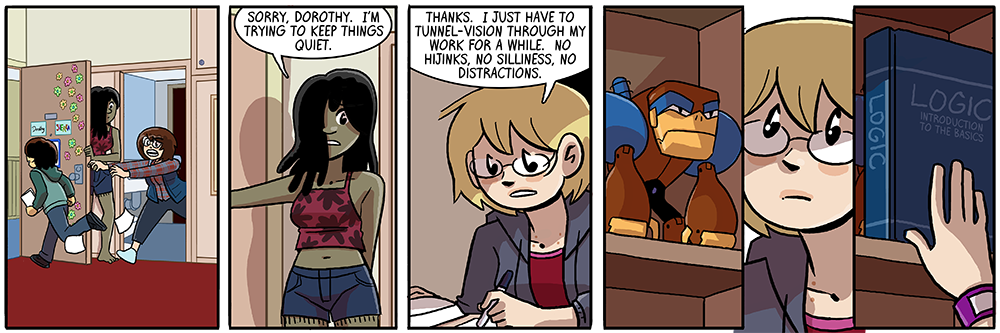
As Dorothy stare up at the poignant representation of her carefree love with Walky, and then walls it off by putting a symbol of both logic and her education LITERALLY before of it.
Sure! Democracy is the system of government where the stupid people are allowed to step in and run the place if the smart people stop paying attention for one single second. Few other systems of government allow the worst elements of society to usurp power so easily – most others require somebody to die first.
TemperaryObsessor
Democracy lowers the barriers for smart people getting control back too.
Jhon
Um? Gerrymanders? Packed judiciary?
begbert2
Correct – with a monarchy it’s hard to depose a good monarch, but a bad monarch requires the knife just as much. With democracy it can flip on a time limit rather than an expiration – though it helps if the voting is fair.
Regarding gerrymandering, that technically isn’t stupid people screwing with the system. It’s evil people screwing with the system. We just at the moment happen to have hordes of stupid people backing (and infiltrating) our (more) evil party.
TerribleName
We have a *representative* democracy with low voter participation and an extremely limited choice of pre-corrupted representatives. Also the system was never really designed to ‘represent’ anyone not already very wealthy. The incidental good that has been achieved was really more about stopping peasant revolts. The US government is really very functional, it was just never designed to function for *you*.
No, we have a republic, not a democracy. We are a union of states, not a union of individuals. It’s why you can lose the popular vote and still be president.

196 thoughts on “Quiet”
Ana Chronistic
WHAT PLACE DOES LOGIC HAVE IN THIS WEB COMIC
(oh hey I’m p sure I have that book tho)
Reltzik
There’s plenty of logic. Just like in any grand tragedy, you have to establish the protagonist in a position of virtue and success before you tear it utterly to shreds.
Clif
She started from the position that Walky was a throw-away boyfriend. Not a position of virtue, but the potential for tragedy lurks just the same.
Reltzik
Not so much “throwaway” but “mutually-acknowledged as casual and not long-term”.
But I was referring to LOGIC as the protagonist that would ended up getting torn to shreds.
Clif
Ah.
Opus the Poet
I think my 1988 edition had a grey cover. The chip guide was yellow and red with a TI logo on it, back when you could build an entire computer from single-gate chips and nary a uP in sight. And 8-bit uP ruled the world.
Clif
Didn’t a collision with an asteroid kill them all off?
Psyme
No, the dinosaurs ate all of them, and then the asteroid killed the dinosaurs off sometime later.
Edem
Top shelf, apparently…
Johnnyo
To quote one of my other favorite webcomics: “Logic is knowing what the f**k is going on.”
Derek
what class teaches Logic?
tim gueguen
Philosophy.
Derek
huh that’s funny, I took philosophy in my first two years and we didn’t have logic unit
ajm5007
I’m a philosophy professor. We teach logic, and also a whole bunch of other stuff. Philosophy’s a bit of a grab bag area of study.
Eyebrow
As a Mathematics undergrad, I took two logic courses, formal and informal. Both were counted as Philosophy courses and had PHIL numbers.
MM
The Logic 101 class at my college satisfied both a humanities and an engineering requirement. It was pretty popular.
Agemegos
I got it in freshman maths, freshman computing, and freshman electrical engineering, using three different sets of notation. I think philosophy covers it too.
Keulen
My college had an Introduction to Logic class as an elective. Best elective class I ever took.
Reltzik
When you get down to it, doesn’t EVERY class teach logic?
….
*waits for a zillion counterexamples*
Chris Phoenix
In 1991 I took a sociology class at Stanford. The prof was studying the incest taboo and genetics. He said something mathematical which didn’t make sense. I tried to tell him so. He said “But that’s what the formula says.” He was very sure of himself. I eventually found that the formula was a simplification, and its necessary assumption was untrue in the case he was applying it to. But he had been so sure of himself that I didn’t go back and try again to point out that he was wrong.
Math isn’t quite the same as logic, but I’d hope that any Stanford professor using math as a core part of their studies would use it correctly and apply basic intuition… nope.
Deanatay
Math, like logic, is a set of tools for deriving truths from other truths. The problem with both is, if your chain of reasoning starts with a falsehood, your conclusions will also often be false.
thejeff
And you can’t actually prove those basic postulates using those tools. It’s tricky.
Reltzik
And did being in that class ultimately turn into an exercise in applied logic for you? *evil grin*
abacuswizard
I learned formal logic in a class called Intro to Abstract Math, which also covered methods of proof and basic set theory. I was also taking Into to C Programming at the same time, so it was really neat to see a new topic from the mathematical perspective one week and then see how it’s implemented in C the next week.
Most of the upper-division math classes had Intro to Abstract Math as a prerequisite, and generally started from all that logic stuff, added a few more axioms, and continued proving things from there.
The cool thing was that many of the upper-division philosophy classes (I minored in philosophy) required the philosophy class Intro to Symbolic Logic as a prereq, but allowed substituting Intro to Abstract Math because Intro to Abstract Math basically covered the entirety of the Intro to Symbolic Logic curriculum in the first week or two. Good times.
If anyone’s interested in learning more, the textbook we used for Intro to Abstract Math is called “A Transition to Advanced Mathematics” by Smith, Eggen, & St Andre, and I highly recommend it.
Derek
that actually sounds pretty rad, I kind of wish I could have taken Abstract Math but my grades were struggling enough as it were
begbert2
I took a formal logic class late in my college experience. It was a philosophy credit, which met one of my Core 2 requirements.
It was the most surreal experience I’ve ever had. There were people there who just could not understand “and”. Let me repeat that: there were people there, that despite the concept being repeated several times, still did not understand the logical operator “and”. (Which does exactly what you think it does.) “Or” completely blew them away.
Myself, I didn’t take the textbook out of the shrinkwrap until the final. I spent most of the class wondering what alternate dimension of abject stupidity I’d wandered into.
abacuswizard
I think what I liked most about Intro to Abstract Math is that most of the quarter felt like learning ways to formally write down the patterns of thought that were already in my brain.
butting
Logic 101 at the university that gave us the BOFH was a philosophy course that was required for comp sci degrees.
It was also the bunniest of bunny courses. The final exam (75% of the final grade? I think?) had a choose-twelve-of-these-equally-weighted-15-questions format, where fourteen were simple solve-the-algebraic-logic-problem questions and the fifteenth was an essay question.
That was a three hour exam, with no exits allowed during the first 45 minutes. There were students doing the essay question just for the sake of having something to do after solving eleven problems in the first ten minutes.
Scoops
I took a Philosophy of Logic course. Modus ponens. Socrates is mortal. And so on.
Clif
Gotta love Modus ponens. Accept “if P then Q” and accept P then you must accept Q. For example: If this sentence is true, then Santa Claus is real. We could claim that sentence is false, but that would be ridiculous as it only makes a claim contingent on the sentence being true. An if/then statement is considered true when the if-part is false. And so we must accept the sentence as true. And since we accept the sentence is true, which is to say we have accepted that “if this sentence is true, then Santa Claus is real,” by Modus ponens we must accept that Santa Claus is real.
Betcha they didn’t teach you that in your Philosophy of Logic course.
abacuswizard
You are relying on the unstated assumption that any collection of words can be assigned the value “true” or “false.” This is not so.
Jim
I remember a Freshman course called “Logic, reasoning and persuasion” where I first learned the terms contrapositive, and ad hominem.
Sunny
It’s a pre-requisite for philosophy as well as anything math-related (programming, physics, chemistry, etc). Introductory logic classes at the university I went to were among the largest since it’s needed for so many fields. Unlike begbert and butting, this was not a “bunny course”, about one third through we got to the point of “this is how you prove rules of logic without making any assumptions” at which about half of the students couldn’t follow very well anymore. About two thirds through we got to the point of “and this is how you construct an entire logical system from scratch” at which point 3/4ths off the class dropped out knowing they’d have to retake it anyway.
I got it on my second try. Good thing you could retake individual courses as often as you needed back then.
Derek
I find it fascinating that’s it’s a prerequisite to both philosophy and mathematics.
Some people (who severely lack imagination if you ask me) think that philosophy is for “sissies” who want to ponder on the immortality of the mountains all day while math is a hard science for rationality and manliness. (People will assign gender markers to the weirdest things). It has never occurred to them that philosophy and mathematics could be so related
Shpanda4354
My Discreet Math and Fundamentals of Math both covered logic and proof theorems. Nevertheless, Dorothy’s book is likely from a philosophy class as she is pre-law.
N0083rp00F
I took LOGIC: Modern Inductive Reasoning at one college and boy was that a bad decision since I could not wrap my head around it. When I was at a different college I took logic again only because I needed the Humanities credit and it was the only one to fit my schedule. I had a blast. Turns out my previous horrific experience was because the instructor had no bleeping clue what they were talking about and gave the best grades to the more squeezable students
Yeah they swung like a Spirograph and I was still socially blind at the time. I still need the aid of Beer Glasses tm to be able to socially focus.
AnvilPro
I forgot how most of Faz’ character in Shortpacked was just acting nothing like any human being ever would
Nono
I mean, Shortpacked! also had Galasso, Mike, and Robin.
It’s about a 50-50 split on normalcy and bizarre there.
Durandal_1707
And Ultra Car. And Yaz. And Ninja Rick. And Conquest. And the various strawman customers.
It was way more than 50-50.
Nono
Well, as far as ‘normals’ go, you had Ethan, Amber, Leslie, Ronnie, Jacob, Ken, and Malaya. Not the worst ratio ever.
Cholma
A resurrected president is “normal”? Might as well include Jeshua ben Joseph in there as well. 😀
showler
I wonder if we’ll ever see Faz hang out with Ruth’s brother?
Freemage
Faz is the physical embodiment of the PUA segment of the manopshere. As such, he’s not so much an individual person as a collection of the psyches of thousands of some of the worst people in the world.
I will be interested to see if there’s any insight offered into his behavior at any point in the future, though.
thejeff
Yeah, it’s not really clear to me that Faz can really make the transition from creepy/funny archetype to real character with depth. Not without throwing away his essential Fazness.
Trying to offer insight into his character may just highlight the ways it just isn’t realistic.
Roborat
Might have to use a chart to illustrate that.
Jhon
This chart
shows the day to day wonderfulness that is Faz.
Bathymetheus
Umm . . . it seems to be reversed left-to-right.
Phil
Happy Valentine’s day as Dorothy ponders who/what her true love is?
Reltzik
As Dorothy stare up at the poignant representation of her carefree love with Walky, and then walls it off by putting
a symbol ofboth logic and her education LITERALLY before of it.Phil
Nah, she’s actually REALLY into apes.
Reltzik
Well, yes. Walky IS classed as hominoidea.
Doctor_Who
Fool, you can’t defeat Hijinks with Logic! It’ll only make them stronger!
Reltzik
“But… that shouldn’t be able to work-”
“AND YET IT DOES! Hahahaha, Hijinks beats logic AGAIN!”
Doctor_Who
That was Robin’s campaign slogan.
Reltzik
It’s sad what this says about American democracy.
Emoroffle
We have a democracy?
begbert2
Sure! Democracy is the system of government where the stupid people are allowed to step in and run the place if the smart people stop paying attention for one single second. Few other systems of government allow the worst elements of society to usurp power so easily – most others require somebody to die first.
TemperaryObsessor
Democracy lowers the barriers for smart people getting control back too.
Jhon
Um? Gerrymanders? Packed judiciary?
begbert2
Correct – with a monarchy it’s hard to depose a good monarch, but a bad monarch requires the knife just as much. With democracy it can flip on a time limit rather than an expiration – though it helps if the voting is fair.
Regarding gerrymandering, that technically isn’t stupid people screwing with the system. It’s evil people screwing with the system. We just at the moment happen to have hordes of stupid people backing (and infiltrating) our (more) evil party.
TerribleName
We have a *representative* democracy with low voter participation and an extremely limited choice of pre-corrupted representatives. Also the system was never really designed to ‘represent’ anyone not already very wealthy. The incidental good that has been achieved was really more about stopping peasant revolts. The US government is really very functional, it was just never designed to function for *you*.
Clif
No, we have a republic, not a democracy. We are a union of states, not a union of individuals. It’s why you can lose the popular vote and still be president.
Clif
Partially ninja-ed by TerribleName.
Needfuldoer
No matter how hard you try to stop them, hijinks will ensue.
Roborat
That would make a good concept, and title, for a webcomic.
Clif
Ooo! Quick register hijinkswillensue.com
Roger
hooray! 2 panel sierra!
MM
I was wrong. Sierra is already She-Hulk.
Passchendaele
Yes, because putting work before exercising and eating is both healthy and logical. Dorothy whyyyyy. ;-;
Reltzik
Don’t try reasoning with her, her logic’s all tied up holding Monkey Master at bay.