It’s definitely not 1-1, but while my neuroatypicality doesn’t overlap much at all with either autism or adhd, that doesn’t make it not neuroatypicality, and I’ve got that in some pretty big ways.
(And it’s atypical enough that the collection doesn’t have a name. So that’s fun.)
Tatterhood
Relating so hard right now
Michael Steamweed
Former public school edumacator-type here. Definitely a strong correlation there. The vast majority of “gifted / talented students” I assessed were in some variety of neurodiversity. And since I had to meet with their parents often, I also noticed strong neuro-d traits in them, too. The kid apple doesn’t fall far from the neuro-d tree.
Needfuldoer
Funny how genetics works like that.
“We didn’t have no brain problems back in MY day!” Uh-huh, so that can’t possibly explain why Grandpa knows everything there is to know about stamps and ate the same seven meals every week for 50 years.
Look some grandad’s just really like trains, or as my family discovered, it’s not Autism if the one book you’re obsessed with is the bible. Then you’re just a dedicated minister.
StClair
That ain’t autism, that’s just “bein’ particular”.
Rose by Any other Name
Ayup. 3 generations of autism, and probably more if we could go back and check my dead grandfather.
Almost makes one think that autism isn’t a disorder so much as a perfectly normal human trait that society treats as abnormal much as we used to with left handedness.
Dorothy is approaching her autism here the same basic way Jennifer approaches her being queer, in that both of them are compartmentalizing it as “something else” more socially accepted where they live
the reality is that shade never made anyone less queer or less mentally disabled, but if shade crams all of us back into the closet, that’s how it’ll LOOK to the majority
in the end it’s still giving into the desires of those who care not about how the world actually IS but how they want it to PRESENT (-_-)
Really, it’s just that graph of how left-handedness became “more common” (that is, less hidden) after people stopped being punished for it (and associated implications), but when looking for it I found that page which adds more on the subject.
deliverything
Oops. Once again, I went back to read earlier comments and forgot it wasn’t the current page. Well, hopefully someone’ll wander back here sometime and find that page interesting to read.
Dorothy is likely using it here as a “safe way” to refer to autistic burnout due to internalized ableism she has yet to really confront. I did the same when I was formerly repulsed by the label.
gramble
I’ve gotta say, I think that this is reading into Dorothy’s motives in a way that doesn’t seem to mesh with what’s on the page? She’s currently dealing with the weight of expectations she and others have placed on herself, and even if she is autistic there’s a good lot of her current struggles that don’t trace directly to some internalized ableism. Also relevant is that Walky immediately weighs in, as this comic’s poster child of ADHD gifted kid burnout, drawn pretty much precisely along the standard lines of those tropes (which lean way more heavily into ADHD than autism).
Proxiehunter
I don’t think Dorothy knows she’s autism coded.
JR
Dorothy was clearly identified as gifted. Dina knew herself to be autistic and was identified only as ESL. I’m not sure on what basis Dina would be offended by Dorothy referring to herself as a former gifted kid. I certainly don’t have a problem with it, as a former gifted kid myself.
Leorale
Gifted is a seperate diagnosis (though plenty of Autistic kids are also gifted).
When I was in school, Gifted meant you had an IQ of at least 130. We were in a different class all day long, with only other gifted kids, and a teacher with the additional credential of “Special Ed: Gifted”. Because, gifted kids legit learn differently from average kids.
Now / in the US, you typically get into a gifted program by getting good grades, and the diagnosis doesn’t typically get you anything that fancy — way closer to pulling you out of class for 30min of worksheets, as Walky describes.
The Lurker
And in many parts of the US “Gifted and Talented” programs were cut to provide services to meet other IEP needs. At least in the school districts where I taught. LD/Gifted certificates in the late 1900’s, now long out of date.
I did that back before Gifted and Talented programs were a thing (and then did the programs once they were). I assume people still do it from time to time?
Yumi
I think one reason some students who meet “gifted” criteria might not skip a grade is social skills. For some students, especially 2E (gifted & neurodiverse), social skills might already be a challenge in a way that might just be worse if they skipped a grade.
Mark
This. I was definitely better off staying with my age cohort.
Back in my day, at my school anyway, what you got if you blew through the standard schoolwork and got bored is that once in a while a teacher would notice and offer extra material that was more challenging. I don’t think we had any formal program, just caring teachers. My thanks to them all!
Mark
One other thing, that I may have mentioned before, was the “SRA box”. In one class, if you finished the seatwork early, you could get other interesting stuff to work on, right there in the classroom. It was self-paced enrichment, in effect. I liked that a lot and I think it was good for me.
StClair
Definitely was for me.
Some Ed
Schools don’t get paid to let kids skip grades. As such, letting kids skip grades costs them money, because they’re letting those kids go at least one year early.
My school system claimed they weren’t letting me skip grades because my lack of friends in my grade clearly showed I lacked social skills. I lacked friends in my grade because I kept blowing the curve.
Note that kids being able to “blow the curve” shows a critical lack of understanding of statistics on the part of the teaching staff. The correct approach to curving grades would be to compute the score histogram.
How exactly to apply that’s a subject for some debate, but it’s probably more important to note that most teachers wouldn’t want to go to that effort, and would just like a better approach to dealing with curve breakers.
Fortunately, there is one, and it’s really simple to do. “Throw out the outliers” is the statistics principle. The officially correct way to do this would be to compute the standard deviation of grades and not include any that are more than two standard deviations from the mean in the curve. That is, when the mean was 62% and the standard deviation was 12%, that kid who got 100%? They still get an A, but that’s not the top of the curve. Nor is it the second highest grade at 89%. The top of the curve is that guy who got an 83%. Compute the curve without those two really high grades in the list.
But a lot of teachers would prefer to just eyeball it, and that’s fine also. In that case, the curve might be +11% instead of +17%.
Unfortunately, the kids might be clever enough to recognize that the teacher should’ve ignored two grades when computing the curve instead of just one and blame the teachers. So the teachers instead do curves entirely wrong and just blame the students who probably shouldn’t have been in their class in the first place for them not doing their jobs well.
Yumi
Honestly have never known a teacher to actually grade on a curve. Mostly just flat scores, sometimes with a boost based on a curve in advanced classes.
Also, another reason (also connected to funding) why schools might not want a student to skip a grade– standardized test scores. If you’re bringing up the average for your grade, but presumably wouldn’t be bringing up the average quite as much if you skipped a grade, what makes the school look better?
I never graded on a curve, but I did vaguely use one a a check on myself, to make sure I was teaching the material correctly and was making the tests appropriately challenging.
I mean, I didn’t plot them out or anything, but I could at least ask questions like “Were there more As than Fs?” and so forth.
>As such, letting kids skip grades costs them money, because they’re letting those kids go at least one year early.
This is true for private but not public schools
Public school saves an entire year of supplies and food lol
The kids in public school are usually not skipped grades because it often makes them miserable and lonely and in a socially unrelatable place compared to their peers. Clearly that wouldn’t happen for every kid but it’s hard to predict who it will happen for vs for whom it won’t
Yumi
When I was in elementary school, the gifted program– called PACE– was like that, where kids would be pulled from class for chucks of time. At one point, I was in a group being tested on if we would qualify for PACE, and it was in the format of these sort-of games. I was doing well at them at first, but I started thinking, “My friends who are in PACE come back with more math worksheets; meanwhile, enough of the class goes that when they’re gone, the teacher mainly uses the time to read aloud to the rest of us. Why, exactly, would I want to be in the math worksheets group over the story time group?” So I just stopped answering things.
Leorale
All these responses really make me miss the congregated Gifted classes (Canadian public school in the 1990s). We almost never did worksheets — we were skipping the horrible drills that our brains pretty much didn’t need. We did experiments, and read books, and wrote stories and poems, and built little cars to run down ramps, and solved problems like how to drop eggs off the roof without breaking them. So cool!
And then the budget got cut.
The dumbest idea that was floated at the time was that the gifted kids would teach the remedial kids. Can you imagine? Just because you do well on IQ tests does not make you patient or deft or skillful at teaching! Teaching special ed involves, like, actual skills. So insulting to think that clever 10yr olds could do it.
Anyway then I came to the US, in a poverty-stricken rural community, where everyone was in the same class and the 6th Graders next to me couldn’t read. Wacky times.
Yumi
We did most of that in my mainstream classroom– I went to a very good school district– but I do think I would have been pretty sad if only the kids in the gifted program got to do the fun learning stuff.
Leorale
I sure hope the mainstream kids got to do the fun learning stuff, too! They must’ve done it sometimes. I was just told that we had *more* time for the cool stuff, because mainstream kids typically needed more drill than we did…
In fairness, my info is roughly as reliable as whatever was told to a 10-yr-old, roughly 20 years ago.
They did also tell us that we were the future; I’m pretty sure we were supposed to save the world with our shiny smartypantsness? It’s unclear now, but I know that we did not, in fact, save the world.
That’s the sort of thing that so seriously burned out Dorothy.
Dave the Inverted
For my own part, I found that being gifted often made me *completely unable* to teach or tutor slower kids. It turns out that when you grasp a concept instantly and intuitively, you have *no fucking idea* how to communicate it to someone who doesn’t *also* immediately get it.
Wait, seriously? I got into gifted programs in the 70s (in the U) by, yes, having strong IQ tests at 4.
I got kicked- out- of gifted programs for 2 years by having poor standardized tests (because of my learning disability; result was that I had perfect unfinished tests; of course, learning disabilities are universally another form of neuro-diversity).
Then I got into an entire gifted -school- (one of the best in NYC) due to a standardized test, which, at least when you take it without prep, does more or less correlate to an IQ test much more to the constellation of abilities and work that get you good grades.
So the idea that a school would take their strong performers regardless of whether their skills were due to hard work vs IQ and throw them into a class together because they are too good at school (as opposed to making a special class for fast learners and letting them learn together so they don’t get bored and spend half the class reading under the desk [lolno they’ll do that anyway] and make dooles [ditto]) seems bizarre. The students that aren’t getting bored and are getting good grades because they’re good where they are are doing fine; don’t mess with that.
It’s possible that it’s not 1-1. That said, what *is* autism?
It’s basically a bucket to put people who don’t “communicate well” with normal people. They’ve identified a bunch of traits that are strongly associated with communication difficulties and defined the syndrome based on being too far from “normal” on those traits.
The gifted program I was in actually tested for some of those traits. They weren’t officially looking for autistic kids, and they were certainly only testing for the “too much” side of that delta rather than looking for “too deviant’ like the normal autism test does. But it wasn’t particularly surprising that basically every kid in that program was on spectrum, given that aspect of the testing. Also, some of the other testing was looking for ‘out of the box thinkers’, and that’s also pretty highly correlated with autism (but definitely not 1-1.)
To be clear, I have known a bunch of gifted people who didn’t really seem like they were autistic. They didn’t get into that gifted program, but in some cases that was at least partially due to the fact they didn’t go to that school system. But what i find interesting about that group of people is over half of them have since admitted that they were autistic the whole time, they just mask well.
I should also point out that the gifted program I went to wasn’t just about getting additional math worksheets. I don’t think we actually got any additional math worksheets. If they gave us math worksheets with actual interesting problems, that would’ve been cool. But our gifted program was mostly about stuff that wasn’t in the general curriculum at all, and the stuff that was came in much later. For example, we were learning foreign languages in elementary school, which didn’t start for regular school for us until most of the way through junior high school.
While IQ tests aren’t really a good judge if intelligence, I took one once and am technically not even “above average”, I jut happened to find math and science interesting and thus paid attention in class, and somehow this made me the “smart kid”
the very concept of Intelligence Quotient and corresponding set of tests to measure it was only ever intended to be used alongside other diagnostics to identify kids who needed help in school,
it was never intended by it’s creator to identify “geniuses”, let alone be some kind of absolute measure of brain power akin to power levels in DBZ or some shit XD
the cold hard truth is that the concept of IQ as known around the world today only ever got as popular as it did outside the niche of educational psychology because, in the United States, it was used to disenfranchise people
Dunno if it’ll confirm it (tho i imagine like 50% of the cast is either lgbt, neurotypical or both) but i imagine there were some ‘gifted kid programs’ or so tho idk if they’d still call it that these days to make the ‘average’/students with lower than average grades feel worse but i know in high school at least htere were some AP/IB classes but i odn’t think it wasnecessarily forced on anyone (Tho i’m sure a handful of ppl signed up for it b/c helps with early college prep or just looks good on ur record or so)
Dorothy’s parents are either late Gen X or early Millennial at this point. Maybe she learned it from one of them, who got their own “gifted kid” education in their time.
Yumi
I hear “gifted kid” more often these days than I did growing up– my school had a gifted program, but it wasn’t called that, and I, at least, didn’t exactly think of it that way (more, these kids are good at school AND have parents who push them pretty hard). Now “gifted kid” shows up in online spaces more, often in the discussion of burnout, from what I’ve seen.
When I was a kid they called it the “Accelerant Class,” basically where all the kids who were learning fast enough that reigning it in for the rest would hold them back, so they got put in another class and got to read the more advanced books. And yes, there was some burnout that thinned the herd – I didn’t last long in the Accelerant classes, just because the homework got to be a burden. Of course, nowadays the kids aren’t being given homework apparently because they realised during the pandemic that it’s just busywork that doesn’t actually reinforce the lessons and just creates more work for teachers.
Haven’t most mainstream education systems just been herding kids from kindergarten through graduation whether they’re absorbing the material or not, ever since “no child left behind” passed? And the lockdown years only exasperated the problem?
At least that’s the impression I’ve been getting from lurking on /r/teachers… Kids know they don’t have to do anything but play with their phones all day and they’ll still pass, or at worst they’ll have to take a six week summer school course.
Mark
Moving masses through the program in lockstep is what’s rewarded now, so, yeah?
It’s being inflicted on colleges too, where the Legislature calls it “finishing on time” or some such malarkey. Me, I needed nine semesters to finish my B.S. but I turned out so well that the school hired me.
Yumi
It’s very hard to hold a student back (in K-5, at least) unless a parent wants it as well. And at the same time, there was a law here for a few years saying if kids weren’t reading at a certain level by 3rd grade, they would be held back– but I don’t know if that was ever actually enforced; there were a lot of complicating factors and then they got rid of it. Now there are pushes to get rid of honors classes and such– there are a lot of downsides to tracking, but the proposed move to have secondary teachers teaching three different levels within each class doesn’t seem realistic either.
besides the historical widespread adoption of IQ tests and later derived aptitude tests in the US having very racist motivations, the unspoken aim of identifying “gifted individuals” in our country’s education system for special treatment has always been the product of elitist and conservative sentiments,
i.e. the underlying belief that “the freedom that will be used by only one man in a million may be more important to society and more beneficial to the majority than any freedom that we all use” (Fredrik Hayek)
(for reals fuck that shit) (9_9)
yak
OTOH, some people are either more prepared or more capable at school than others, and removing access to advanced education from public schools only results in gatekeeping students who would be able to flourish with more challenging curriculum than the standard, but can’t afford private tutors.
Is why I like video games better than US schools, you can advance hands on and other learning without a class directing you at a “one-size-fits-all” pace XD
Jeremiah
I fail to see the correlation
Shadowsnail
My interpretation (as someone who very much enjoys leveling up): Video game progress is self-directed, based on the time and effort you put in. You move on to greater challenges at your own pace, so you can choose to grind when you think you need it and race ahead when you think you can handle it. A good educational game (can be hard to come by) covers all the same content as a class, but in this format.
In the education system, you are tied to a grade level, then a unit, then the instructor’s (or state’s) schedule. If you need to spend more time on something, it usually needs to be done outside of school hours. If you’re ready to move ahead, you either need to skip an entire grade or wait until the teacher serves you the new content and assignments.
thejeff
In theory, but I really doubt “good educational games” exist – at least in the “can broadly replace human teachers” format we’re implying here.
They would also have the problem of being self-directed, which means using that format entirely would mean students could skip things they need and focus on things they find easier or more fun.
But really the issue is more that the good educational game is personalized, while human teachers need to teach whole classes, rather than work one on one with each student.
Mark
Hm. I hear a lot about how “capitalism” is so bad and all, but when we try to actually meet each person “according to his needs” suddenly that’s elitist and we have to crush everybody into the same mold.
Yes, I’m being deliberately provocative. And I am listening.
thejeff
To a point.
Part of the problem is that we’re not great and definitely biased about who needs and deserves that extra help.
And even in socialism, resources are limited, so when we try to meet students “according to their needs”, we still have to choose between putting those resources into students who are struggling and falling behind and putting them into those who are already excelling but could do even more.
Regret
I’d love to give a serious answer, but there’s a logical leap I can’t follow right around “suddenly” that seems to come from something specific you’re thinking of, could you spell it out for me?
Tobias
The aim of identifying gifted individuals, in most educational programs, is to give them what they need. Gifted programs have been traditionally classified as a type of “special education”, at least around here, which is just a general term for programs dedicated to students whose needs are not being met by the standard approach and curricula.
The label is, like all special education labels, there to provide information on which special education framework is likely to be most suitable for the students needs.
The move to get rid of gifted programs has, generally, been actively harmful to the students who would previously have fallen under that label, even if the previous gifted programs often fell short of what they should be. Throwing our hands up in the air and just saying “welp, guess there’s nothing we can do” is not in the best interests of the students.
Yumi
I wish more parents understood this about gifted programs. I definitely feel my school district had parents pushing for their kids to be in the gifted program because it proved they were smart, and so it probably wasn’t operating as it was meant to.
When my kids were put in the G&T program they were were labeled “severely and profoundly” gifted, like it was a disability, because G&T was using the same bucket as learning disabled kids. Basically my kids were taking money away from kids with learning disabilities because of federal rules about teaching.
In my case at least, getting praised for working hard would have backfired, since I wasn’t working hard. I was more the Walky type. I could coast by without doing much work, so I did.
Didn’t really lead to problems until later in college. 🙁
But I don’t think we really had “Gifted” programs when I was in school.
Mark
Yes. I would prefer to give (and receive) praise for results rather than effort. You praise effort when the results fall short of the mark. One is appreciation, the other encouragement.
thejeff
OTOH, what lead to problems later in college was that I’d always coasted and never had to work at learning things, so there are flaws in that approach too.
The big thing school is supposed to be teaching is how to do the work of learning things, so how do you encourage that
Yumi
Kids should have something they have to put effort into, in my opinion, and their effort in that should be positively reflected to them. Results can also be praised, and that can be motivating to some kids to work hard– like, “everyone really liked my story, I want to keep writing things,” or “I did really well on this test and I liked how that felt, so I want keep trying” (especially if a good score is new to them).

224 thoughts on “Unharmed”
Proto_Eevee
hoping for an amazi-girl/incelerator roller skate chase
Slartibeast Button, BIA
I’m picturing it as the one from “The Muppets Take Manhattan.”
rougey
Carla joins in, just because
Decidedly Orthogonal
Carla’s not a joiner. She’s a leader. But getting out the skates just to kick ass is definitely her wheel-house.
NGPZ
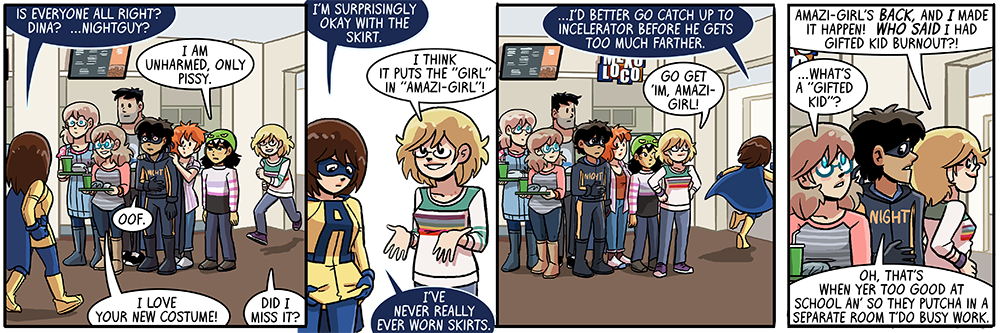
ugh, “gifted kid”?
Is what I hate about social perceptions of autism in the US, it either you have superpowers or you’re called the R-slur (-_-)
take note that Dina also probably heard Dorothy and probably also knows what she means ?
Thag Simmons
I don’t know if Gifted Kid should be considered a 1-1 correlation with autism. I think it’s overperformers in general
ian livs
It’s definitely not 1-to-1, but nearly every former “gifted kid” I know ended up some sort of neurodivergent and/or mentally ill
Frelance
I resemble that remark.
Opus the Poet
Dittos.
Needfuldoer
a-Yup.
Dara
It’s definitely not 1-1, but while my neuroatypicality doesn’t overlap much at all with either autism or adhd, that doesn’t make it not neuroatypicality, and I’ve got that in some pretty big ways.
(And it’s atypical enough that the collection doesn’t have a name. So that’s fun.)
Tatterhood
Relating so hard right now
Michael Steamweed
Former public school edumacator-type here. Definitely a strong correlation there. The vast majority of “gifted / talented students” I assessed were in some variety of neurodiversity. And since I had to meet with their parents often, I also noticed strong neuro-d traits in them, too. The kid apple doesn’t fall far from the neuro-d tree.
Needfuldoer
Funny how genetics works like that.
“We didn’t have no brain problems back in MY day!” Uh-huh, so that can’t possibly explain why Grandpa knows everything there is to know about stamps and ate the same seven meals every week for 50 years.
Elle L
Look some grandad’s just really like trains, or as my family discovered, it’s not Autism if the one book you’re obsessed with is the bible. Then you’re just a dedicated minister.
StClair
That ain’t autism, that’s just “bein’ particular”.
Rose by Any other Name
Ayup. 3 generations of autism, and probably more if we could go back and check my dead grandfather.
Almost makes one think that autism isn’t a disorder so much as a perfectly normal human trait that society treats as abnormal much as we used to with left handedness.
NGPZ
this, and let us not forget queerness ^^
Dorothy is approaching her autism here the same basic way Jennifer approaches her being queer, in that both of them are compartmentalizing it as “something else” more socially accepted where they live
the reality is that shade never made anyone less queer or less mentally disabled, but if shade crams all of us back into the closet, that’s how it’ll LOOK to the majority
in the end it’s still giving into the desires of those who care not about how the world actually IS but how they want it to PRESENT (-_-)
deliverything
Speaking of left-handedness and being forced to pretend to be different:
https://www.truthorfiction.com/the-history-of-left-handedness/
Really, it’s just that graph of how left-handedness became “more common” (that is, less hidden) after people stopped being punished for it (and associated implications), but when looking for it I found that page which adds more on the subject.
deliverything
Oops. Once again, I went back to read earlier comments and forgot it wasn’t the current page. Well, hopefully someone’ll wander back here sometime and find that page interesting to read.
Inahc
ooh thank you, I’ve been looking for that graph! never thought I’d get more than the raw image 🙂
charlie
i dunno, i think gifted is close to 100% correlated with the autistic/adhd neurodivergent cloud.
NGPZ
Dorothy is likely using it here as a “safe way” to refer to autistic burnout due to internalized ableism she has yet to really confront. I did the same when I was formerly repulsed by the label.
gramble
I’ve gotta say, I think that this is reading into Dorothy’s motives in a way that doesn’t seem to mesh with what’s on the page? She’s currently dealing with the weight of expectations she and others have placed on herself, and even if she is autistic there’s a good lot of her current struggles that don’t trace directly to some internalized ableism. Also relevant is that Walky immediately weighs in, as this comic’s poster child of ADHD gifted kid burnout, drawn pretty much precisely along the standard lines of those tropes (which lean way more heavily into ADHD than autism).
Proxiehunter
I don’t think Dorothy knows she’s autism coded.
JR
Dorothy was clearly identified as gifted. Dina knew herself to be autistic and was identified only as ESL. I’m not sure on what basis Dina would be offended by Dorothy referring to herself as a former gifted kid. I certainly don’t have a problem with it, as a former gifted kid myself.
Leorale
Gifted is a seperate diagnosis (though plenty of Autistic kids are also gifted).
When I was in school, Gifted meant you had an IQ of at least 130. We were in a different class all day long, with only other gifted kids, and a teacher with the additional credential of “Special Ed: Gifted”. Because, gifted kids legit learn differently from average kids.
Now / in the US, you typically get into a gifted program by getting good grades, and the diagnosis doesn’t typically get you anything that fancy — way closer to pulling you out of class for 30min of worksheets, as Walky describes.
The Lurker
And in many parts of the US “Gifted and Talented” programs were cut to provide services to meet other IEP needs. At least in the school districts where I taught. LD/Gifted certificates in the late 1900’s, now long out of date.
Needfuldoer
Whatever happened to skipping a grade?
Ray Radlein
I did that back before Gifted and Talented programs were a thing (and then did the programs once they were). I assume people still do it from time to time?
Yumi
I think one reason some students who meet “gifted” criteria might not skip a grade is social skills. For some students, especially 2E (gifted & neurodiverse), social skills might already be a challenge in a way that might just be worse if they skipped a grade.
Mark
This. I was definitely better off staying with my age cohort.
Back in my day, at my school anyway, what you got if you blew through the standard schoolwork and got bored is that once in a while a teacher would notice and offer extra material that was more challenging. I don’t think we had any formal program, just caring teachers. My thanks to them all!
Mark
One other thing, that I may have mentioned before, was the “SRA box”. In one class, if you finished the seatwork early, you could get other interesting stuff to work on, right there in the classroom. It was self-paced enrichment, in effect. I liked that a lot and I think it was good for me.
StClair
Definitely was for me.
Some Ed
Schools don’t get paid to let kids skip grades. As such, letting kids skip grades costs them money, because they’re letting those kids go at least one year early.
My school system claimed they weren’t letting me skip grades because my lack of friends in my grade clearly showed I lacked social skills. I lacked friends in my grade because I kept blowing the curve.
Note that kids being able to “blow the curve” shows a critical lack of understanding of statistics on the part of the teaching staff. The correct approach to curving grades would be to compute the score histogram.
How exactly to apply that’s a subject for some debate, but it’s probably more important to note that most teachers wouldn’t want to go to that effort, and would just like a better approach to dealing with curve breakers.
Fortunately, there is one, and it’s really simple to do. “Throw out the outliers” is the statistics principle. The officially correct way to do this would be to compute the standard deviation of grades and not include any that are more than two standard deviations from the mean in the curve. That is, when the mean was 62% and the standard deviation was 12%, that kid who got 100%? They still get an A, but that’s not the top of the curve. Nor is it the second highest grade at 89%. The top of the curve is that guy who got an 83%. Compute the curve without those two really high grades in the list.
But a lot of teachers would prefer to just eyeball it, and that’s fine also. In that case, the curve might be +11% instead of +17%.
Unfortunately, the kids might be clever enough to recognize that the teacher should’ve ignored two grades when computing the curve instead of just one and blame the teachers. So the teachers instead do curves entirely wrong and just blame the students who probably shouldn’t have been in their class in the first place for them not doing their jobs well.
Yumi
Honestly have never known a teacher to actually grade on a curve. Mostly just flat scores, sometimes with a boost based on a curve in advanced classes.
Also, another reason (also connected to funding) why schools might not want a student to skip a grade– standardized test scores. If you’re bringing up the average for your grade, but presumably wouldn’t be bringing up the average quite as much if you skipped a grade, what makes the school look better?
Ray Radlein
I never graded on a curve, but I did vaguely use one a a check on myself, to make sure I was teaching the material correctly and was making the tests appropriately challenging.
I mean, I didn’t plot them out or anything, but I could at least ask questions like “Were there more As than Fs?” and so forth.
Moonie
>As such, letting kids skip grades costs them money, because they’re letting those kids go at least one year early.
This is true for private but not public schools
Public school saves an entire year of supplies and food lol
The kids in public school are usually not skipped grades because it often makes them miserable and lonely and in a socially unrelatable place compared to their peers. Clearly that wouldn’t happen for every kid but it’s hard to predict who it will happen for vs for whom it won’t
Yumi
When I was in elementary school, the gifted program– called PACE– was like that, where kids would be pulled from class for chucks of time. At one point, I was in a group being tested on if we would qualify for PACE, and it was in the format of these sort-of games. I was doing well at them at first, but I started thinking, “My friends who are in PACE come back with more math worksheets; meanwhile, enough of the class goes that when they’re gone, the teacher mainly uses the time to read aloud to the rest of us. Why, exactly, would I want to be in the math worksheets group over the story time group?” So I just stopped answering things.
Leorale
All these responses really make me miss the congregated Gifted classes (Canadian public school in the 1990s). We almost never did worksheets — we were skipping the horrible drills that our brains pretty much didn’t need. We did experiments, and read books, and wrote stories and poems, and built little cars to run down ramps, and solved problems like how to drop eggs off the roof without breaking them. So cool!
And then the budget got cut.
The dumbest idea that was floated at the time was that the gifted kids would teach the remedial kids. Can you imagine? Just because you do well on IQ tests does not make you patient or deft or skillful at teaching! Teaching special ed involves, like, actual skills. So insulting to think that clever 10yr olds could do it.
Anyway then I came to the US, in a poverty-stricken rural community, where everyone was in the same class and the 6th Graders next to me couldn’t read. Wacky times.
Yumi
We did most of that in my mainstream classroom– I went to a very good school district– but I do think I would have been pretty sad if only the kids in the gifted program got to do the fun learning stuff.
Leorale
I sure hope the mainstream kids got to do the fun learning stuff, too! They must’ve done it sometimes. I was just told that we had *more* time for the cool stuff, because mainstream kids typically needed more drill than we did…
In fairness, my info is roughly as reliable as whatever was told to a 10-yr-old, roughly 20 years ago.
They did also tell us that we were the future; I’m pretty sure we were supposed to save the world with our shiny smartypantsness? It’s unclear now, but I know that we did not, in fact, save the world.
That’s the sort of thing that so seriously burned out Dorothy.
Dave the Inverted
For my own part, I found that being gifted often made me *completely unable* to teach or tutor slower kids. It turns out that when you grasp a concept instantly and intuitively, you have *no fucking idea* how to communicate it to someone who doesn’t *also* immediately get it.
mneme
Wait, seriously? I got into gifted programs in the 70s (in the U) by, yes, having strong IQ tests at 4.
I got kicked- out- of gifted programs for 2 years by having poor standardized tests (because of my learning disability; result was that I had perfect unfinished tests; of course, learning disabilities are universally another form of neuro-diversity).
Then I got into an entire gifted -school- (one of the best in NYC) due to a standardized test, which, at least when you take it without prep, does more or less correlate to an IQ test much more to the constellation of abilities and work that get you good grades.
So the idea that a school would take their strong performers regardless of whether their skills were due to hard work vs IQ and throw them into a class together because they are too good at school (as opposed to making a special class for fast learners and letting them learn together so they don’t get bored and spend half the class reading under the desk [lolno they’ll do that anyway] and make dooles [ditto]) seems bizarre. The students that aren’t getting bored and are getting good grades because they’re good where they are are doing fine; don’t mess with that.
zaratustra
we cannot forget the contribution of ADHD
Some Ed
It’s possible that it’s not 1-1. That said, what *is* autism?
It’s basically a bucket to put people who don’t “communicate well” with normal people. They’ve identified a bunch of traits that are strongly associated with communication difficulties and defined the syndrome based on being too far from “normal” on those traits.
The gifted program I was in actually tested for some of those traits. They weren’t officially looking for autistic kids, and they were certainly only testing for the “too much” side of that delta rather than looking for “too deviant’ like the normal autism test does. But it wasn’t particularly surprising that basically every kid in that program was on spectrum, given that aspect of the testing. Also, some of the other testing was looking for ‘out of the box thinkers’, and that’s also pretty highly correlated with autism (but definitely not 1-1.)
To be clear, I have known a bunch of gifted people who didn’t really seem like they were autistic. They didn’t get into that gifted program, but in some cases that was at least partially due to the fact they didn’t go to that school system. But what i find interesting about that group of people is over half of them have since admitted that they were autistic the whole time, they just mask well.
I should also point out that the gifted program I went to wasn’t just about getting additional math worksheets. I don’t think we actually got any additional math worksheets. If they gave us math worksheets with actual interesting problems, that would’ve been cool. But our gifted program was mostly about stuff that wasn’t in the general curriculum at all, and the stuff that was came in much later. For example, we were learning foreign languages in elementary school, which didn’t start for regular school for us until most of the way through junior high school.
Paradox
Not 1-to-1, but there is a lot of overlap
While IQ tests aren’t really a good judge if intelligence, I took one once and am technically not even “above average”, I jut happened to find math and science interesting and thus paid attention in class, and somehow this made me the “smart kid”
NGPZ
the very concept of Intelligence Quotient and corresponding set of tests to measure it was only ever intended to be used alongside other diagnostics to identify kids who needed help in school,
it was never intended by it’s creator to identify “geniuses”, let alone be some kind of absolute measure of brain power akin to power levels in DBZ or some shit XD
the cold hard truth is that the concept of IQ as known around the world today only ever got as popular as it did outside the niche of educational psychology because, in the United States, it was used to disenfranchise people
Uly
Many of the genes associated with ADHD and autism are also associated with high IQ.
anon
Dunno if it’ll confirm it (tho i imagine like 50% of the cast is either lgbt, neurotypical or both) but i imagine there were some ‘gifted kid programs’ or so tho idk if they’d still call it that these days to make the ‘average’/students with lower than average grades feel worse but i know in high school at least htere were some AP/IB classes but i odn’t think it wasnecessarily forced on anyone (Tho i’m sure a handful of ppl signed up for it b/c helps with early college prep or just looks good on ur record or so)
Needfuldoer
Dorothy’s parents are either late Gen X or early Millennial at this point. Maybe she learned it from one of them, who got their own “gifted kid” education in their time.
Yumi
I hear “gifted kid” more often these days than I did growing up– my school had a gifted program, but it wasn’t called that, and I, at least, didn’t exactly think of it that way (more, these kids are good at school AND have parents who push them pretty hard). Now “gifted kid” shows up in online spaces more, often in the discussion of burnout, from what I’ve seen.
morhek
When I was a kid they called it the “Accelerant Class,” basically where all the kids who were learning fast enough that reigning it in for the rest would hold them back, so they got put in another class and got to read the more advanced books. And yes, there was some burnout that thinned the herd – I didn’t last long in the Accelerant classes, just because the homework got to be a burden. Of course, nowadays the kids aren’t being given homework apparently because they realised during the pandemic that it’s just busywork that doesn’t actually reinforce the lessons and just creates more work for teachers.
Truly I was born in the wrong time.
yak
lmao they called it accelerant? Like what you add to fuel to make it burn faster? That’s too good.
Needfuldoer
Haven’t most mainstream education systems just been herding kids from kindergarten through graduation whether they’re absorbing the material or not, ever since “no child left behind” passed? And the lockdown years only exasperated the problem?
At least that’s the impression I’ve been getting from lurking on /r/teachers… Kids know they don’t have to do anything but play with their phones all day and they’ll still pass, or at worst they’ll have to take a six week summer school course.
Mark
Moving masses through the program in lockstep is what’s rewarded now, so, yeah?
It’s being inflicted on colleges too, where the Legislature calls it “finishing on time” or some such malarkey. Me, I needed nine semesters to finish my B.S. but I turned out so well that the school hired me.
Yumi
It’s very hard to hold a student back (in K-5, at least) unless a parent wants it as well. And at the same time, there was a law here for a few years saying if kids weren’t reading at a certain level by 3rd grade, they would be held back– but I don’t know if that was ever actually enforced; there were a lot of complicating factors and then they got rid of it. Now there are pushes to get rid of honors classes and such– there are a lot of downsides to tracking, but the proposed move to have secondary teachers teaching three different levels within each class doesn’t seem realistic either.
Icalasari
The gifted kid label does so much damage. If I never got it and instead got praised for working hard, I wouldn’t have burned out when I hit a wall
NGPZ
much more damage than you think
besides the historical widespread adoption of IQ tests and later derived aptitude tests in the US having very racist motivations, the unspoken aim of identifying “gifted individuals” in our country’s education system for special treatment has always been the product of elitist and conservative sentiments,
i.e. the underlying belief that “the freedom that will be used by only one man in a million may be more important to society and more beneficial to the majority than any freedom that we all use” (Fredrik Hayek)
(for reals fuck that shit) (9_9)
yak
OTOH, some people are either more prepared or more capable at school than others, and removing access to advanced education from public schools only results in gatekeeping students who would be able to flourish with more challenging curriculum than the standard, but can’t afford private tutors.
NGPZ
i mean why shouldn’t they be able to move on without the “gifted kid” label?
the way education in the US works to say the very least is in need of MASSIVE overhauls
yak
Well sure, but more often what is being done is instead just getting rid of the idea of putting kids in advanced classes at all.
NGPZ
Is why I like video games better than US schools, you can advance hands on and other learning without a class directing you at a “one-size-fits-all” pace XD
Jeremiah
I fail to see the correlation
Shadowsnail
My interpretation (as someone who very much enjoys leveling up): Video game progress is self-directed, based on the time and effort you put in. You move on to greater challenges at your own pace, so you can choose to grind when you think you need it and race ahead when you think you can handle it. A good educational game (can be hard to come by) covers all the same content as a class, but in this format.
In the education system, you are tied to a grade level, then a unit, then the instructor’s (or state’s) schedule. If you need to spend more time on something, it usually needs to be done outside of school hours. If you’re ready to move ahead, you either need to skip an entire grade or wait until the teacher serves you the new content and assignments.
thejeff
In theory, but I really doubt “good educational games” exist – at least in the “can broadly replace human teachers” format we’re implying here.
They would also have the problem of being self-directed, which means using that format entirely would mean students could skip things they need and focus on things they find easier or more fun.
But really the issue is more that the good educational game is personalized, while human teachers need to teach whole classes, rather than work one on one with each student.
Mark
Hm. I hear a lot about how “capitalism” is so bad and all, but when we try to actually meet each person “according to his needs” suddenly that’s elitist and we have to crush everybody into the same mold.
Yes, I’m being deliberately provocative. And I am listening.
thejeff
To a point.
Part of the problem is that we’re not great and definitely biased about who needs and deserves that extra help.
And even in socialism, resources are limited, so when we try to meet students “according to their needs”, we still have to choose between putting those resources into students who are struggling and falling behind and putting them into those who are already excelling but could do even more.
Regret
I’d love to give a serious answer, but there’s a logical leap I can’t follow right around “suddenly” that seems to come from something specific you’re thinking of, could you spell it out for me?
Tobias
The aim of identifying gifted individuals, in most educational programs, is to give them what they need. Gifted programs have been traditionally classified as a type of “special education”, at least around here, which is just a general term for programs dedicated to students whose needs are not being met by the standard approach and curricula.
The label is, like all special education labels, there to provide information on which special education framework is likely to be most suitable for the students needs.
The move to get rid of gifted programs has, generally, been actively harmful to the students who would previously have fallen under that label, even if the previous gifted programs often fell short of what they should be. Throwing our hands up in the air and just saying “welp, guess there’s nothing we can do” is not in the best interests of the students.
Yumi
I wish more parents understood this about gifted programs. I definitely feel my school district had parents pushing for their kids to be in the gifted program because it proved they were smart, and so it probably wasn’t operating as it was meant to.
Opus the Poet
When my kids were put in the G&T program they were were labeled “severely and profoundly” gifted, like it was a disability, because G&T was using the same bucket as learning disabled kids. Basically my kids were taking money away from kids with learning disabilities because of federal rules about teaching.
thejeff
In my case at least, getting praised for working hard would have backfired, since I wasn’t working hard. I was more the Walky type. I could coast by without doing much work, so I did.
Didn’t really lead to problems until later in college. 🙁
But I don’t think we really had “Gifted” programs when I was in school.
Mark
Yes. I would prefer to give (and receive) praise for results rather than effort. You praise effort when the results fall short of the mark. One is appreciation, the other encouragement.
thejeff
OTOH, what lead to problems later in college was that I’d always coasted and never had to work at learning things, so there are flaws in that approach too.
The big thing school is supposed to be teaching is how to do the work of learning things, so how do you encourage that
Yumi
Kids should have something they have to put effort into, in my opinion, and their effort in that should be positively reflected to them. Results can also be praised, and that can be motivating to some kids to work hard– like, “everyone really liked my story, I want to keep writing things,” or “I did really well on this test and I liked how that felt, so I want keep trying” (especially if a good score is new to them).