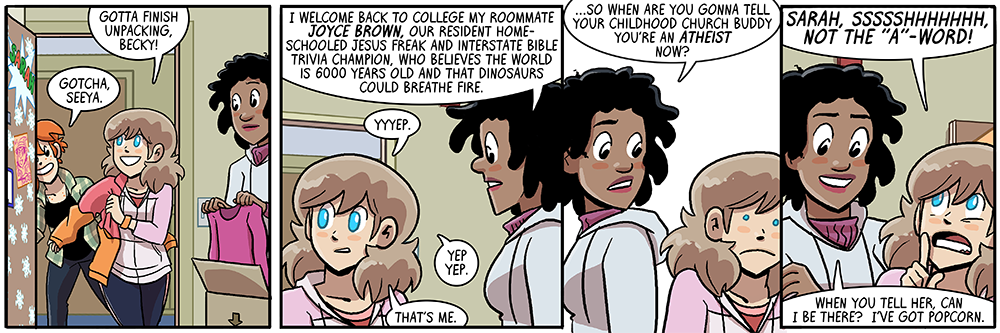
No way Joyce ends up Agnostic or Deist. That girl COMMITS.
BorkBorkBork
I’m just curious how one leaps from “the god my parents raised me to believe isn’t real” to “I’m positive there is no god.” Not that I doubt someone can make that leap – Joyce IS semi-autobiographical – I just wish I saw the reasoning. One would think you’d stop by agnostic or deist first.
BarerMender
It’s a rare atheist who will say, “I’m positive there is no god.” The standard atheist position is, “I don’t believe there’s a god.” Big difference.
Yet_One_More_Idiot
My sister and I were raised as Methodists by our parents…these days my sister identifies as a Deist/Spiritualist (believes in a god, not quite sure what god), while I’m an Atheist. And yes, I do say “I’m positive there are no gods”, so there’s that too.
Sharks
I hear this conversation all the time and this line of reasoning kinda bugs me. I don’t really see the difference between the level of belief of someone who says they’re positive that god exists and one who says they don’t believe there’s a god. I’m in the latter category, but honestly, I don’t know that I could make myself believe that a god exists if I tried. I mean, yeah, if god physically appeared and there was consensus on some series of tests to validate his godhood and he passed those tests in a public and provable way, I would probably change my mind. I’m pretty confident in saying that’s not going to happen, though.
The whole “gnostic->agnostic axis vs theist->atheist” paradigm creates four “quadrants” of belief, but assumes the existence of gnostic atheists, which…well, I’m sure there are a couple of those out there, but I feel like that’s such an insignificant proportion of people that maybe there’s not really a point in giving them their own category? Yes, I would absolutely change my mind in the face of overwhelming evidence that says god exists, but I’m so confident that is NOT going to happen, it doesn’t really make sense that there’s some mostly-empty category of “atheists, but like, even more sure about their atheism than is reasonable.”
BarerMender
The difference is, not believing is not making a claim. It’s rejecting a claim. It’s up to the believers to support their claim. Stating a positive belief that god doesn’t exist is making a claim and you should be ready to back it up. You’ve shifted the burden of proof to yourself. And, yes, it’s possible to back up a claim that the Christian god doesn’t exist, but that still leaves a lot of gods.
Captain Oblivious
Yes exactly. However, any backup of a claim of non-existence other than the lack of evidence for existence is rather weak. re: Russel’s Teapot. A lack of any evidence is sufficient to fully discard an idea put forth. I can imagine and propose all sorts of ludicrous ideas that any reasonable person can confidently say do not exist, and the burden is not on them to discredit my claim. Since non-existence is not proovable, it is a faulty hypothesis. The only way to resolve and test, is an existence hypothesis. Thus regardless of my claim of non-existence, the burden of proof remains on those who claim existence.
Pink elephants, flying spaghetti monsters, god, allah, yahweh, osiris, zeus, thetans, cthulhu, mother nature, magical witchcraft, ancestral spirits, ghosts, poltergeists, posession, angels, demons, pixies, faeries, trolls, giants etc… All fail the test of evidence, and I’m quite comfortable with that.
BarerMender
The backup for the nonexistence of the Christian god is, boiled way the hell down, that the universe looks nothing like what you would expect it to look like if said character was real. For an entire unboiled book on this, see _God, the failed hypothesis_, by physicist Victor Stenger (Prometheus Books, 2007).
Yet_One_More_Idiot
Notice, I didn’t say anything about the Christian God. I said that I positively believe there are NO gods. None at all.
But this is not the place to start a long drawn-out theological debate, I’m sure.
Jungle Dwayne
For me, I say “I don’t believe the Christian god exists” in the same way I say “I don’t believe there is an invisible, telepathic flying unicorn named George flying above my head that silently judges everything I think”. Sure, strictly speaking I can’t rigorously PROVE the flying unicorn is not there, but my unbelief is really closer to an active belief-in-nonexistence than to a sort of milquetoast “maybe there is, and maybe there ain’t”.
Some Ed
As an agnostic, I have been asked by so many atheists why I don’t take the leap from saying “a being of even a fraction of the power of god could vamboozle me with ease” to saying “there is absolutely, positively no god, damnit!” that I’m pretty sure I’d remember if some atheists simply accepted me in that mix. It’d be so different. And positive.
But I don’t recall that happening since around 2008 or so. Admittedly, I’ve stopped saying I’m agnostic in public spaces.
Personally, to me, it feels like to say one has conviction that there is no god is a tremendous leap to make from agnosticism. It feels like a much smaller leap to make from being a believer in monotheism. Actually, not a leap at all: just the “denial” step in dealing with loss, just with a different spin on it than “I’m not having a crisis in faith.” It’s less about there actually not being a god, and more about doing something one feels will be emotionally harmful to that one true god that one still believes, deep down, actually does exist, and you’re just mad at them for not actually existing.
BarerMender
Positive conviction there is no god isn’t standard atheism. It’s called “hard atheism,” and it’s a small percentage of all atheists. Your personal experience notwithstanding. Standard atheism is saying, “Oh, you say God is real? I don’t believe you. Show me the evidence.” It isn’t a position, it’s the lack of a position. Agnosticism isn’t saying, “I don’t know.” That’s soft atheism. Agnosticism is saying, “It can’t be known.”
I really don’t think this terminology is as widely used as you imply. I’m sure there’s a community of people who discuss these things and like to assign such points on a spectrum. And for sociological purposes, that might be useful. But those of us who sorted it out without such a group tended to rely on what googling “atheism definition” and “agnostic definition” gets you. Or, in pre-internet days, what the etymologies imply.
BarerMender
This community exists and it’s huge. They have conventions. They have many, many blogs, including a large presence on Patheos (under “nonreligious”). They have clubs at most universities. They have books and nationally circulated magazines. Join us. It’s great over here.
BarerMender
For books, I recommend George H. Smith, _Atheism: The Case Against God_, Nash, 1974. A highly philosophical treatment without getting bogged in obscure arguments.
BarerMender
For major magazines, Google the Secular Directory.
No disrespect meant, BarerMinder: you’re clearly quite knowledgeable here. But I finally left church because I was too much of a free-thinker to have someone else tell me what I believed*, so I don’t think I’d do well at a convention that began by telling me “no no, your so-called agnosticism is ACTUALLY soft atheism.” I recognize language changes over time, and maybe you’re on the cusp of that, but I’d maintain it hasn’t happened yet for the general public.
Some Ed
My position is not that “it cannot be known”, but rather, “I do not have the ability to know.” I know what my capabilities are. I don’t know what yours are.
As far as the other things you suggest, there’s nothing inherent about their definition that precludes knowledge of. We just happen to not have knowledge of.
All powerful, all knowing beings are categorically different in this regard. It wouldn’t have to be “the Christian God”, “the Jewish God”, or “the Muslim God” to be within the area of definitive uncertainty that I’ve worked out I have. Vishnu, Shiva, Adi Parashakti, YISUN, and many others would undoubtedly qualify.
In general, it’s possible to misconstrue any particular idea to be the idea you want it to be. It’s easier with ideas that are close, such as “I don’t know” and “I can’t know”.
But I believe I was pretty clear enough in saying my belief is “I can’t know” for you to need to be willful to misconstrue what I’ve declared my position to be. And, by so doing, have proven that even “soft atheists” such as yourself can’t stand the idea that somebody can categorically declare themselves unable to know about this particular topic.
drs
Are you agnostic about the existence of leprechauns, Gray aliens abducting people, or centuries old foxes who can turn into people?
WalkerOfSorrow
I don’t see the merit of that question, personally. I know it’s very common in the atheist community, but it’s an unnecessary reduction to absurdity, and a maligned one at that. If someone says they’re agnostic, they’re not saying nothing can be known (not by default). That’s Nihilism.
If we’re not going by the narrow definition that agnostic means “God”, the Christian God, can’t be known to exist, then the technical definition is only saying “superhuman beings or spirits worshiped as having power over nature or human fortunes” can’t be known to exist. That’s what the neutral definition of a god is.
Leprechauns would only fall into that if they are worshiped. Gray aliens as a concept aren’t spirits (per se) and aren’t necessarily superhuman either. More advanced than current Earth societies, sure. And almost no one refers to them in a context of worship or controlling human fortunes. Kitsune are closer to gods than anything else on your list.
But my point is that you appear to be making the position sound foolish by listing various “fictional” creatures and implying equivalency. Well, either that or you’re just having a laugh.
drs
I’m making the position sound foolish because the distinction *is* foolish to my eyes. There is no difference between my lack of belief in aliens, space teapots, or Trump’s empathy, and my lack of belief in God, Zeus, a divine Jesus, or the angel Moroni. Why should doubt in beings of worship get a special label?
Leprechauns, or fairies in general, were probably closer to kitsune before Christianity changed things. Even in today’s Christian Iceland, there seems to be a belief in fairies not far off from pagan propitiation.
thejeff
It’s subtler than that and it’s hard to argue that only specific beings that have been worshiped are relevant to atheism/agnosticism. Many theistic arguments lead only to “Creator God” and not to “who is the Christian God as described in the Bible”, though they often imply that follows.
A hypothetical all powerful creator as suggested by the usual design arguments doesn’t have to be the God of Abraham or the father of Jesus or any other specific deity worshiped by humans, but would still fall into the usual atheist and agnostic categories.
Beyond that though, I tend to agree with drs – I don’t see why a supernatural being that was worshiped is fundamentally different than one that was not. Especially as you go back in history and belief in such creatures/spirits looks more like part of religion than of fiction. Do you really stick with agnosticism when it comes to old pagan gods or cultic figures?
But even more, why do gods get their own special category of doubt that we don’t apply to anything else?
I think God gets their own category of doubt we don’t assign to anything else because God isn’t like anything else. Vampires and werewolves and what-have-you may be undisprovable, but their presence or absence don’t have significance on a cosmological or personal scale. If I learned vampires were real (really learned, had it proven), then I might have a couple questions for the Red Cross; if I learned God was real (really learned, had it proven) and learned what God LIKED, then virtually everything about my own life would change.
Jtbc, if scale/power/significance over our lives were what makes gods special, then wouldn’t that category also include speculative but entirely naturalistic (and therefore orders of magnitude more likely) phenomena, such as living in a computer simulation, or the existence of a galaxy-spanning alien civilization with technology so advanced to be indistinguishable from magic, operating on level of understanding that compares to ours as ours does to that of ants? (Ancient Aliens can make for okay scifi, but those cranks tend to think disappointingly small on the Kardashev scale, smh…)
Many ex-believer atheists did pass through an ‘agnostic’ self-identification stage. Doesn’t mean all did. Also doesn’t mean the stage lasted very long. Joyce has had months.
Radiance
Well, it has been a few months. Maybe she passed through all those phases already.
Jeff K!
When you’re that deep into your faith, you have already done whatever mental gymnastics are necessary to utterly dismiss any other branch of Christianity as being wrong.
It’s designed to keep you in your branch, and it succeeds at making the act of having doubts difficult. But once you find the strength to actually address your doubts and leave your branch, there’s not much reason to not just chuck the whole thing.
Agemegos
Yeah. Joyce already disbelieved in a myriad of gods from Amaterasu to Zeus, not only thought that their existence was untrue but absurd. Once the God of her mother was exposed as a farrago of human fantasies and lies, its commandments as the self-service of an authoritarian patriarchy, why should she think “but maybe true anyway” rather than “just like all the others”.
C.T Phipps
Does she believe that? One would think that she’d believe her church is a horrible betrayal of the religion first.
Agemegos
Certainly possible. But I would have thought that it is equally possible to look at the church, teachings, and Bible and say “there is no reason to believe any of this”. “If not this church and teaching, why any?” And there’s no good answer.
thejeff
I think that’s more Becky’s path. For Joyce though, it’s all tied together. Break one piece and the whole thing unravels.
See her bit awhile back about how if evolution is true, everything they’ve been taught is a lie. Evolution->no Eden->no Fall->no Original Sin
Regalli
Yeah, Joyce has been previously established as
– having an all-or-nothing approach to her doctrine – the evolution thing being a prime example. Probably why she had to start in accepting Becky with ‘okay the church’s INTERPRETATION is wrong but the Bible isn’t!’ as well.
– being actively triggered by songs from her own congregation since the first Toedad incident.
– struggling to ‘feel God’ at all once removed from the trappings of the church she grew up in, and
– questioning, as a result, if she ever felt God at all or if it was the ceremony and routine of church she took comfort in.
I can’t entirely remember if it was established in-strip or something Willis has said in Roomies/It’s Walky commentary that they went through and that I resonated with, but there also seems to be an element of adherence to the doctrine being less about faith and more about a crushing fear of hell, and I can see the ‘realizing that under that fear, there is nothing’ step I went through as well. (Having been raised in a liberal household but internalizing that fear from society as a whole. I think it’s an anxiety disorder thing, or a more generalized neurodivergence thing.)
OBBWG
Studies (for which I don’t have a link handy) have shown that people who are deeply religious tend to jump from one extreme to the other when changing beliefs. Gradual change is less likely. This is probably because having an extreme belief system requires almost 100% commitment. When that commitment is gone (shattered), it goes away completely and a new, usually opposite, 100% commitment fills the hole.
fridge_logic
As a moderate who took their dear sweet time coming around I can see this. It was probably 5 years from the point where I realized praying made no sense if god could see all to the point where I was actually ready to say I didn’t believe in god at all.
Certainly helped that my moderate church and moderate parents weren’t giving me any strong reasons to go bounding off too fast either. I think if I had people actively advocating to harm gay people in my community my conversion would have been a bit more sudden.
Freemage
Likewise–I came from a sincere, but moderate and tolerant religious background (Episcopal Church, in a racially diverse area, with a strong social conscience). As a result, I took a long time to come around to atheism, and even now I lack the innate animus that a lot of former fundie atheists have towards religion–I’ve known too many Hanks and Jacobs to be completely soured on the notion that religion provides an outlet for some folks to do good.
Huehuetotl
Agnostic and atheist aren’t mutually exclusive, even though a lot of people use the terms as if they were. Atheism is for the question, “do you believe any gods exist?” Agnosticism is for the question, “are you certain one or more gods do/don’t exist. There is such a thing as agnostic theists, but because doubt tends to be taboo among religious people, they don’t usually identify themselves that way.
In my experience, the main difference between people who identify as atheist vs “I’m not an atheist, I’m agnostic” is a willingness to say, “probably no gods, stigma be damned”.
Honestly the difference seems to come mostly from internet arguments with theists trying to show atheists are also relying on faith since they can’t prove there is no god.
OBBWG
As a committed Atheist I agree with us having faith. I can no better prove there is no god than a believer can prove there is one. We both rely on unsubstantiated beliefs (i.e. faith).
Agnostics are more correct and logical. They acknowledge they don’t know.
thejeff
By that argument, I also have “faith” that plenty of other things with no evidence for their existence don’t exist. Russel’s Teapot being the classic example, but there are literally an infinite number of others – most of which have never even been imagined.
It’s not a useful definition. To hold to that, agnostics must admit they don’t know anything for certain. Which in the strictest of senses, I will agree with, but it’s not a rigor that is applied to anything other than the existence of a God. (Is it merely a matter of faith that I believe there is a person calling themself OBBWFG on the other side of this discussion and the whole thing isn’t merely being fed to me through some elaborate hoax? A brain in a vat scenario? Or some version of Last Thursdayism?)
Agemegos
I’m with thejeff here. It’s not possible even in principle to refute even solipsism with the rigour with which I can prove the the square root of two is not rational. Since no-one can prove that the phenomenological universe even exists, asking that I prove that there is no teapot orbiting the Sun between the Earth and Mars to the same standard as that to which I prove that there is no largest prime number is just the wrong standard. But no-one would say that I have faith that there is no Rolls-Royce in my carport, or that I have faith that the crown came of one of my molars at lunchtime yesterday.
GRW59 is not in my carport. There is no Rolls-Royce in my carport. Sure, someone could have secretly swapped out my Subaru overnight. It’s logically possible that I was driving a Rolls yesterday and only hallucinated the Subaru. But I can be sufficient sure that didn’t happen to get on with my day.
OBBWG
First, I am a real person (which is exactly what a ‘bot would say).
The key word in my previous post was “unsubstantiated” beliefs. “Unsupported” may have been a better word. Reduced to its most basic premise, scientific theory says there is no way to know anything with absolute certainty. As Descartes noted, “cognito, ergo sum” may be the only thing one is absolutely certain of.
Fortunately, most beliefs have some substance, support or basis. One can reasonably conclude that there is no largest prime number based on what we know of number theory. One can conclude with high probability that the sun will rise tomorrow or that your car, not a Rolls, is still in your garage. Most things in life have a reasonable level of support for their belief. (Or, like Pizzagate, can be reasonably disproven.)
The existence or non-existence of God, however, is virtually impossible to prove without actual divine intervention. To assert either that God exists or does not exist is to make an unsupportable statement. What you see as proof of God, I see as proof of coincidence or chance.
Regarding Russel’s teapot: Right now a car is in orbit around the sun. It is too small to be seen by telescopes. Does it exist? Yes. We saw it launch. But in 10,000 years it becomes a myth. All records of its launch are gone. One day, someone finds it (or evidence of its launch or something). Proof can be had.
“Faith”, and I meant it in the more narrow religious sense, is believing something that there is no way to reasonably prove or disprove either by science, logic or reason. I, as an Atheist, actively assert there is no god. As per Russell, it is my duty to support that statement. (For simplicity, ignore proving a negative.) I cannot support this statement by science, reason or logic. Therefore, it is an unsupported belief. The same applies to those who claim God exists.
There are specific things that I can reasonably disprove, like the Earth is 6024 years old or creationism. I can even argue against a Christian god, especially if you believe the Bible is literal. But I cannot successfully argue against the existence of supreme being. That belief is faith.
thejeff
Proof of God is certainly possible. The Christian God is supposedly omnipotent. Such a being could proof its existence without trouble.
Disproof is not, but then proving a negative is generally impossible. Does it really make a difference if you think that someday in the future we might be able to disprove something, even though we can’t now? Is that sufficient to decide that it’s not real? We could in theory go look for Russel’s teapot, therefore I don’t have to suspend judgement on whether or not it exists?
aqua
Seems an easy leap to me. Whatever made you decide that your family’s religion is wrong had to be strong enough to overcome nostalgia and would probably sour you on religion in general. Next step would be needing something to be proven to you before you believe. Atheism would be the go to until something could be proven to you.
Proof does not need to be scientific, someone’s life story could be proof to you.
StClair
huh, maybe I should have put my comment here instead of further down… *shrug*
Agemegos
It’s more a “there is no reason to believe that there are any gods”.
Reltzik
Oy.
Long story short, there’s a handful of subtly different definitions for the word “atheist” floating around out there, and not all of them require a firm belief that no gods exist. Google “strong atheism vs weak atheism” for more.
Agemegos
Yeah, there is a long history of defining “atheism” to win debates instead of asking people who use it as a self-identifier what their position actually is.
The same is true of a lot of other words, of course.
Chris Phoenix
Many religions – perhaps especially those with magic sky beings – look pretty silly from the outside. If you’re in one of them, and you then disbelieve in that religion, why would you want to believe in another religion that you always knew was silly?
TLDR: Monotheists already disbelieve in every god except one.
Agemegos
As Stephen Roberts put it, “I contend that we are both atheists. I just believe in one fewer god than you do. When you understand why you dismiss all the other possible gods, you will understand why I dismiss yours.”
wwwhhattt
It ain’t necessarily true though, lots of monotheists (at least, I’ve heard this from christians, muslims and Hindus) believe that all religions are just different ways of worshipping the same thing. ‘Course evangelicals of all stripes would disagree


404 thoughts on “Unpacking”
Ana Chronistic
going straight for the jugular, huh Sarah
also, nice hair!
Undrave
That’s our Sarah! *canned laughter*
butts
i am absolutely reveling in everyone’s new looks so far
Kendra
I like everyone’s but Becky’s. It just looks WAY to big to me? Like she’d have to be wearing hair extensions.
Ana Chronistic
Wouldn’t put it past her to have discovered hair extensions
butts
Hey, the Cameron Esposito is a classic.
Liliet
As a person with that exact hair (might or might not be inspired by hers), yes it does look weird and yes it does look exactly like that.
I need a haircut, just like Becky does!
Lars
And she smiles in the last panel. That is … unusual.
Reltzik
She’s freaking Joyce out by forcing her to confront uncomfortable things about her faith and upbringing. That usually brings a smile to her face.
Deanatay
I was wondering what that… SHAPE on Sarah’s face was…. She must’ve gotten to murder someone she really dislikes over the break.
I now worry for Raidah’s safety.
Needfuldoer
She’s blunt and comes out swinging with hard-hitting questions. No wonder the baseball bat is her weapon of choice.
sliver
I need an upvote button for this comment, please.
Geneseepaws
+1
Chris
So, crisis of faith, but not ready to put a name to it.
Diner Kinetic
I *was* gonna ask if that wasn’t more agnostic, but honestly that feels more “crisis of faith but there’s no crisis, meh is fine”
Doctor_Who
Problem is, I’m conditioned so that any time I hear an event described as a “Crisis” I just wonder which DC hero is going to die.
Undrave
Could be a Green Lantern, we got spares.
Diner Kinetic
In this case: Bibleman
BorkBorkBork
As long as it’s not Larry-Boy, we’re good.
Wizard
Who cares, they’ll just come back in the next one.
Sunny
And every time I hear that word I can’t help but wonder if it’ll run on my computer system.
Viktoria
No way Joyce ends up Agnostic or Deist. That girl COMMITS.
BorkBorkBork
I’m just curious how one leaps from “the god my parents raised me to believe isn’t real” to “I’m positive there is no god.” Not that I doubt someone can make that leap – Joyce IS semi-autobiographical – I just wish I saw the reasoning. One would think you’d stop by agnostic or deist first.
BarerMender
It’s a rare atheist who will say, “I’m positive there is no god.” The standard atheist position is, “I don’t believe there’s a god.” Big difference.
Yet_One_More_Idiot
My sister and I were raised as Methodists by our parents…these days my sister identifies as a Deist/Spiritualist (believes in a god, not quite sure what god), while I’m an Atheist. And yes, I do say “I’m positive there are no gods”, so there’s that too.
Sharks
I hear this conversation all the time and this line of reasoning kinda bugs me. I don’t really see the difference between the level of belief of someone who says they’re positive that god exists and one who says they don’t believe there’s a god. I’m in the latter category, but honestly, I don’t know that I could make myself believe that a god exists if I tried. I mean, yeah, if god physically appeared and there was consensus on some series of tests to validate his godhood and he passed those tests in a public and provable way, I would probably change my mind. I’m pretty confident in saying that’s not going to happen, though.
The whole “gnostic->agnostic axis vs theist->atheist” paradigm creates four “quadrants” of belief, but assumes the existence of gnostic atheists, which…well, I’m sure there are a couple of those out there, but I feel like that’s such an insignificant proportion of people that maybe there’s not really a point in giving them their own category? Yes, I would absolutely change my mind in the face of overwhelming evidence that says god exists, but I’m so confident that is NOT going to happen, it doesn’t really make sense that there’s some mostly-empty category of “atheists, but like, even more sure about their atheism than is reasonable.”
BarerMender
The difference is, not believing is not making a claim. It’s rejecting a claim. It’s up to the believers to support their claim. Stating a positive belief that god doesn’t exist is making a claim and you should be ready to back it up. You’ve shifted the burden of proof to yourself. And, yes, it’s possible to back up a claim that the Christian god doesn’t exist, but that still leaves a lot of gods.
Captain Oblivious
Yes exactly. However, any backup of a claim of non-existence other than the lack of evidence for existence is rather weak. re: Russel’s Teapot. A lack of any evidence is sufficient to fully discard an idea put forth. I can imagine and propose all sorts of ludicrous ideas that any reasonable person can confidently say do not exist, and the burden is not on them to discredit my claim. Since non-existence is not proovable, it is a faulty hypothesis. The only way to resolve and test, is an existence hypothesis. Thus regardless of my claim of non-existence, the burden of proof remains on those who claim existence.
Pink elephants, flying spaghetti monsters, god, allah, yahweh, osiris, zeus, thetans, cthulhu, mother nature, magical witchcraft, ancestral spirits, ghosts, poltergeists, posession, angels, demons, pixies, faeries, trolls, giants etc… All fail the test of evidence, and I’m quite comfortable with that.
BarerMender
The backup for the nonexistence of the Christian god is, boiled way the hell down, that the universe looks nothing like what you would expect it to look like if said character was real. For an entire unboiled book on this, see _God, the failed hypothesis_, by physicist Victor Stenger (Prometheus Books, 2007).
Yet_One_More_Idiot
Notice, I didn’t say anything about the Christian God. I said that I positively believe there are NO gods. None at all.
But this is not the place to start a long drawn-out theological debate, I’m sure.
Jungle Dwayne
For me, I say “I don’t believe the Christian god exists” in the same way I say “I don’t believe there is an invisible, telepathic flying unicorn named George flying above my head that silently judges everything I think”. Sure, strictly speaking I can’t rigorously PROVE the flying unicorn is not there, but my unbelief is really closer to an active belief-in-nonexistence than to a sort of milquetoast “maybe there is, and maybe there ain’t”.
Some Ed
As an agnostic, I have been asked by so many atheists why I don’t take the leap from saying “a being of even a fraction of the power of god could vamboozle me with ease” to saying “there is absolutely, positively no god, damnit!” that I’m pretty sure I’d remember if some atheists simply accepted me in that mix. It’d be so different. And positive.
But I don’t recall that happening since around 2008 or so. Admittedly, I’ve stopped saying I’m agnostic in public spaces.
Personally, to me, it feels like to say one has conviction that there is no god is a tremendous leap to make from agnosticism. It feels like a much smaller leap to make from being a believer in monotheism. Actually, not a leap at all: just the “denial” step in dealing with loss, just with a different spin on it than “I’m not having a crisis in faith.” It’s less about there actually not being a god, and more about doing something one feels will be emotionally harmful to that one true god that one still believes, deep down, actually does exist, and you’re just mad at them for not actually existing.
BarerMender
Positive conviction there is no god isn’t standard atheism. It’s called “hard atheism,” and it’s a small percentage of all atheists. Your personal experience notwithstanding. Standard atheism is saying, “Oh, you say God is real? I don’t believe you. Show me the evidence.” It isn’t a position, it’s the lack of a position. Agnosticism isn’t saying, “I don’t know.” That’s soft atheism. Agnosticism is saying, “It can’t be known.”
T Campbell
I really don’t think this terminology is as widely used as you imply. I’m sure there’s a community of people who discuss these things and like to assign such points on a spectrum. And for sociological purposes, that might be useful. But those of us who sorted it out without such a group tended to rely on what googling “atheism definition” and “agnostic definition” gets you. Or, in pre-internet days, what the etymologies imply.
BarerMender
This community exists and it’s huge. They have conventions. They have many, many blogs, including a large presence on Patheos (under “nonreligious”). They have clubs at most universities. They have books and nationally circulated magazines. Join us. It’s great over here.
BarerMender
For books, I recommend George H. Smith, _Atheism: The Case Against God_, Nash, 1974. A highly philosophical treatment without getting bogged in obscure arguments.
BarerMender
For major magazines, Google the Secular Directory.
T Campbell
No disrespect meant, BarerMinder: you’re clearly quite knowledgeable here. But I finally left church because I was too much of a free-thinker to have someone else tell me what I believed*, so I don’t think I’d do well at a convention that began by telling me “no no, your so-called agnosticism is ACTUALLY soft atheism.” I recognize language changes over time, and maybe you’re on the cusp of that, but I’d maintain it hasn’t happened yet for the general public.
Some Ed
My position is not that “it cannot be known”, but rather, “I do not have the ability to know.” I know what my capabilities are. I don’t know what yours are.
As far as the other things you suggest, there’s nothing inherent about their definition that precludes knowledge of. We just happen to not have knowledge of.
All powerful, all knowing beings are categorically different in this regard. It wouldn’t have to be “the Christian God”, “the Jewish God”, or “the Muslim God” to be within the area of definitive uncertainty that I’ve worked out I have. Vishnu, Shiva, Adi Parashakti, YISUN, and many others would undoubtedly qualify.
In general, it’s possible to misconstrue any particular idea to be the idea you want it to be. It’s easier with ideas that are close, such as “I don’t know” and “I can’t know”.
But I believe I was pretty clear enough in saying my belief is “I can’t know” for you to need to be willful to misconstrue what I’ve declared my position to be. And, by so doing, have proven that even “soft atheists” such as yourself can’t stand the idea that somebody can categorically declare themselves unable to know about this particular topic.
drs
Are you agnostic about the existence of leprechauns, Gray aliens abducting people, or centuries old foxes who can turn into people?
WalkerOfSorrow
I don’t see the merit of that question, personally. I know it’s very common in the atheist community, but it’s an unnecessary reduction to absurdity, and a maligned one at that. If someone says they’re agnostic, they’re not saying nothing can be known (not by default). That’s Nihilism.
If we’re not going by the narrow definition that agnostic means “God”, the Christian God, can’t be known to exist, then the technical definition is only saying “superhuman beings or spirits worshiped as having power over nature or human fortunes” can’t be known to exist. That’s what the neutral definition of a god is.
Leprechauns would only fall into that if they are worshiped. Gray aliens as a concept aren’t spirits (per se) and aren’t necessarily superhuman either. More advanced than current Earth societies, sure. And almost no one refers to them in a context of worship or controlling human fortunes. Kitsune are closer to gods than anything else on your list.
But my point is that you appear to be making the position sound foolish by listing various “fictional” creatures and implying equivalency. Well, either that or you’re just having a laugh.
drs
I’m making the position sound foolish because the distinction *is* foolish to my eyes. There is no difference between my lack of belief in aliens, space teapots, or Trump’s empathy, and my lack of belief in God, Zeus, a divine Jesus, or the angel Moroni. Why should doubt in beings of worship get a special label?
Leprechauns, or fairies in general, were probably closer to kitsune before Christianity changed things. Even in today’s Christian Iceland, there seems to be a belief in fairies not far off from pagan propitiation.
thejeff
It’s subtler than that and it’s hard to argue that only specific beings that have been worshiped are relevant to atheism/agnosticism. Many theistic arguments lead only to “Creator God” and not to “who is the Christian God as described in the Bible”, though they often imply that follows.
A hypothetical all powerful creator as suggested by the usual design arguments doesn’t have to be the God of Abraham or the father of Jesus or any other specific deity worshiped by humans, but would still fall into the usual atheist and agnostic categories.
Beyond that though, I tend to agree with drs – I don’t see why a supernatural being that was worshiped is fundamentally different than one that was not. Especially as you go back in history and belief in such creatures/spirits looks more like part of religion than of fiction. Do you really stick with agnosticism when it comes to old pagan gods or cultic figures?
But even more, why do gods get their own special category of doubt that we don’t apply to anything else?
T Campbell
I think God gets their own category of doubt we don’t assign to anything else because God isn’t like anything else. Vampires and werewolves and what-have-you may be undisprovable, but their presence or absence don’t have significance on a cosmological or personal scale. If I learned vampires were real (really learned, had it proven), then I might have a couple questions for the Red Cross; if I learned God was real (really learned, had it proven) and learned what God LIKED, then virtually everything about my own life would change.
znk
Jtbc, if scale/power/significance over our lives were what makes gods special, then wouldn’t that category also include speculative but entirely naturalistic (and therefore orders of magnitude more likely) phenomena, such as living in a computer simulation, or the existence of a galaxy-spanning alien civilization with technology so advanced to be indistinguishable from magic, operating on level of understanding that compares to ours as ours does to that of ants? (Ancient Aliens can make for okay scifi, but those cranks tend to think disappointingly small on the Kardashev scale, smh…)
Vulcanodon
(Raises hand) There are different ways to phrase it. Mine is “I am pretty damn sure there is no god.”
thejeff
“I have no need of that hypothesis”.
BarerMender
–Diderot.
thejeff
Attributed to Pierre-Simon Laplace, but not well attested.
Vulcanodon
Joyce has said before that if one part is a lie, then it’s all a lie.
drs
Many ex-believer atheists did pass through an ‘agnostic’ self-identification stage. Doesn’t mean all did. Also doesn’t mean the stage lasted very long. Joyce has had months.
Radiance
Well, it has been a few months. Maybe she passed through all those phases already.
Jeff K!
When you’re that deep into your faith, you have already done whatever mental gymnastics are necessary to utterly dismiss any other branch of Christianity as being wrong.
It’s designed to keep you in your branch, and it succeeds at making the act of having doubts difficult. But once you find the strength to actually address your doubts and leave your branch, there’s not much reason to not just chuck the whole thing.
Agemegos
Yeah. Joyce already disbelieved in a myriad of gods from Amaterasu to Zeus, not only thought that their existence was untrue but absurd. Once the God of her mother was exposed as a farrago of human fantasies and lies, its commandments as the self-service of an authoritarian patriarchy, why should she think “but maybe true anyway” rather than “just like all the others”.
C.T Phipps
Does she believe that? One would think that she’d believe her church is a horrible betrayal of the religion first.
Agemegos
Certainly possible. But I would have thought that it is equally possible to look at the church, teachings, and Bible and say “there is no reason to believe any of this”. “If not this church and teaching, why any?” And there’s no good answer.
thejeff
I think that’s more Becky’s path. For Joyce though, it’s all tied together. Break one piece and the whole thing unravels.
See her bit awhile back about how if evolution is true, everything they’ve been taught is a lie. Evolution->no Eden->no Fall->no Original Sin
Regalli
Yeah, Joyce has been previously established as
– having an all-or-nothing approach to her doctrine – the evolution thing being a prime example. Probably why she had to start in accepting Becky with ‘okay the church’s INTERPRETATION is wrong but the Bible isn’t!’ as well.
– being actively triggered by songs from her own congregation since the first Toedad incident.
– struggling to ‘feel God’ at all once removed from the trappings of the church she grew up in, and
– questioning, as a result, if she ever felt God at all or if it was the ceremony and routine of church she took comfort in.
I can’t entirely remember if it was established in-strip or something Willis has said in Roomies/It’s Walky commentary that they went through and that I resonated with, but there also seems to be an element of adherence to the doctrine being less about faith and more about a crushing fear of hell, and I can see the ‘realizing that under that fear, there is nothing’ step I went through as well. (Having been raised in a liberal household but internalizing that fear from society as a whole. I think it’s an anxiety disorder thing, or a more generalized neurodivergence thing.)
OBBWG
Studies (for which I don’t have a link handy) have shown that people who are deeply religious tend to jump from one extreme to the other when changing beliefs. Gradual change is less likely. This is probably because having an extreme belief system requires almost 100% commitment. When that commitment is gone (shattered), it goes away completely and a new, usually opposite, 100% commitment fills the hole.
fridge_logic
As a moderate who took their dear sweet time coming around I can see this. It was probably 5 years from the point where I realized praying made no sense if god could see all to the point where I was actually ready to say I didn’t believe in god at all.
Certainly helped that my moderate church and moderate parents weren’t giving me any strong reasons to go bounding off too fast either. I think if I had people actively advocating to harm gay people in my community my conversion would have been a bit more sudden.
Freemage
Likewise–I came from a sincere, but moderate and tolerant religious background (Episcopal Church, in a racially diverse area, with a strong social conscience). As a result, I took a long time to come around to atheism, and even now I lack the innate animus that a lot of former fundie atheists have towards religion–I’ve known too many Hanks and Jacobs to be completely soured on the notion that religion provides an outlet for some folks to do good.
Huehuetotl
Agnostic and atheist aren’t mutually exclusive, even though a lot of people use the terms as if they were. Atheism is for the question, “do you believe any gods exist?” Agnosticism is for the question, “are you certain one or more gods do/don’t exist. There is such a thing as agnostic theists, but because doubt tends to be taboo among religious people, they don’t usually identify themselves that way.
In my experience, the main difference between people who identify as atheist vs “I’m not an atheist, I’m agnostic” is a willingness to say, “probably no gods, stigma be damned”.
bubba0077
As a strict agnostic atheist, I approve this message.
thejeff
Honestly the difference seems to come mostly from internet arguments with theists trying to show atheists are also relying on faith since they can’t prove there is no god.
OBBWG
As a committed Atheist I agree with us having faith. I can no better prove there is no god than a believer can prove there is one. We both rely on unsubstantiated beliefs (i.e. faith).
Agnostics are more correct and logical. They acknowledge they don’t know.
thejeff
By that argument, I also have “faith” that plenty of other things with no evidence for their existence don’t exist. Russel’s Teapot being the classic example, but there are literally an infinite number of others – most of which have never even been imagined.
It’s not a useful definition. To hold to that, agnostics must admit they don’t know anything for certain. Which in the strictest of senses, I will agree with, but it’s not a rigor that is applied to anything other than the existence of a God. (Is it merely a matter of faith that I believe there is a person calling themself OBBWFG on the other side of this discussion and the whole thing isn’t merely being fed to me through some elaborate hoax? A brain in a vat scenario? Or some version of Last Thursdayism?)
Agemegos
I’m with thejeff here. It’s not possible even in principle to refute even solipsism with the rigour with which I can prove the the square root of two is not rational. Since no-one can prove that the phenomenological universe even exists, asking that I prove that there is no teapot orbiting the Sun between the Earth and Mars to the same standard as that to which I prove that there is no largest prime number is just the wrong standard. But no-one would say that I have faith that there is no Rolls-Royce in my carport, or that I have faith that the crown came of one of my molars at lunchtime yesterday.
GRW59 is not in my carport. There is no Rolls-Royce in my carport. Sure, someone could have secretly swapped out my Subaru overnight. It’s logically possible that I was driving a Rolls yesterday and only hallucinated the Subaru. But I can be sufficient sure that didn’t happen to get on with my day.
OBBWG
First, I am a real person (which is exactly what a ‘bot would say).
The key word in my previous post was “unsubstantiated” beliefs. “Unsupported” may have been a better word. Reduced to its most basic premise, scientific theory says there is no way to know anything with absolute certainty. As Descartes noted, “cognito, ergo sum” may be the only thing one is absolutely certain of.
Fortunately, most beliefs have some substance, support or basis. One can reasonably conclude that there is no largest prime number based on what we know of number theory. One can conclude with high probability that the sun will rise tomorrow or that your car, not a Rolls, is still in your garage. Most things in life have a reasonable level of support for their belief. (Or, like Pizzagate, can be reasonably disproven.)
The existence or non-existence of God, however, is virtually impossible to prove without actual divine intervention. To assert either that God exists or does not exist is to make an unsupportable statement. What you see as proof of God, I see as proof of coincidence or chance.
Regarding Russel’s teapot: Right now a car is in orbit around the sun. It is too small to be seen by telescopes. Does it exist? Yes. We saw it launch. But in 10,000 years it becomes a myth. All records of its launch are gone. One day, someone finds it (or evidence of its launch or something). Proof can be had.
“Faith”, and I meant it in the more narrow religious sense, is believing something that there is no way to reasonably prove or disprove either by science, logic or reason. I, as an Atheist, actively assert there is no god. As per Russell, it is my duty to support that statement. (For simplicity, ignore proving a negative.) I cannot support this statement by science, reason or logic. Therefore, it is an unsupported belief. The same applies to those who claim God exists.
There are specific things that I can reasonably disprove, like the Earth is 6024 years old or creationism. I can even argue against a Christian god, especially if you believe the Bible is literal. But I cannot successfully argue against the existence of supreme being. That belief is faith.
thejeff
Proof of God is certainly possible. The Christian God is supposedly omnipotent. Such a being could proof its existence without trouble.
Disproof is not, but then proving a negative is generally impossible. Does it really make a difference if you think that someday in the future we might be able to disprove something, even though we can’t now? Is that sufficient to decide that it’s not real? We could in theory go look for Russel’s teapot, therefore I don’t have to suspend judgement on whether or not it exists?
aqua
Seems an easy leap to me. Whatever made you decide that your family’s religion is wrong had to be strong enough to overcome nostalgia and would probably sour you on religion in general. Next step would be needing something to be proven to you before you believe. Atheism would be the go to until something could be proven to you.
Proof does not need to be scientific, someone’s life story could be proof to you.
StClair
huh, maybe I should have put my comment here instead of further down… *shrug*
Agemegos
It’s more a “there is no reason to believe that there are any gods”.
Reltzik
Oy.
Long story short, there’s a handful of subtly different definitions for the word “atheist” floating around out there, and not all of them require a firm belief that no gods exist. Google “strong atheism vs weak atheism” for more.
Agemegos
Yeah, there is a long history of defining “atheism” to win debates instead of asking people who use it as a self-identifier what their position actually is.
The same is true of a lot of other words, of course.
Chris Phoenix
Many religions – perhaps especially those with magic sky beings – look pretty silly from the outside. If you’re in one of them, and you then disbelieve in that religion, why would you want to believe in another religion that you always knew was silly?
TLDR: Monotheists already disbelieve in every god except one.
Agemegos
As Stephen Roberts put it, “I contend that we are both atheists. I just believe in one fewer god than you do. When you understand why you dismiss all the other possible gods, you will understand why I dismiss yours.”
wwwhhattt
It ain’t necessarily true though, lots of monotheists (at least, I’ve heard this from christians, muslims and Hindus) believe that all religions are just different ways of worshipping the same thing. ‘Course evangelicals of all stripes would disagree