Hey, I’ve heard it argued, defensibly and with citations, that we’re not even the most evolved primate. I’ll posit that the most evolved form of life is either a virus or some single celled organism (depending on your working definition of life), but whichever it is, it’d be the thing with the /shortest/ generational cycle, giving it the most opportunities for exposure to harm and adaptation.
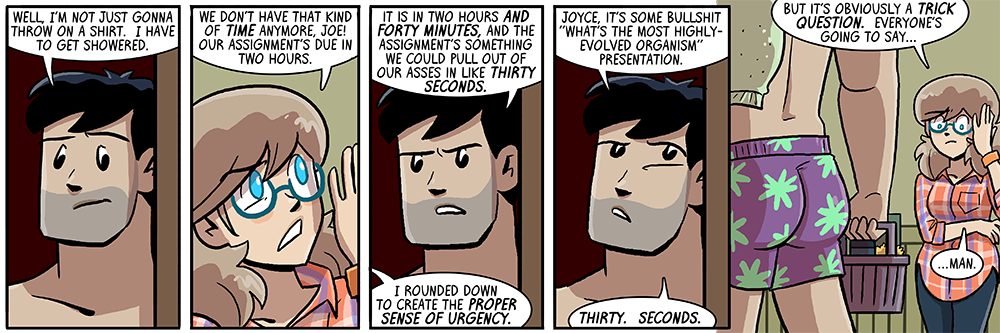
What does “most highly-evolved” even mean? (Also, nice punchline)
Thag Simmons
It doesn’t. It’s the wrong question to ask, and the correct answer is to point out that it’s an incorrect way to look at evolution
Clif
It doesn’t what?
Joyce knows a trick question when she hears it. They should go with Joe, personally, as the specific individual organism as their answer. Joe can argue for real and Joyce can argue ironically, presenting his selection of underwear as a sure sign of the ultimate in evolved taste.
eh, whatever
It doesn’t what?
Mean anything.
It doesn’t real!
Kamino Neko
I’m torn between thinking that Prof. Brock wants to hear that because it is, of course, the correct answer, and shows his students are thinking on the right track…or that he wants them to say ‘man’ (or octopus, or a virus, or whatever) so he can crush their petty little souls.
Daniel M Ball
The question is itself not an objective question with an objective answer. “Highly Evolved” is emotional terminology, it’s like asking ‘Best’ without qualifiers-the answer depends on the opinion of the asker.
this makes it not a scientific question, but instead a test of psychology and personality.
SeanR
Most highly evolved is probably something like a mite. Short generations, and so closely associated with the host organism that it can’t change to a different species of host.
All man has is a inquisitive brain, tool use, and the capacity for language. That makes us EXCEPTIONALLY capable generalists, but also short-cuts us actually genetically adapting to a new environment, as we can more easily kill something furry to steal its coat.
Also, the opportunity for Man’s evolution is about to come to an end. We will, once we get past the moral hurdles, start using gene-tweaking to eliminate anything that is inimical to the individual’s survival, and eventually, start adding improvements in.
I want a stronger lower back and a throat that isn’t at risk of choking. Maybe a tweak that takes the appendix out for good, but leaves the tissue in place to continue to fulfill its secondary purpose. I suspect the women in this crowd would like a coccyx that softens in the last two weeks of pregnancy to make for a less labyrinthine birth canal. Possibly just soften up the entire pelvis.
Miles
Nah, it’s definitely a mountaintop bird.
Or maybe a goat.
Miles
Ooh or maybe the duck billed platypus. Evolution must jave been particularly high that day.
DudeMyDadOwnsaDealership
For starters, it’s a good sign that Joyce knows that something’s amiss.
My take is “highly evolved” is a term far more rooted in Science Fiction and it’s hold on the human imagination than legit biology. With my understanding of what it means to be evolved in practice, Sharks and Crocodilians are more “highly evolved” than humans due to needing so few species-changing mutations to adapt over a much longer period of time than even primates have existed, much less humans. They got it right millions of years ahead of us, and still going strong.
The correct answer is most likely what the Professor defines as the meaning of “highly evolved.”
Leo
But even that depends on luck that conditions in their environment remained stable enough or changed within benign/beneficial parameters to allow them to remain relatively unchanged over so long. One big event and you see species that have remained recognisably the same for long periods of years requiring rapid adaptation or disappearing entirely.
I agree with you that it’s an unrealistic question, and hopefully that’s the point the professor is trying to make. Evolution doesn’t have a start or end goal, which is what a lot of people get wrong, it’s a process of genetic material simply finding the best way to replicate itself. The most *well* evolved organism is one that is currently prospering in its niche without needing to adapt, but that’s a fluctuating thing rather than a static observation.
annamal
I would assume it meant the species which has undergone the most evolutionary changes over time, in which case I would suspect it’s something that evolves quickly like bacteria.
thejeff
OTOH, you could argue that while bacteria change quickly, they’ve stayed basically like their distant ancestors and that the most highly evolved group would be the one that had changed the most.
thejeff
It’s not rooted in Science Fiction, but in pre-scientific classifications. The “great chain of being” with humans as the pinnacle of creation and other creatures organized in steps below dates back to Plato and Aristotle.
I thought it was Species 8472, or whatever The Traveler was.
I am Nothing
Google is never wrong.
Urainaskar
According to Google, Chimps are merely more “highly evolved” than humans, not the most highly evolved organism. In actuality, the answer is more likely that every organism are evolved to the same degree.
milu
according to the New Scientist article reporting on the paper, the scientists compared chimpanzee & human genomes to that of their common ancestor (actually they used a macaque genome as a proxy), and found that the chimp genome was more different than the human one.
i couldn’t find the actual paper but i doubt it used the words “more evolved”, let alone “more highly evolved”.
“More genes underwent positive selection in chimpanzee evolution than in human evolution”
milu
nice!
and we can now confirm that the researchers did not use the words “more evolved” or “highly evolved” (or indeed, “evolved”) anyhere in their paper. Bad New Scientist, bad.
instead they talk about “positively selected genes”, which they abbreviate to PSG because that’s a mouthful.
their hypothesis for why there’s been more PSGs in chimps than in humans is interesting, they argue that, for most of the >6My since the two lineages split, chimps have had a significantly larger population (or technically, a larger effective population) than humans, which will usually correlate to rates of genetic innovation.
also it should be noted that PSGs is not the only way for differences to happen between two genomes. it doesn’t take into account deletions, insertions, number of copies, polymorphism, not to mention the epigenome…
…a realization i owe to this more recent article (2019 vs 2007), which reviews the many studies on chimp/human molecular divergence that have been done since. it doesn’t challenge the previous study’s findings but it does provide a sense that the issue is vastly more complicated than that first study might have led one to believe.
Notably, it concludes by saying: “the lack of information on genome populational diversity could impact the total extent of human and chimpanzee interspecies divergence by misinterpretation of polymorphic sequences.”
If I understand things correctly, every living thing currently extant is *equally* evolved in that the actions of evolution have been working on us all for exactly the same length of time. ‘More evolved’ is a nonsense term, so Joyce is correct that it’s a trick question.
GDM
Yes. But it’s still a 30 second answer.
It isn’t, maybe, a 30 second dissertation, and Joyce may have some complications with Creationism but a quick search for earliest forms of life, a couple of references to transition fossils and the phylogenetic “tree” will adequately show everything has been evolving since life started and is still evolving QED everything’s equally evolved as everything else. We justvhave different niche to fill.
Demoted Oblivious
Working through deconstructing that interpretation: Whatever definition is used, I doubt that anyone using the term means pure chronology from the local origin of life (else the much less obtuse question: when was the origin of life). ex:Two cars set out from Detroit travelling west for two hours. One is travelling at 30 mph, the other is travelling at 13.5 m/s. Which one has expended more stored energy vs. how long have they been travelling?
Unless conditions are remarkably similar, but perfectly slightly different to accomodate the subtle differences between the two cars, they are not equal, not even in how long they have been travelling, since the faster or heavier car will have experience slower time (whichever condition ends up having a bigger impact).
If one really wants to stick with that time definition then we must compute if time travels faster at the equator due to being further from the gravity well, or if it’s slower due to the surface of the earth moving faster due to rotation, as compared to the poles. (all must also account for local variations in surface density over time, and other influencing characteristics.)
That would have been my answer, the most evolved organism is one with the shortest generational cycle combined with the most plastic DNA, so likely some form of virus or bacteria, complicated by the possible argument about viruses possibly not being alive.
I wouldn’t worry about it too much. I mean in Bob’s Burgers, Linda’s sister contracted “Butts Disease” as you describe it, and spite her many misgivings she made a full recovery.
The classic hard work vs talent debate. By that logic I think Joe has the edge. Walky’s ass will inevitably fade with time, while Joe’s discipline will keep his well maintained for years to come.
Correct. “Highly-evolved” isn’t a thing, because it assumes evolution is directional (i think that’s the right word? “towards a purpose” at any rate), which is an annoyingly common misconception.
I treat it as “most iterated”. It seems to make anthro-centrists batty.
RassilonTDavros
That’s pretty much the only way I could conceive of the term having any actual scientific meaning, but even then I have to wonder what, exactly, counts as an iteration.
vlademir1
I could see ‘highly evolved” as a a term for species that are so overfitted to the parameters of their current environment that tiny changes could potentially wipe them out in less than evolutionary timescales.
Demoted Oblivious
That sounds more like hyper specialized or adapted. Also, awesome grav. What is that bleak eye seeing and from whom/where does its gaze originate?
Thag Simmons
It’s relative to the scope of the discussion, as I understand it.
Bob John
I don’t think most iterated makes any sense, because number of generations means nothing if no adaptation takes place in all that time. There are species with short generational cycles that have remained virtually unchanged for millions of years, during which time whales have evolved from something resembling a shrew.
Demoted Oblivious
You raise a valid point about potentially discounting a certain class of data points, but I don’t think it’s a sufficient argument to completely sink iterations as a workable definition. And regardless of _appearing_ unchanged at a casual glance, all species change over time. Even if the environment hasn’t changed in a way encouraging macroscopic changes, species create internal pressures for evolutionary adaptation, as does disease and even just changes in food preferences. The lowly fruit fly, if restrained from iterating with its own kind, may die during mating when paired with a descendant removed by some generations. [sorry, it’s just a reference, not the original study].
milu
supposing it was even possible to quantify “evolution” in that way, i don’t see what such a ranking would tell us. geneticists do think about reproductive period when doing “molecular dating”, but they’re only trying to end up with something like, “this species split from that species X million years ago”, not “this species is X units more evolved than that one”. because that’s not a metric that exists (that i know of).
but honestly, i don’t even see how we would begin to calculate that sort of number.
complex organisms such as humans have evolved immunity systems that randomly generate billions of antibody proteins, and hypermutation in parts of the genome to counter the higher rate of reproduction of microbes/viruses. so… who wins? do we still count one generation of human as equivalent to one generation of bacteria? because those don’t seem commensurate to me.
what about the bacteria in our gut, which go through a vast number of reproductive cycles throughout one animal’s life, how do we count these? their evolution surely affects our fitness as individuals, and as a species. so..?
it doesn’t seem worth the trouble ?♀️
Demoted Oblivious
Aside from saying that it makes other primates better than us, and bacteria better than everything (except maybe viruses) to mentals the anthro-centrists? Absolutely nothing.
milu
anthro-centrists think they’re so reasonable and balanced, but at the first sign of a crisis they’ll immediately turn around and throw in their lot with the anthro-fascists, and throw the rest of us under the bus, and throw up their hands in the agony and throes of scruples and throat-clutching.
The obvious answer is either dolphin or mice: one was smart enough to leave this planet and the other smart enough to create a planet for the sole purpose of figuring out what the Ultimate Question is.
That is exactly the point I went into the comments to see if anyone had made.
Wagstaff
The fact that few people here realized that only proves Professor Brock’s assignment’s effectiveness as a surrogate for deep thought in regard to the concept of evolution.

414 thoughts on “Two hours”
Ana Chronistic
except for Becky, who will say WIMMIN
Ana Chronistic
come ON what’s wrong with classic white with red hearts
or
silk boxers with Eeyore
He Who Abides
Whatever happened to solid colored boxers as an option.
Yes, I know I’m boring. I’ve made peace with that.
Clif
All the cool kids have boxers with the Mandelbrot set.
Sambo
I knew my day would come!
Caninse
I’m pro-plaid/tartan myself.
John
As a Campbell: Black Watch, accept no substitutes.
I had a girlfriend once give me a pair of silk boxers in Black Watch with Marvin the Martian on them.
Demoted Oblivious
Hey, I’ve heard it argued, defensibly and with citations, that we’re not even the most evolved primate. I’ll posit that the most evolved form of life is either a virus or some single celled organism (depending on your working definition of life), but whichever it is, it’d be the thing with the /shortest/ generational cycle, giving it the most opportunities for exposure to harm and adaptation.
LiterallyJustSomeGuy
What does “most highly-evolved” even mean? (Also, nice punchline)
Thag Simmons
It doesn’t. It’s the wrong question to ask, and the correct answer is to point out that it’s an incorrect way to look at evolution
Clif
It doesn’t what?
Joyce knows a trick question when she hears it. They should go with Joe, personally, as the specific individual organism as their answer. Joe can argue for real and Joyce can argue ironically, presenting his selection of underwear as a sure sign of the ultimate in evolved taste.
eh, whatever
Mean anything.
It doesn’t real!
Kamino Neko
I’m torn between thinking that Prof. Brock wants to hear that because it is, of course, the correct answer, and shows his students are thinking on the right track…or that he wants them to say ‘man’ (or octopus, or a virus, or whatever) so he can crush their petty little souls.
Daniel M Ball
The question is itself not an objective question with an objective answer. “Highly Evolved” is emotional terminology, it’s like asking ‘Best’ without qualifiers-the answer depends on the opinion of the asker.
this makes it not a scientific question, but instead a test of psychology and personality.
SeanR
Most highly evolved is probably something like a mite. Short generations, and so closely associated with the host organism that it can’t change to a different species of host.
All man has is a inquisitive brain, tool use, and the capacity for language. That makes us EXCEPTIONALLY capable generalists, but also short-cuts us actually genetically adapting to a new environment, as we can more easily kill something furry to steal its coat.
Also, the opportunity for Man’s evolution is about to come to an end. We will, once we get past the moral hurdles, start using gene-tweaking to eliminate anything that is inimical to the individual’s survival, and eventually, start adding improvements in.
I want a stronger lower back and a throat that isn’t at risk of choking. Maybe a tweak that takes the appendix out for good, but leaves the tissue in place to continue to fulfill its secondary purpose. I suspect the women in this crowd would like a coccyx that softens in the last two weeks of pregnancy to make for a less labyrinthine birth canal. Possibly just soften up the entire pelvis.
Miles
Nah, it’s definitely a mountaintop bird.
Or maybe a goat.
Miles
Ooh or maybe the duck billed platypus. Evolution must jave been particularly high that day.
DudeMyDadOwnsaDealership
For starters, it’s a good sign that Joyce knows that something’s amiss.
My take is “highly evolved” is a term far more rooted in Science Fiction and it’s hold on the human imagination than legit biology. With my understanding of what it means to be evolved in practice, Sharks and Crocodilians are more “highly evolved” than humans due to needing so few species-changing mutations to adapt over a much longer period of time than even primates have existed, much less humans. They got it right millions of years ahead of us, and still going strong.
The correct answer is most likely what the Professor defines as the meaning of “highly evolved.”
Leo
But even that depends on luck that conditions in their environment remained stable enough or changed within benign/beneficial parameters to allow them to remain relatively unchanged over so long. One big event and you see species that have remained recognisably the same for long periods of years requiring rapid adaptation or disappearing entirely.
I agree with you that it’s an unrealistic question, and hopefully that’s the point the professor is trying to make. Evolution doesn’t have a start or end goal, which is what a lot of people get wrong, it’s a process of genetic material simply finding the best way to replicate itself. The most *well* evolved organism is one that is currently prospering in its niche without needing to adapt, but that’s a fluctuating thing rather than a static observation.
annamal
I would assume it meant the species which has undergone the most evolutionary changes over time, in which case I would suspect it’s something that evolves quickly like bacteria.
thejeff
OTOH, you could argue that while bacteria change quickly, they’ve stayed basically like their distant ancestors and that the most highly evolved group would be the one that had changed the most.
thejeff
It’s not rooted in Science Fiction, but in pre-scientific classifications. The “great chain of being” with humans as the pinnacle of creation and other creatures organized in steps below dates back to Plato and Aristotle.
Rex Vivat
According to Google, the answer is “chimps”
Needfuldoer
I thought it was Species 8472, or whatever The Traveler was.
I am Nothing
Google is never wrong.
Urainaskar
According to Google, Chimps are merely more “highly evolved” than humans, not the most highly evolved organism. In actuality, the answer is more likely that every organism are evolved to the same degree.
milu
according to the New Scientist article reporting on the paper, the scientists compared chimpanzee & human genomes to that of their common ancestor (actually they used a macaque genome as a proxy), and found that the chimp genome was more different than the human one.
i couldn’t find the actual paper but i doubt it used the words “more evolved”, let alone “more highly evolved”.
Demoted Oblivious
I found it!
https://www.pnas.org/content/104/18/7489.short
“More genes underwent positive selection in chimpanzee evolution than in human evolution”
milu
nice!
and we can now confirm that the researchers did not use the words “more evolved” or “highly evolved” (or indeed, “evolved”) anyhere in their paper. Bad New Scientist, bad.
instead they talk about “positively selected genes”, which they abbreviate to PSG because that’s a mouthful.
their hypothesis for why there’s been more PSGs in chimps than in humans is interesting, they argue that, for most of the >6My since the two lineages split, chimps have had a significantly larger population (or technically, a larger effective population) than humans, which will usually correlate to rates of genetic innovation.
also it should be noted that PSGs is not the only way for differences to happen between two genomes. it doesn’t take into account deletions, insertions, number of copies, polymorphism, not to mention the epigenome…
…a realization i owe to this more recent article (2019 vs 2007), which reviews the many studies on chimp/human molecular divergence that have been done since. it doesn’t challenge the previous study’s findings but it does provide a sense that the issue is vastly more complicated than that first study might have led one to believe.
Notably, it concludes by saying: “the lack of information on genome populational diversity could impact the total extent of human and chimpanzee interspecies divergence by misinterpretation of polymorphic sequences.”
foamy
If I understand things correctly, every living thing currently extant is *equally* evolved in that the actions of evolution have been working on us all for exactly the same length of time. ‘More evolved’ is a nonsense term, so Joyce is correct that it’s a trick question.
GDM
Yes. But it’s still a 30 second answer.
It isn’t, maybe, a 30 second dissertation, and Joyce may have some complications with Creationism but a quick search for earliest forms of life, a couple of references to transition fossils and the phylogenetic “tree” will adequately show everything has been evolving since life started and is still evolving QED everything’s equally evolved as everything else. We justvhave different niche to fill.
Demoted Oblivious
Working through deconstructing that interpretation: Whatever definition is used, I doubt that anyone using the term means pure chronology from the local origin of life (else the much less obtuse question: when was the origin of life). ex:Two cars set out from Detroit travelling west for two hours. One is travelling at 30 mph, the other is travelling at 13.5 m/s. Which one has expended more stored energy vs. how long have they been travelling?
Unless conditions are remarkably similar, but perfectly slightly different to accomodate the subtle differences between the two cars, they are not equal, not even in how long they have been travelling, since the faster or heavier car will have experience slower time (whichever condition ends up having a bigger impact).
If one really wants to stick with that time definition then we must compute if time travels faster at the equator due to being further from the gravity well, or if it’s slower due to the surface of the earth moving faster due to rotation, as compared to the poles. (all must also account for local variations in surface density over time, and other influencing characteristics.)
Daibhid C
Yep. See also “living fossils” nonsense.
Roborat
That would have been my answer, the most evolved organism is one with the shortest generational cycle combined with the most plastic DNA, so likely some form of virus or bacteria, complicated by the possible argument about viruses possibly not being alive.
Paradox
The correct answer is obviously crabs
https://en.m.wikipedia.org/wiki/Carcinisation
Miles
There’s an oddly specific xkcd about this
https://m.xkcd.com/2418/
Bagge
Why cute that answer would net her a two hour lecture with a very irate Dina.
Doctor_Who
Joyce is suffering from a Joeverload, or possibly a Joeverdose.
Let’s hope she can find the antiJoete fast.
NerdHerder
b u t t s
Doctor_Who
Joyce’s comic making career is in trouble if this causes her to contract Butts Disease, the condition by which you become able to only draw butts.
Though if she also draws female butts, I could see Daisy letting it slide.
Demoted Oblivious
While this may require the WBDDB to reappear for catharsis, I suspect her nemesis, Seymore Butts will dispatch her villainy with aplomb.
Wagstaff
I wouldn’t worry about it too much. I mean in Bob’s Burgers, Linda’s sister contracted “Butts Disease” as you describe it, and spite her many misgivings she made a full recovery.
Caninse
If she can draw dicks like she did previously and then butts…well, I believe we all know where that’s going then.
Sirksome
Hrmmm…is Walky’s position as the one with the best ass in danger?!
AlexanderHammil
Walky has the best naturally occurring ass. Joe has to work for his.
Sirksome
The classic hard work vs talent debate. By that logic I think Joe has the edge. Walky’s ass will inevitably fade with time, while Joe’s discipline will keep his well maintained for years to come.
Nono
See I would have expected Joe to be the kinda guy that would skip leg day.
Scoops!
Can’t skip butt day, those are my thrusting muscles.
Needfuldoer
Your comments have each other’s Gravatar.
He Who Abides
I’m . . . not sure Joyce is looking at Joe’s butt. She might be more concerned with his bulge instead.
Wizard
Judging by her eyes, I’d say she’s very carefully not looking at his bulge.
TrueVCU
BUTTS BUTTS BUTTS BUTTS
GOD SMILES ON US ALL THIS DAY
Nono
I came for the evolutionary debates, stayed for the Joe butt.
DailyBrad
Damn, Joe. Joyce, can’t say I don’t get it.
Thag Simmons
So the answer is that there isn’t one, right.
RassilonTDavros
Correct. “Highly-evolved” isn’t a thing, because it assumes evolution is directional (i think that’s the right word? “towards a purpose” at any rate), which is an annoyingly common misconception.
StClair
Thank you.
Thag Simmons
I mean I guess you could use ‘Highly Evolved’ as a synonym of ‘Derived’ but it would give you the wrong impression.
Demoted Oblivious
I treat it as “most iterated”. It seems to make anthro-centrists batty.
RassilonTDavros
That’s pretty much the only way I could conceive of the term having any actual scientific meaning, but even then I have to wonder what, exactly, counts as an iteration.
vlademir1
I could see ‘highly evolved” as a a term for species that are so overfitted to the parameters of their current environment that tiny changes could potentially wipe them out in less than evolutionary timescales.
Demoted Oblivious
That sounds more like hyper specialized or adapted. Also, awesome grav. What is that bleak eye seeing and from whom/where does its gaze originate?
Thag Simmons
It’s relative to the scope of the discussion, as I understand it.
Bob John
I don’t think most iterated makes any sense, because number of generations means nothing if no adaptation takes place in all that time. There are species with short generational cycles that have remained virtually unchanged for millions of years, during which time whales have evolved from something resembling a shrew.
Demoted Oblivious
You raise a valid point about potentially discounting a certain class of data points, but I don’t think it’s a sufficient argument to completely sink iterations as a workable definition. And regardless of _appearing_ unchanged at a casual glance, all species change over time. Even if the environment hasn’t changed in a way encouraging macroscopic changes, species create internal pressures for evolutionary adaptation, as does disease and even just changes in food preferences. The lowly fruit fly, if restrained from iterating with its own kind, may die during mating when paired with a descendant removed by some generations. [sorry, it’s just a reference, not the original study].
milu
supposing it was even possible to quantify “evolution” in that way, i don’t see what such a ranking would tell us. geneticists do think about reproductive period when doing “molecular dating”, but they’re only trying to end up with something like, “this species split from that species X million years ago”, not “this species is X units more evolved than that one”. because that’s not a metric that exists (that i know of).
but honestly, i don’t even see how we would begin to calculate that sort of number.
complex organisms such as humans have evolved immunity systems that randomly generate billions of antibody proteins, and hypermutation in parts of the genome to counter the higher rate of reproduction of microbes/viruses. so… who wins? do we still count one generation of human as equivalent to one generation of bacteria? because those don’t seem commensurate to me.
what about the bacteria in our gut, which go through a vast number of reproductive cycles throughout one animal’s life, how do we count these? their evolution surely affects our fitness as individuals, and as a species. so..?
it doesn’t seem worth the trouble ?♀️
Demoted Oblivious
Aside from saying that it makes other primates better than us, and bacteria better than everything (except maybe viruses) to mentals the anthro-centrists? Absolutely nothing.
milu
anthro-centrists think they’re so reasonable and balanced, but at the first sign of a crisis they’ll immediately turn around and throw in their lot with the anthro-fascists, and throw the rest of us under the bus, and throw up their hands in the agony and throes of scruples and throat-clutching.
Cholma
The obvious answer is either dolphin or mice: one was smart enough to leave this planet and the other smart enough to create a planet for the sole purpose of figuring out what the Ultimate Question is.
Mano308gts
So long and thanks for all the jokes.
DrunkenNordmann
Nah, the real answer is crabs.
vlademir1
That is exactly the point I went into the comments to see if anyone had made.
Wagstaff
The fact that few people here realized that only proves Professor Brock’s assignment’s effectiveness as a surrogate for deep thought in regard to the concept of evolution.
DudeMyDadOwnsaDealership