Indeed, thou speakest true. ‘Tis folly to speak in such a way improper, for it doth entertain many to call thine bluff.
Thou art thine own, not thy brother nor sister; alas, prithee listen a while, for I would speak unto thee.
(You are your own, not your brother or sister; alas, I pray that you listen a while, for I would speak to you.)
Too many speak Thou for yours and Thee for mine, and know not what they speak of. Many amongst them believe all else is untrue.
‘Tis almost as bad as those that believe there is but one O in too (to them, the truth is to many) or Type Like They Are Speaking A Title, All The Time. Beginning with no beginning. They speak with periods and no comma.
“If you say in the first chapter that there is a rifle hanging on the wall, in the second or third chapter it absolutely must go off. If it’s not going to be fired, it shouldn’t be hanging there.” –Anton Chekhov
Mike S
But Alfred Hitchcock described suspense thusly:
You show two guys talking in a diner. Under the table, you show a bomb. Anyone can have the bomb go off, it’s what the audience expects. But showing the casual conversation, then the bomb, building anxiety and anticipation in the audience. Then you have the characters get up and leave without having the bomb go off. THAT is suspense.
Chekhov is talking about minimalism, Hitchcock about suspense. When working on a stage, you don’t make a prop unless you’re going to use it. That doesn’t mean that you have to use it the way everyone thinks you will.
Valdrax
Furthermore, Hitchcock actually uses the bomb by not using it. Chekhov was talking about not wasting time on elements that detract from the story by their unimportance.
A gun hanging on a wall in a hunter’s lodge and never being fired, for example, is not an example of failing to apply Chekhov’s Gun if the purpose of the gun is to establish that the scene takes place in a hunter’s lodge as decor.
Chekhov also was speaking of the theater, and not movies or such. In the theater, things that aren’t a part of the plot can distract from the goings-on, as everything is on a fixed plane of vision; in movies, if they want to get your eyes off of the guy in the back of the restaurant picking his nose in the previous scene, all they have to do is jump to another camera angle.
Some reckon it may also be due to the fact that a firearm should always be considered loaded (even when you yourself have removed the magazine and/or rounds therein), and keeping a firearm (be it loaded with blanks or empty) hanging over the fireplace in the theater may well be a safety hazard if it’s not there for a particular reason.
Tucker
Chekhov’s Gun also applies heavily to literature. It does not make sense for an author to take the time to establish parts of an environment if they are not to be relevant. That was the folly of Tolkien, if he had one.
Zababcd
In literature, everything is automatically ‘relevant’ the moment you write it. It’s not possible to use words which don’t change the meaning.
“The magician removed his hat” implies that the magician is probably going to perform a magic trick (assuming the correct context).
“The magician removed his black hat” implies that the magician may be a little sinister, because we’re drawing attention to the ‘blackness’, often the colour of evil or corruption in literature.
“The magician removed his black hat with a flourish” indicates either that the magician is egotistical and showy (the black hat could be grey otherwise), or that he enjoys manipulating the audience, or both.
Even if the magician turns out to be your average performer, then we understand that this projected air is part of his performance, which tells us more about him as a character – and when we know more about the characters everything they do becomes further enriched with meaning, as we experience whatever transpires in the novel through the eyes of the characters (but not only through the eyes of the characters).
There are many well-known minimalists in literature. Actually, there’s no-one in literature who isn’t a minimalist – some are just more minimalist than others. To give more detail or more environmental factors, even when they’re not relevant to plot, is useful, because they are relevant to the story as a whole. In the theatre it’s slightly different; something must have relevance to the plot if it is to be relevant at all.
Kelly
@Tucker
LotR was a story Tolkien made up to go with his world, which he had already spent many years on (and arguably, the world was just something he made up to give his languages a place to exist). I other words, it isn’t the background detail that is irrelevant, it is the story that is irrelevant.
Anyway, if you want irrelevant detail (and I do!), go read The Wheel of Time Series.
Tucker
Oh, don’t get me wrong, I wasn’t shitting on Tolkien per-say. All I meant is that there was a lot of detail that wasn’t immediately relevant to the plot. Especially the first chapter of the Hobbit with the lengthy descriptions of Hobbit holes (which only appear a few times). They’re very interesting, but don’t necessarily fit into Chekov’s Gun. That said, the level of detail was hugely helpful to Jackson when doing the film adaptations, where films can (and typically do, even if by accident) have much extraneous detail that has no immediate relevance to the plot.
Griffin
Tom Bombadil is the biggest Chekov’s gun in the series. A nigh all powerful being whose only task is to rescue them from a tree in the first book?
thomas0comer
Chekov’s gun does apply to literature, but if you are describing a room in detail and making it look like somebody lives there, I see no reason why you can’t have, say, a rifle hanging on the wall even if it’s not going to be fired. It’s descriptive, which helps with realism (It makes it feel more like somebody lives there), it sets the scene a bit better (maybe a hunting lodge), and it adds characterization (whoever owns the room might be a hunter).
Chekov’s gun taken literally applies better to theater, while considering the meaning—don’t include things that don’t do anything for the work except make it longer–applies very well to everything.
And I consider adding detail to apply in many cases as doing something for the story, although you should obviously be sparing with the details when limited by things like a budget (in terms of money and time, as well as polygons/memory on video games/animations and the like).
Tucker
Most deft writers, rather than describe every square inch of a room, will instead give a vague idea of the room and then a deep understanding of the character inhabiting said room. This allows for the reader, understanding the character well, to populate the room with their imagination, increasing the immersion (making the space make sense to the reader, as opposed to the writer). With the preceding methodology, only relevant plot devices would be deliberately placed into the prose.
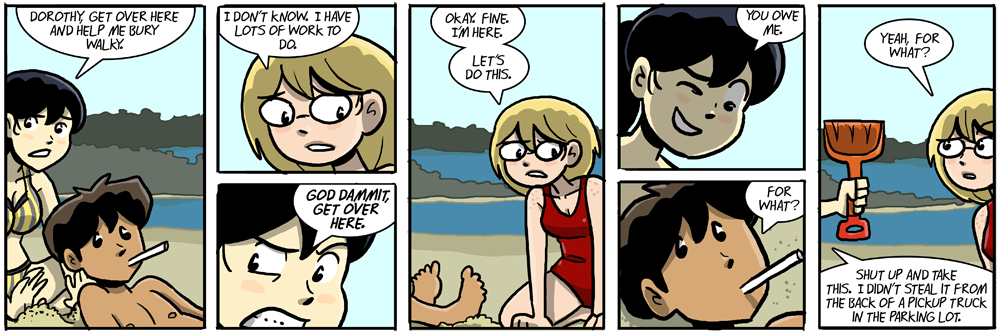
“For what?” “Yeah, for what?” “For teaching Walky how to survive being buried alive, something he WILL need in life, and for teaching you how to dispose of a body.”
Blah blah blah blah, creepy description of the disturbing things I want done to people, yadda yadda, horrible discussion of snuff fantasies, yammer yammer, definite signs of my mental disabilities, umbrella in the peanut butter.
Billie, think about it. Even if you force Walky to admit his feelings for Dorothy, they’ll just date awkwardly for a month or so before breaking up. No one likes being forced into relationships, you have to let them develop naturally.
Luckly his wife’s pregnancy won’t be in DoA comic time, otherwise they won’t be born until she’s in a nursing home.
Tucker
David intends to live to be nearly centenarian status in order to finish freshman year. DOA renewal for sophomore year is about as likely as underGRADS.

140 thoughts on “Owe”
Bunk
Billie’s got a plan.
Kernanator
“I love it when a plan comes together.”
darcos0
cue the A-team music
Kernanator
“I pity the foo’ that don’t wanna bury Walky.”
f.p.
Like Waspinator?
Tucker
PLANS!
JetFool
WHY UNIVERSE HATE WASPINATOR?
Pat
Yeah, but it looks like a pretty bad plan.
Plasma Mongoose
Suspiciously Specific Denial
Kernanator
I was about to say, that was oddly specific.
Plasma Mongoose
Wasn’t it thou…
Blob Marley
Nay, ’twas not I. It must have been thou. Or them over thither. :3
Plasma Mongoose
People use words like ‘thou’ these days don’t they?
AJBulldis
Usually incorrectly.
Raiser
Indeed, thou speakest true. ‘Tis folly to speak in such a way improper, for it doth entertain many to call thine bluff.
Thou art thine own, not thy brother nor sister; alas, prithee listen a while, for I would speak unto thee.
(You are your own, not your brother or sister; alas, I pray that you listen a while, for I would speak to you.)
Too many speak Thou for yours and Thee for mine, and know not what they speak of. Many amongst them believe all else is untrue.
‘Tis almost as bad as those that believe there is but one O in too (to them, the truth is to many) or Type Like They Are Speaking A Title, All The Time. Beginning with no beginning. They speak with periods and no comma.
It’s enough to drive a learnéd man to insanity.
Tucker
Stay a while, and listen.
Plasma Mongoose
The THOU I use doesn’t rhyme with shall (thou shall not commit murder), it’s the shortened version of though (isn’t it thou)
f.p.
Moral of the story:using the correct word is worth two more letters. 🙂
Michelle J Caboose
Yes it is. However, if Plas had used proper spelling, we would not have been treated to a Shakespearean spelling lesson. ^_^
CWR
I was under the impression that was spelled tho or sometimes tho’…there are rules to improper spelling, you know.
iSaidCandleja-
As often as people have mentioned that truck, I never expected it to be noticed by the characters. I’m just glad there wasn’t a gun on the mantle.
Blob Marley
Note that the absence of a gun on the mantle is not proof positive of the absence of a gun.
Kernanator
…I don’t get it.
Wait, maybe?
Wackd
“If you say in the first chapter that there is a rifle hanging on the wall, in the second or third chapter it absolutely must go off. If it’s not going to be fired, it shouldn’t be hanging there.” –Anton Chekhov
Mike S
But Alfred Hitchcock described suspense thusly:
You show two guys talking in a diner. Under the table, you show a bomb. Anyone can have the bomb go off, it’s what the audience expects. But showing the casual conversation, then the bomb, building anxiety and anticipation in the audience. Then you have the characters get up and leave without having the bomb go off. THAT is suspense.
So do we believe Hitchcock or Chekhov?
dchorror
They don’t contradict, really.
Chekhov is talking about minimalism, Hitchcock about suspense. When working on a stage, you don’t make a prop unless you’re going to use it. That doesn’t mean that you have to use it the way everyone thinks you will.
Valdrax
Furthermore, Hitchcock actually uses the bomb by not using it. Chekhov was talking about not wasting time on elements that detract from the story by their unimportance.
A gun hanging on a wall in a hunter’s lodge and never being fired, for example, is not an example of failing to apply Chekhov’s Gun if the purpose of the gun is to establish that the scene takes place in a hunter’s lodge as decor.
Raiser
Chekhov also was speaking of the theater, and not movies or such. In the theater, things that aren’t a part of the plot can distract from the goings-on, as everything is on a fixed plane of vision; in movies, if they want to get your eyes off of the guy in the back of the restaurant picking his nose in the previous scene, all they have to do is jump to another camera angle.
Some reckon it may also be due to the fact that a firearm should always be considered loaded (even when you yourself have removed the magazine and/or rounds therein), and keeping a firearm (be it loaded with blanks or empty) hanging over the fireplace in the theater may well be a safety hazard if it’s not there for a particular reason.
Tucker
Chekhov’s Gun also applies heavily to literature. It does not make sense for an author to take the time to establish parts of an environment if they are not to be relevant. That was the folly of Tolkien, if he had one.
Zababcd
In literature, everything is automatically ‘relevant’ the moment you write it. It’s not possible to use words which don’t change the meaning.
“The magician removed his hat” implies that the magician is probably going to perform a magic trick (assuming the correct context).
“The magician removed his black hat” implies that the magician may be a little sinister, because we’re drawing attention to the ‘blackness’, often the colour of evil or corruption in literature.
“The magician removed his black hat with a flourish” indicates either that the magician is egotistical and showy (the black hat could be grey otherwise), or that he enjoys manipulating the audience, or both.
Even if the magician turns out to be your average performer, then we understand that this projected air is part of his performance, which tells us more about him as a character – and when we know more about the characters everything they do becomes further enriched with meaning, as we experience whatever transpires in the novel through the eyes of the characters (but not only through the eyes of the characters).
There are many well-known minimalists in literature. Actually, there’s no-one in literature who isn’t a minimalist – some are just more minimalist than others. To give more detail or more environmental factors, even when they’re not relevant to plot, is useful, because they are relevant to the story as a whole. In the theatre it’s slightly different; something must have relevance to the plot if it is to be relevant at all.
Kelly
@Tucker
LotR was a story Tolkien made up to go with his world, which he had already spent many years on (and arguably, the world was just something he made up to give his languages a place to exist). I other words, it isn’t the background detail that is irrelevant, it is the story that is irrelevant.
Anyway, if you want irrelevant detail (and I do!), go read The Wheel of Time Series.
Tucker
Oh, don’t get me wrong, I wasn’t shitting on Tolkien per-say. All I meant is that there was a lot of detail that wasn’t immediately relevant to the plot. Especially the first chapter of the Hobbit with the lengthy descriptions of Hobbit holes (which only appear a few times). They’re very interesting, but don’t necessarily fit into Chekov’s Gun. That said, the level of detail was hugely helpful to Jackson when doing the film adaptations, where films can (and typically do, even if by accident) have much extraneous detail that has no immediate relevance to the plot.
Griffin
Tom Bombadil is the biggest Chekov’s gun in the series. A nigh all powerful being whose only task is to rescue them from a tree in the first book?
thomas0comer
Chekov’s gun does apply to literature, but if you are describing a room in detail and making it look like somebody lives there, I see no reason why you can’t have, say, a rifle hanging on the wall even if it’s not going to be fired. It’s descriptive, which helps with realism (It makes it feel more like somebody lives there), it sets the scene a bit better (maybe a hunting lodge), and it adds characterization (whoever owns the room might be a hunter).
Chekov’s gun taken literally applies better to theater, while considering the meaning—don’t include things that don’t do anything for the work except make it longer–applies very well to everything.
And I consider adding detail to apply in many cases as doing something for the story, although you should obviously be sparing with the details when limited by things like a budget (in terms of money and time, as well as polygons/memory on video games/animations and the like).
Tucker
Most deft writers, rather than describe every square inch of a room, will instead give a vague idea of the room and then a deep understanding of the character inhabiting said room. This allows for the reader, understanding the character well, to populate the room with their imagination, increasing the immersion (making the space make sense to the reader, as opposed to the writer). With the preceding methodology, only relevant plot devices would be deliberately placed into the prose.
Brendan
It’s Robin’s truck. She’s taking a page from Scott Brown.
So of course there’s a gun.
Animal
Trucks don’t have mantles.
Tucker
They have dashes.
Animal
And firearms are normally not kept there, but in a rack on the back window of the cab, or (in the case of my truck) in a case behind the seat.
Tucker
Oh, I realize, but the dash does most resemble a mantle, does it not? =P
Andrew Colunga
Nevermind the shovel, where’d you get the straw?
DagonXIII
I suspect that Walky got it from the same place as his mcnuggets.
Kernanator
From his pants.
Björn
With his penis?
And now it’s in his FAAAACE.
Fred
Or it’s Walky’s hollowed-out femur. Note that the legs aren’t completely showing.
Tucker
Not his femurs. He needs those to live!
Yusaku777
“For what?” “Yeah, for what?” “For teaching Walky how to survive being buried alive, something he WILL need in life, and for teaching you how to dispose of a body.”
iSaidCandleja-
“For that beer stash comment from a while back. He deserves to be buried alive for that insult!”
Kernanator
“For crossing the line from ‘Antics’ to ‘Bad Touch’.”
Blob Marley
Sweat, baby, sweat, baby, sex is a Texas drought
Plasma Mongoose
Walky better hope that it won’t end up being a Texas funeral.
Kernanator
Wait, they’re nowhere near Texas… Oh.
Ooooohhhhh…….
Plasma Mongoose
NOOOOOOW you get it! >:D
Joraiem
I’m gonna be honest, at first I was thinking, “…because Davan would be there?”
Tucker
Me and you do the kind of stuff that only Prince would sing about
Ridureyu
Blah blah blah blah, creepy description of the disturbing things I want done to people, yadda yadda, horrible discussion of snuff fantasies, yammer yammer, definite signs of my mental disabilities, umbrella in the peanut butter.
Scoops!
Umbrella in the peanut butter!? This will not stand!
Kamino Neko
Sure it will, if it’s very thick peanut butter.
OhHayMike
Two drums and a cymbal fall off a cliff…
ScytheAkse
For her starting the hook up between you and dorothy duh!
… i need friends like billie lol
RaijinK
Openly being friendly to Walky? Billie’s softening up sooner than I thought. That poll option suddenly doesn’t look so far off.
Jackson
Not openly enough for either him or Dorothy to actually realize it, though.
DagonXIII
Billie, think about it. Even if you force Walky to admit his feelings for Dorothy, they’ll just date awkwardly for a month or so before breaking up. No one likes being forced into relationships, you have to let them develop naturally.
Kernanator
This is the comics. Nobody said there would be realism.
David
A month in DoA time, I’ll be sending my kids to college.
Mkvenner
You have kids?
Kamino Neko
Expect them to be conceived Thursday of next week in-comic time, and born on Friday.
Plasma Mongoose
Luckly his wife’s pregnancy won’t be in DoA comic time, otherwise they won’t be born until she’s in a nursing home.
Tucker
David intends to live to be nearly centenarian status in order to finish freshman year. DOA renewal for sophomore year is about as likely as underGRADS.
Kernanator
Wow. Even Willis is making jokes about his Webcomic Time.
NakedDumblydore
Willis-time is like Valve-time, but without JK Simmons doing voice over.
Tucker
Yeah, the thing about VALVe Time is that occasionally it is early.