OK, the Doe Friendship is an awesome name! And I love how his greeting is crafted to meet Dina with her style. Seriously, how much growth did Joe experience during the skip?
Joe was never the monster he’s made out to be in the comments, sometimes. He was just unthinking. Pieces of this have been there as far back as the first year. I think having the list outed and talking to Joyce about it made him start to re-evaluate a lot of things.
Common sense
Agree. old joe was even funny at times and comment people often just overreacted alot to his antics.
Thag Simmons
I mean at times Joe can be a real prick
He’s not malicious and he usually means well, but he can still be a prick who deserves to get yelled at sometimes
thejeff
Let’s not overlook Joe’s character arc in favor of thinking the commentariat was just overreacting. It’s not like he didn’t have plenty of defenders even when he was at his worst either.
Daniel M Ball
I thing the revealing part in your comment, is that either he would need, or someone would think he needs, ‘defenders’ at all.
not his behaviours, HIM.
as in “Joe” needing defenders. Joe did something that people don’t like, therefore he is forever ‘surprising’ when he does something reasonably intelligent or even sensitive, right?? because obviously you can only be a certain way and frozen in time forever on your worst action, right?? I mean, if you go back to that storyline and wander through the comments, that’s the majority view. The entirety of the character is the ‘do list’.
thejeff
The hell?
The “defenders” I meant weren’t saying “Yeah, Joe’s got some problems, but he’s also got some good points.” They were straight up dismissing his problems. Especially before the list was revealed to everyone, but even after that arc.
He’s great on consent. He always takes no for an answer. The list isn’t a big deal, every rates people.
My opinion of him went up a lot when we found out he was just boasting about a lot of the sex – particularly about using alcohol to get threesomes. Of course, portraying yourself like that isn’t a good look, but it’s better than actually doing it.
Again, the whole point of the character arc is Joe overcoming actual real problems that he had. Ways that he was hurting people – as Joyce pointed out in their conversation after the donuts. Whitewashing that just kills his growth and his struggle.
Doesn’t mean he didn’t have good moments even before then, but they were often lost in the performative objectification he was trapped in.
Joe is surprisingly conscious of fashion. He dressed up specifically for his date with Joyce, so he knows what’s flattering for him. And otherwise he as has a fairly regular colour scheme – greens and purples – that even extends to his underwear. And his masculinity’s not so fragile that he doesn’t subscribe to Walky’s ‘only men have one pair of shoes’ policy.
RacingTurtle
Joe can be fashionable, but he did not really dress up for their date way back when. He wished he had when she arrived, though!
spriteless auntie
I did not realize Joe was mainly in villian coded colors until you mentioned green and purple.
Clif
Villains are required to wear color coded outfits to let you know they’re villains? Those who wear green and purple aren’t to be trusted?
Chromaphobia wears a black hat.
Shade
I don’t think that’s surprising at all for the character.
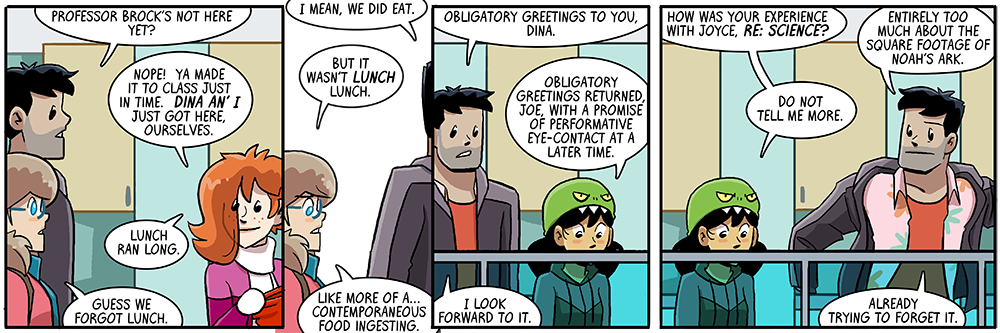
Why can’t more conversations go like this in life. Really feels like Joe and Dina know how to cut out the bullshit pleasantries around each other. Very efficient conversation. Very good.
Not quite. I think Dina actually enjoys spending time with Sarah as long as that time is productive and not in the action of encouraging magic based beliefs.
This feels more like they’re not really friends and not trying to be but that doesn’t mean we can’t be civil and engage in polite and concise discussion when social cues obligate such.
Rabid Rabbit
On the other hand, Dina’s the one who keeps the conversation going in panel 4, which clearly wasn’t necessary; panel 3 took care of all the necessary social cues (equivalent to “Hi, how’s it going?” “Good, thanks, how about you?” “Good, thanks.”)
I knew a guy in college who was very Dina-like in mannerisms. He worked at the computer lab, and I was CS so I talked to him a lot.
We’d converse a lot like this. “Pleasant afternoon or evening, state your purpose for this encounter.” “I require no less than 2 hours access to one of your devices with Emacs installed upon it, please direct me to a suitable station.”
He’d do this with everyone. Could never tell if he was doing it for fun, or if he was just like that. Perfectly nice guy, once you got used to him.
I personally go back and forth on this. Very often I’d very much like to skip the obligatory social niceties and get to the point, but sometimes I like them, when I’m out of RAM and I don’t have much brain left it’s good to have an easy script to fall back on.
If you do this as a running bit IRL (with a sneaky smile that suggests that yes, you know it’s odd, but no, you’re not going to stop), most people adjust surprisingly quick.
…Okay, I wish more people could understand “performative eye-contact” and be equally cool with me just… not wanting to do it at some moments. Also, I want Joe’s shirt, ngl
Seriously, that is one wonderfully straightforward interaction.
Gotta say, seeing Dina just… exist, autistically, in a social circle that accepts her without question by now is one of my favorite things. The last Danny/Sal interactions were adorable, but the Dina/Becky strip after Ross’s death where Dina uses her own lack of outward expressions to give Becky permission not to do performative grief, because she knows Becky’s feeling a mess of things? Not just my favorite moment of theirs, but probably a contender for my favorite DoA strip ever.
As much as I tend to discourage people using psychiatric labels so casually, I think this kind of acceptance is also rather beautiful.
Delicious Taffy
People are autistic, Steven.
Wagstaff
Steven who?
Dina may have social anxiety and such, but that does not necessarily connotate autism.
Anna
Then again…I have social anxiety, but I don’t really recognise myself in Dina at all. Apart, perhaps, from the quite rare occasions when she gets overwhelmed, which may be anxiety but not necessarily.
Regalli
I’m an autistic who recognizes myself in Dina so consistently and constantly I just consider it canon or all but. It’s the sensory things, it’s the considering eye contact performative and being read as ‘unexpressive’ and thus unemotional, it’s the specificity of her speech, it’s the special interest – hell, even things like joint hypermobility are associated with autism way more often than would be expected randomly.
(I’m much more split on Joyce, but that’s because Willis has discussed the ‘am I autistic or traumatized with obsessive behaviors as a result’ thing more than once, so it feels way more like diagnosing WILLIS than a fictional character who seems to have been written with some degree of conscious intent as autistic. Some Dina strips are based off Willis’s life, but she doesn’t feel quite as close a match to him as Joyce. But at the same time… yeah Joyce has a lot of behaviors that feel familiar to me in that specific way as well.)
Wagstaff
The reflection of Willis is part of the reason why I pointed this out. As interesting as your train of thought may be, I speak from experience when I say that it’s much too easy to get wrapped up in a false diagnosis. Focusing too much on a label may lead us to infer behaviors that don’t exist. Even if Willis did have something along those lines, we may very well be looking at a combination of conditions, or even just a collection of “symptoms” like the ones you described with differing, weakly related causes.
Delicious Taffy
The difference here is, Dina isn’t real, even if she’s based partially on certain aspects of her author’s real life. It’s 100% harmless and not remotely risky in any way to analyse her behaviors and character traits, see that they’re basically 1:1 with a lot of autistic people, and then consider her autistic based on that. It feels like you’re treating that identification and projection as something that could lead to some kind of roadblock or problem.
Wagstaff
I just think it’s presumptuous and even a little offensive to throw around labels like this. Behaviors are one thing. But it’s really the behaviors and the nature of what drives them that determines any condition, if there’s any at all. Only a doctor can really diagnose them, and for good reason too.
Delicious Taffy
Presumptuous, maybe. But when you’ve got two autistic people both telling you their lived experience aligns with a character whose portrayal leans heavily into neurodivergence tropes, it might be better to leave it be.
Wagstaff
Alright, then.
But keep in mind that while all autistic people are neurodivergent, not all neurodivergent people are autistic.
Regalli
I don’t have much to add after Delicious Taffy’s excellent discussion, but yeah. Dina’s traits are written with what appears to be a conscious eye towards ‘this is, specifically, autism,’ as evidenced by the sheer number of distinct character traits that are stereotypically and recognizably autistic. Joyce is somewhat ambiguously neurodivergent (in that she’s definitely neurodivergent, starting with the fact that we know she has PTSD, but there’s also an ambiguity in some of her quirks – food not touching, for example – and which particular combination of brain chemistry would have produced them.) Dina, like Amber, didn’t map 1:1 to a particular diagnosis at comic’s start, but gradually her traits got more and more specifically autistic as autistic readers told Willis ‘hey we see ourselves in this character.’ That talk with Becky, or her talk with Joe here, are pretty dang ‘an autistic person who doesn’t feel the need to mask, because her friends are attuned to her.’ (Acknowledging the greeting as obligatory but the words themselves are immaterial, calling the eye contact performative, Becky’s line about how Dina feels things strongly and other people don’t know how to read her so they misinterpret her, they’re pretty specific autism feels.)
Amber’s not diagnosed with anything either, but by now the comic’s been so blatant that it’d be a bad faith argument to say she’s not plural. Dina is about that level of blatant to autistic readers, in specific ways that don’t seem to be drawn from Willis’s life (like inverting your hypermobile joints to imitate a special interest) but have unusually high correlations that aren’t widely talked about outside our overlapping communities. That suggests research. Hell, when Niantic partnered with Autism Speaks for an event, Willis did a whole Twitter thread about how Pokemon was created by an autistic man with a highly autistic fanbase and AS is our community’s supervillain, so it was a particularly offensive action to use Pokemon Go for this purpose. Autism Speaks puts so much money into generating good publicity from non-autistics, and has such overwhelmingly bad reception from us, that I don’t expect anyone to know that who hasn’t done specific research on the subject. Anyone looking at our community hubs for the first time will pick it up in about twenty minutes, anyone just Googling autism will get about nine hits from them above anything led by autistics. If a character shows very regular autistic traits, from an author who’s said she’s not diagnosed but acts in very autistic ways, they agree, and the author seems very likely to have actually researched things about the autistic community, I feel pretty comfortable saying ‘she’s autistic.’
He has said specifically that the kinds of social debilitating he had were most likely due to the way he was raised. He said that he didn’t want to label her like that specifically because it wasn’t his original intention with those traits in her, and because by doing so he may very well be misrepresenting those kinds of people.
Delicious Taffy
Yeah, and then the very last bit of that post straight-out says “But yeah, Dina probably is Aspergery. Undiagnosed.”
It really seems like you’re intentionally leaving out the parts you don’t want to acknowledge. You’ve got multiple people saying they identify with the character, plus explicit (albeit out-of-comic) text on the subject, and you’re still treating it like some “well, we don’t have all the information here” hypothetical scenario in which Someone might get offended. Is it you? If it’s you getting offended by us referring to this fictional teenager as autistic, just say so. Otherwise, stop talking for and over the actual fucking autistic people telling you it’s fine.
Wagstaff
Look, I just don’t want people using these psychological labels so casually; not just autism but psychological labels in general. For instance, as hard as it is to believe, there was once a time when “psychotic”, “sociopath”, and “psychopath” were very specific, distinct things. Now altogether, they mean no more than “undesirable”, because of a process that I think needs to stop (as much as people can realistically help themselves).
By the way “Aspergery” does not mean “aspergers”. It just means having traits that are common to aspergers and many other types of neurodivergence.
Delicious Taffy
The way you write these replies comes off as incredibly condescending, whether you intend it or not. I’m well aware of how harmful it can be to use psych terms pejoratively and how easily they can be used to other people. Y’know, there’s a certain slur that starts with the letter R, which wasn’t always considered a slur and used to be downright clinical. It gets thrown at people like me pretty much constantly, along with just about anyone else on the spectrum. In fact, there’s an instance of that slur in this very comic, directed at the most ND-“coded” character. That’s an example of the concept you’re essentially NT-splaining to an ND person, and it’s also another parallel between Dina and the ND people who identify with her. In short, you don’t need to explain this very basic concept to me, because I understand it perfectly, having lived with it as the target for decades.
You’re applying it too broadly, in this instance. It will never be a problem for ND people to recognise ourselves in a fictional character, or to use our own terms in reference to those characters. If a neurotypical appropriates those terms and uses them pejoratively, then they are the problem and I agree they should stop that, but that’s not what’s happening here, so it’s irrelevant. Again, you’re talking over and for people who haven’t protested, and you need to knock it off, please.
If you didn’t mean to be condescending, you can internalize what I’m saying, apply it to future interactions, and we can leave it at that. If you did mean to, even as a schtick, you can just not respond at all, because nobody has ever accused me of being patient with that behavior and I’d rather not get banned from the only decent, welcoming online community I’ve ever been part of.
Wagstaff
Sorry. I really didn’t mean to be condescending, and I especially didn’t mean to make you feel unwelcome. I have a psychology major friend who also views labels this way, so I’m used to thinking of them as terms of rigorous science.
spriteless auntie
The jargon treadmill is a tough thing to stop, ’tis built into how humans use language. Even how it is used in medicine has expanded, as more people are diagnosed who might not have been a generation ago.
But if you want to keep the usage clear, consider: it’s easier to convince people to do a different thing instead, rather than to not do a thing. I mean, you might ask people to say “Dina is on the spectrum, sure, but without a diagnosis it’s best not to call her a specific medical term.” You have provided a replacement word, not just taboo’d a useful term.
Devin
But at the same time, trying to police the language of people who do have the lived experience is maybe not the best use of anyone’s time. If the goal is to stop irresponsible use of terms, maybe the focus should be on people who don’t have context and knowledge to use it correctly, as opposed to folks who have the most direct context and knowledge possible which is what’s happening in this thread.
And even then we run the risk of insisting on people volunteering potentially sensitive information about themselves in order to validate themselves and their experiences. That’s a delicate balance to maintain, and I’m not saying that no attempt should be made, but what’s happened here has been no balance at all. The level of policing of people who understand the life experiences of autism is dismaying to me, and is all too familiar from a slightly different perspective.
Treating medical conditions that real people live with as rigorous science first has the effect of treating real people as secondary, which is what I see happening here.
Wagstaff
Medicine is a science like any other, and like any other science, there needs to be room for honest doubt.
Saying that science doesn’t “put patients first” is really attacking a straw-man. Let’s face it, the human body is complicated, and even where the best evidence and techniques available can give us a prediction only slightly better than a blind guess, it’s thanks to rigorous science that patients still have a better chance of getting treated effectively today than they did 100 years ago. If that’s not treating people as primary, I don’t know what is.
But of course, the acknowledgement of uncertainty in something like medicine is socially unacceptable; acting on pretended knowledge is often the preferred solution, with very impeding consequences. Doctors who acknowledge the full extent of their empirical uncertainty may expect to be replaced with those who can better gain the trust with patients with the lure of tentative certainty. Lowering the standard like that only means that modern day snake oil salespeople can use the exact same lure to scam patients who would have the best chances with medicine that’s been rigorously tested.
Yumi
Way to ignore the solid points Devin was making about the damage you were doing to go off on some tangent.
Clif
This is the language police. You’re all under arrest. Sargent drag them away to the dungeons.
No! Not me. Stop. WHAT ARE YOU DOING? Aaaaaaaaa…
Regalli
In addition to the points Devin made, the points Taffy made, and basically everything else: Fun fact! There’s a known and significant problem with autism, in particular, being extremely underdiagnosed in formal psychiatric settings due to biases by the psych professionals doing the diagnosing. In particular, it’s very common for AFAB people, people of color (especially BIPOC,) and adults who managed to fly under the radar until they were out of the 8-year-old-who-likes-trains stereotype range to be misdiagnosed. Sometimes AFAB autistics are told they can’t be autistic because only boys are. Frequently adult autistics struggle to find someone who’ll diagnose them because they’ve spent childhood brute-forcing coping mechanisms until they can mask, and sometimes the psychologist won’t believe adults can be autistic. Meltdowns and overload in black and brown kids are frequently misdiagnosed by white professionals as ‘behavior issues’ or more pathologized disorders (which is an issue in its own right.) I’m a white femme who was diagnosed at age 10 by the most reputable center in the region (and one of the best-known in the country,) and I STILL had a psychiatrist try to change my diagnosis and insist I couldn’t be autistic because I could talk and have some coping mechanisms as an adult.
Self-diagnosis is widely accepted by autistics as a whole because we recognize there are so many obstacles to diagnosis for basically anyone who’s not a white AMAB 10-year-old or younger with VERY stereotypical behaviors. Even if you can get diagnosed formally, discrimination against diagnosed autistics is a known issue (to name a topical example, doctors in the UK pushed DNRs on autistics and others with developmental and intellectual disabilities last year. That’s likely a factor in how two-thirds of UK COVID deaths were disabled people as of March. I’ve also heard quite a few stories about things like difficulty getting organ transplants due to ‘quality of life’ concerns that basically amount to ‘well they’re autistic, so,’ even pre-pandemic strain on the system.) Formal diagnosis can be a double-edged sword.
So one, you’re talking over autistic people, and two, you’re doing so on a subject that most of the community has a stance on, and that stance is VERY DIFFERENT from yours because of known medical gatekeeping issues.
Wagstaff
Those are some very real problems with the medical system right now in regards to autism, and I am well aware of them. While self-diagnosis has noble intention (I respect you and your entire community for it), I really don’t think it should be treated as a permanent solution. But if it’s necessary for now to make sure autistic people are treated fairly, so be it, I guess.
Just want to make the comment that Dr. Asperger was looking for people who could still work with their divergence in Hitler’s concentration camps, so using his diagnosis has negative connotations to some on the spectrum as “He’s not so broken that he still can’t be useful.”
Wagstaff
Anyone want to use Godwin’s Law here?
Clif
You Nazi!
Coles law is far superior and tastes better.
Regalli
Yeah, I believe Willis’s comment was made before the full depth of his collaboration was publicly known and the autistic community started shifting away from the term as a whole (having previously been considered a ‘it’s removed from the DSM because it really is just autism presenting slightly differently, but some people who were previously diagnosed that way still use it’ by and large.)
Because for the record, it’s not Godwin’s Law, that is in fact a conversation our community’s been having in recent years. You’re being super condescending here, Wagstaff. Knock it off.
Wagstaff
Sorry if I’ve been condescending; I didn’t mean to be unwelcome to those who want to see themselves in the characters here. I definitely didn’t mean to imply that you are throwing around labels irresponsibly. I’m just concerned that using to them may cause more problems then they solve if we’re . Even many therapists agree that it’s good practice to refrain from telling patients what they have unless it’s really necessary.
By the way, Godwin’s Law has been notoriously misconstrued in recent years, and its creator stated that he didn’t intend it to be a conversation ender as much as a conversation starter. I was using it in the former sense.
Wagstaff
I mean the latter sense! Damn!
Devin
“I just think it’s presumptuous and even a little offensive to throw around labels like this.”
“Look, I just don’t want people using these psychological labels so casually…”
Assuming the absolute best here, you’re communicating your intent very poorly. At this point you’ve been told multiple times that you’ve been condescending and asked to knock it off, and you’ve said sorry but you haven’t stopped.
I think you should strongly considering just letting this one go, please.
Tunasammich
So I’m definitely absolutely not trying to criticize this comic or David Willis in all by saying this, nor am I trying to be mean or dogpile you, just to make it clear–
But this is seriously the problem with media in general not saying autism (or ADD) out loud or making it explicitly canon. There are so many characters who seem pretty clearly autistic, but when autistic people point that out or want to identify with them everyone comes out of the woodwork to say you can’t because that character isn’t diagnosed and it hasn’t been said out loud.
On the one hand I get what you’re saying–I personally HATE that people armchair diagnose everyone on the internet. It drives me nuts that any time someone talks about someone being a jerk everyone says they’re narcissistic or have BPD.
I feel like this is different, though. Not just because of all the great points already made about getting an official diagnosis of autism being a fraught thing, but because…I don’t know. It feels like when people say “no you can’t say that character is autistic unless it’s explicitly stated!” It feels like you don’t want that character to be considered autistic because in doing so you’re denigrating that character somehow? When what you feel as an autistic person identifying with them is just about the opposite of that? It seems completely different to me to think a fictional character is autistic than to “diagnose” real people with personality disorders when you don’t know wtf you’re talking about. Actual autistic people recognizing it in others–I just don’t think it’s the same thing at all.
Wagstaff
Thank you. You have done what evidently I have failed to do.
But it still begs the question. How do we know someone is autistic? Working with self-diagnosis may be the only solution for now, but even with good intentions it may suffer from at least a few of the same basic problems as armchair diagnosis in general. How we go about addressing these problems is a whole can of worms I’m not really gonna get into for now.
And by the way, Dina is really more the exception than the rule in the sense that Willis stated that she was designed to be like him when he was a kid. I guess you could say I wasn’t necessarily against preemptively diagnosing Dina as much as I was against preemptively diagnosing Willis. Looking back, I really didn’t make that very clear, and I’m sorry if that caused any confusion.
Devin
Given how you’ve composed yourself in general on this topic I think that’s a can you should maybe just not get into at all, certainly not without learning a bit more about either the actual experiences of the people involved. Or maybe figuring out how to better communicate your intent.
I also want to note that once you put an “if” after “I’m sorry”, it undercuts the apology greatly. Be sorry with conviction, don’t hedge. See more.
David M Willis
and as we all know, being wrongly diagnosed as autistic is actually the greatest possible crime so much that we have to relentlessly shout down everyone else on the goddamn internet just in case they further propagate this blight upon our civilization, jesus christ
Delicious Taffy
Thank you.
Wagstaff
I understand that my behavior regarding misuse of labels was overzealous, and I’m sorry.
At the same time, if one is willing to reject the defense of preventing perpetuation of social damage with those labels in favor of discouraging their use in ordinary conversation, regardless of the speaker’s intention, they also have to reject that same defense from people who want to do away with words like “primitive”, “black sheep” or “king”, under the premise that their usage alone fuels long term social damage, regardless of intention.
Not that I’ve completely made up my mind on the latter issue. And let it be known that I am NOT accusing anyone here of doing the things just described. Just something I noticed and wanted others to notice.
David M Willis
can you like ever say “sorry, i’ll cut it out” without then doing like sixteen paragraphs about how actually you were right
Wagstaff
I definitely did not intend to make myself look more correct there. I just left it there as an interesting starting point for future intellectual discussions. I don’t think I need to get involved in all of them, just so you know.

250 thoughts on “Lunch lunch”
Ana Chronistic
Aww now they’re buds!
/unironically wanting Doe to become BFFs
Demoted Oblivious
OK, the Doe Friendship is an awesome name! And I love how his greeting is crafted to meet Dina with her style. Seriously, how much growth did Joe experience during the skip?
Lux
Probably one of my favorite panels in the entire comic
Roe
me too, I literally LOL’d
Matthew Davis
Joe was never the monster he’s made out to be in the comments, sometimes. He was just unthinking. Pieces of this have been there as far back as the first year. I think having the list outed and talking to Joyce about it made him start to re-evaluate a lot of things.
Common sense
Agree. old joe was even funny at times and comment people often just overreacted alot to his antics.
Thag Simmons
I mean at times Joe can be a real prick
He’s not malicious and he usually means well, but he can still be a prick who deserves to get yelled at sometimes
thejeff
Let’s not overlook Joe’s character arc in favor of thinking the commentariat was just overreacting. It’s not like he didn’t have plenty of defenders even when he was at his worst either.
Daniel M Ball
I thing the revealing part in your comment, is that either he would need, or someone would think he needs, ‘defenders’ at all.
not his behaviours, HIM.
as in “Joe” needing defenders. Joe did something that people don’t like, therefore he is forever ‘surprising’ when he does something reasonably intelligent or even sensitive, right?? because obviously you can only be a certain way and frozen in time forever on your worst action, right?? I mean, if you go back to that storyline and wander through the comments, that’s the majority view. The entirety of the character is the ‘do list’.
thejeff
The hell?
The “defenders” I meant weren’t saying “Yeah, Joe’s got some problems, but he’s also got some good points.” They were straight up dismissing his problems. Especially before the list was revealed to everyone, but even after that arc.
He’s great on consent. He always takes no for an answer. The list isn’t a big deal, every rates people.
My opinion of him went up a lot when we found out he was just boasting about a lot of the sex – particularly about using alcohol to get threesomes. Of course, portraying yourself like that isn’t a good look, but it’s better than actually doing it.
Again, the whole point of the character arc is Joe overcoming actual real problems that he had. Ways that he was hurting people – as Joyce pointed out in their conversation after the donuts. Whitewashing that just kills his growth and his struggle.
Doesn’t mean he didn’t have good moments even before then, but they were often lost in the performative objectification he was trapped in.
pararell spade
My spanish brain read Doe as “Dumbing of Age” because of pronunciation instead of “Dinna and Joe”
Doctor_Who
Joe’s surprisingly good at speaking Dina. No “Hompk!”s, but I guess he just isn’t fluent yet.
Josh Spicer
Wow this whole strip is oddly wholesome is so many different ways.
Clif
You only say that because there are no hostages or handcuffs involved.
wwwhhattt
There aren’t any hands on panel, so we don’t know what’s on them yet
Fist_of_Life
There is one of Becky’s, but I’m suspicious at the absence of her other. I theorize that she handcuffed herself to her chair.
Josh Spicer
Very little about the Jason and Ruth thing is wholesome.
Nono
I know he’s in the process of shedding it, but man, dark jacket with that pink shirt over a red shirt is not a good combo.
Demoted Oblivious
He said himself he is “already trying to forget it.” Also, he did dress quickly cuz of needing to meet with Joyce re: biology.
Kyrik Michalowski
Joe doesn’t seem like he would care that much, unless it cost him a chance at getting laid.
Rabid Rabbit
It’s actually a cunning plan. The idea is that it will cause fashion-conscious women to strip him, which will (theoretically) lead places.
Nono
Joe is surprisingly conscious of fashion. He dressed up specifically for his date with Joyce, so he knows what’s flattering for him. And otherwise he as has a fairly regular colour scheme – greens and purples – that even extends to his underwear. And his masculinity’s not so fragile that he doesn’t subscribe to Walky’s ‘only men have one pair of shoes’ policy.
RacingTurtle
Joe can be fashionable, but he did not really dress up for their date way back when. He wished he had when she arrived, though!
spriteless auntie
I did not realize Joe was mainly in villian coded colors until you mentioned green and purple.
Clif
Villains are required to wear color coded outfits to let you know they’re villains? Those who wear green and purple aren’t to be trusted?
Chromaphobia wears a black hat.
Shade
I don’t think that’s surprising at all for the character.
Sirksome
Why can’t more conversations go like this in life. Really feels like Joe and Dina know how to cut out the bullshit pleasantries around each other. Very efficient conversation. Very good.
Nono
It’s almost the same level of friendship she has with Sarah.
Sirksome
Not quite. I think Dina actually enjoys spending time with Sarah as long as that time is productive and not in the action of encouraging magic based beliefs.
This feels more like they’re not really friends and not trying to be but that doesn’t mean we can’t be civil and engage in polite and concise discussion when social cues obligate such.
Rabid Rabbit
On the other hand, Dina’s the one who keeps the conversation going in panel 4, which clearly wasn’t necessary; panel 3 took care of all the necessary social cues (equivalent to “Hi, how’s it going?” “Good, thanks, how about you?” “Good, thanks.”)
Doctor_Who
I knew a guy in college who was very Dina-like in mannerisms. He worked at the computer lab, and I was CS so I talked to him a lot.
We’d converse a lot like this. “Pleasant afternoon or evening, state your purpose for this encounter.” “I require no less than 2 hours access to one of your devices with Emacs installed upon it, please direct me to a suitable station.”
He’d do this with everyone. Could never tell if he was doing it for fun, or if he was just like that. Perfectly nice guy, once you got used to him.
Needfuldoer
“Please state the nature of the technical emergency.”
At least it sounds like his bedside manner was better than the Mark I EMH’s…
Devin
I personally go back and forth on this. Very often I’d very much like to skip the obligatory social niceties and get to the point, but sometimes I like them, when I’m out of RAM and I don’t have much brain left it’s good to have an easy script to fall back on.
Bridgebrain
If you do this as a running bit IRL (with a sneaky smile that suggests that yes, you know it’s odd, but no, you’re not going to stop), most people adjust surprisingly quick.
ian livs
…Okay, I wish more people could understand “performative eye-contact” and be equally cool with me just… not wanting to do it at some moments. Also, I want Joe’s shirt, ngl
Regalli
Seriously, that is one wonderfully straightforward interaction.
Gotta say, seeing Dina just… exist, autistically, in a social circle that accepts her without question by now is one of my favorite things. The last Danny/Sal interactions were adorable, but the Dina/Becky strip after Ross’s death where Dina uses her own lack of outward expressions to give Becky permission not to do performative grief, because she knows Becky’s feeling a mess of things? Not just my favorite moment of theirs, but probably a contender for my favorite DoA strip ever.
https://www.dumbingofage.com/2020/comic/book-10/04-is-a-song-forever/widelysaid/
Wagstaff
As much as I tend to discourage people using psychiatric labels so casually, I think this kind of acceptance is also rather beautiful.
Delicious Taffy
People are autistic, Steven.
Wagstaff
Steven who?
Dina may have social anxiety and such, but that does not necessarily connotate autism.
Anna
Then again…I have social anxiety, but I don’t really recognise myself in Dina at all. Apart, perhaps, from the quite rare occasions when she gets overwhelmed, which may be anxiety but not necessarily.
Regalli
I’m an autistic who recognizes myself in Dina so consistently and constantly I just consider it canon or all but. It’s the sensory things, it’s the considering eye contact performative and being read as ‘unexpressive’ and thus unemotional, it’s the specificity of her speech, it’s the special interest – hell, even things like joint hypermobility are associated with autism way more often than would be expected randomly.
(I’m much more split on Joyce, but that’s because Willis has discussed the ‘am I autistic or traumatized with obsessive behaviors as a result’ thing more than once, so it feels way more like diagnosing WILLIS than a fictional character who seems to have been written with some degree of conscious intent as autistic. Some Dina strips are based off Willis’s life, but she doesn’t feel quite as close a match to him as Joyce. But at the same time… yeah Joyce has a lot of behaviors that feel familiar to me in that specific way as well.)
Wagstaff
The reflection of Willis is part of the reason why I pointed this out. As interesting as your train of thought may be, I speak from experience when I say that it’s much too easy to get wrapped up in a false diagnosis. Focusing too much on a label may lead us to infer behaviors that don’t exist. Even if Willis did have something along those lines, we may very well be looking at a combination of conditions, or even just a collection of “symptoms” like the ones you described with differing, weakly related causes.
Delicious Taffy
The difference here is, Dina isn’t real, even if she’s based partially on certain aspects of her author’s real life. It’s 100% harmless and not remotely risky in any way to analyse her behaviors and character traits, see that they’re basically 1:1 with a lot of autistic people, and then consider her autistic based on that. It feels like you’re treating that identification and projection as something that could lead to some kind of roadblock or problem.
Wagstaff
I just think it’s presumptuous and even a little offensive to throw around labels like this. Behaviors are one thing. But it’s really the behaviors and the nature of what drives them that determines any condition, if there’s any at all. Only a doctor can really diagnose them, and for good reason too.
Delicious Taffy
Presumptuous, maybe. But when you’ve got two autistic people both telling you their lived experience aligns with a character whose portrayal leans heavily into neurodivergence tropes, it might be better to leave it be.
Wagstaff
Alright, then.
But keep in mind that while all autistic people are neurodivergent, not all neurodivergent people are autistic.
Regalli
I don’t have much to add after Delicious Taffy’s excellent discussion, but yeah. Dina’s traits are written with what appears to be a conscious eye towards ‘this is, specifically, autism,’ as evidenced by the sheer number of distinct character traits that are stereotypically and recognizably autistic. Joyce is somewhat ambiguously neurodivergent (in that she’s definitely neurodivergent, starting with the fact that we know she has PTSD, but there’s also an ambiguity in some of her quirks – food not touching, for example – and which particular combination of brain chemistry would have produced them.) Dina, like Amber, didn’t map 1:1 to a particular diagnosis at comic’s start, but gradually her traits got more and more specifically autistic as autistic readers told Willis ‘hey we see ourselves in this character.’ That talk with Becky, or her talk with Joe here, are pretty dang ‘an autistic person who doesn’t feel the need to mask, because her friends are attuned to her.’ (Acknowledging the greeting as obligatory but the words themselves are immaterial, calling the eye contact performative, Becky’s line about how Dina feels things strongly and other people don’t know how to read her so they misinterpret her, they’re pretty specific autism feels.)
Amber’s not diagnosed with anything either, but by now the comic’s been so blatant that it’d be a bad faith argument to say she’s not plural. Dina is about that level of blatant to autistic readers, in specific ways that don’t seem to be drawn from Willis’s life (like inverting your hypermobile joints to imitate a special interest) but have unusually high correlations that aren’t widely talked about outside our overlapping communities. That suggests research. Hell, when Niantic partnered with Autism Speaks for an event, Willis did a whole Twitter thread about how Pokemon was created by an autistic man with a highly autistic fanbase and AS is our community’s supervillain, so it was a particularly offensive action to use Pokemon Go for this purpose. Autism Speaks puts so much money into generating good publicity from non-autistics, and has such overwhelmingly bad reception from us, that I don’t expect anyone to know that who hasn’t done specific research on the subject. Anyone looking at our community hubs for the first time will pick it up in about twenty minutes, anyone just Googling autism will get about nine hits from them above anything led by autistics. If a character shows very regular autistic traits, from an author who’s said she’s not diagnosed but acts in very autistic ways, they agree, and the author seems very likely to have actually researched things about the autistic community, I feel pretty comfortable saying ‘she’s autistic.’
Keulen
Willis has said that Dina probably has undiagnosed Aspergers, which is a form of autism.
Wagstaff
He has said specifically that the kinds of social debilitating he had were most likely due to the way he was raised. He said that he didn’t want to label her like that specifically because it wasn’t his original intention with those traits in her, and because by doing so he may very well be misrepresenting those kinds of people.
Delicious Taffy
Yeah, and then the very last bit of that post straight-out says “But yeah, Dina probably is Aspergery. Undiagnosed.”
It really seems like you’re intentionally leaving out the parts you don’t want to acknowledge. You’ve got multiple people saying they identify with the character, plus explicit (albeit out-of-comic) text on the subject, and you’re still treating it like some “well, we don’t have all the information here” hypothetical scenario in which Someone might get offended. Is it you? If it’s you getting offended by us referring to this fictional teenager as autistic, just say so. Otherwise, stop talking for and over the actual fucking autistic people telling you it’s fine.
Wagstaff
Look, I just don’t want people using these psychological labels so casually; not just autism but psychological labels in general. For instance, as hard as it is to believe, there was once a time when “psychotic”, “sociopath”, and “psychopath” were very specific, distinct things. Now altogether, they mean no more than “undesirable”, because of a process that I think needs to stop (as much as people can realistically help themselves).
By the way “Aspergery” does not mean “aspergers”. It just means having traits that are common to aspergers and many other types of neurodivergence.
Delicious Taffy
The way you write these replies comes off as incredibly condescending, whether you intend it or not. I’m well aware of how harmful it can be to use psych terms pejoratively and how easily they can be used to other people. Y’know, there’s a certain slur that starts with the letter R, which wasn’t always considered a slur and used to be downright clinical. It gets thrown at people like me pretty much constantly, along with just about anyone else on the spectrum. In fact, there’s an instance of that slur in this very comic, directed at the most ND-“coded” character. That’s an example of the concept you’re essentially NT-splaining to an ND person, and it’s also another parallel between Dina and the ND people who identify with her. In short, you don’t need to explain this very basic concept to me, because I understand it perfectly, having lived with it as the target for decades.
You’re applying it too broadly, in this instance. It will never be a problem for ND people to recognise ourselves in a fictional character, or to use our own terms in reference to those characters. If a neurotypical appropriates those terms and uses them pejoratively, then they are the problem and I agree they should stop that, but that’s not what’s happening here, so it’s irrelevant. Again, you’re talking over and for people who haven’t protested, and you need to knock it off, please.
If you didn’t mean to be condescending, you can internalize what I’m saying, apply it to future interactions, and we can leave it at that. If you did mean to, even as a schtick, you can just not respond at all, because nobody has ever accused me of being patient with that behavior and I’d rather not get banned from the only decent, welcoming online community I’ve ever been part of.
Wagstaff
Sorry. I really didn’t mean to be condescending, and I especially didn’t mean to make you feel unwelcome. I have a psychology major friend who also views labels this way, so I’m used to thinking of them as terms of rigorous science.
spriteless auntie
The jargon treadmill is a tough thing to stop, ’tis built into how humans use language. Even how it is used in medicine has expanded, as more people are diagnosed who might not have been a generation ago.
But if you want to keep the usage clear, consider: it’s easier to convince people to do a different thing instead, rather than to not do a thing. I mean, you might ask people to say “Dina is on the spectrum, sure, but without a diagnosis it’s best not to call her a specific medical term.” You have provided a replacement word, not just taboo’d a useful term.
Devin
But at the same time, trying to police the language of people who do have the lived experience is maybe not the best use of anyone’s time. If the goal is to stop irresponsible use of terms, maybe the focus should be on people who don’t have context and knowledge to use it correctly, as opposed to folks who have the most direct context and knowledge possible which is what’s happening in this thread.
And even then we run the risk of insisting on people volunteering potentially sensitive information about themselves in order to validate themselves and their experiences. That’s a delicate balance to maintain, and I’m not saying that no attempt should be made, but what’s happened here has been no balance at all. The level of policing of people who understand the life experiences of autism is dismaying to me, and is all too familiar from a slightly different perspective.
Treating medical conditions that real people live with as rigorous science first has the effect of treating real people as secondary, which is what I see happening here.
Wagstaff
Medicine is a science like any other, and like any other science, there needs to be room for honest doubt.
Saying that science doesn’t “put patients first” is really attacking a straw-man. Let’s face it, the human body is complicated, and even where the best evidence and techniques available can give us a prediction only slightly better than a blind guess, it’s thanks to rigorous science that patients still have a better chance of getting treated effectively today than they did 100 years ago. If that’s not treating people as primary, I don’t know what is.
But of course, the acknowledgement of uncertainty in something like medicine is socially unacceptable; acting on pretended knowledge is often the preferred solution, with very impeding consequences. Doctors who acknowledge the full extent of their empirical uncertainty may expect to be replaced with those who can better gain the trust with patients with the lure of tentative certainty. Lowering the standard like that only means that modern day snake oil salespeople can use the exact same lure to scam patients who would have the best chances with medicine that’s been rigorously tested.
Yumi
Way to ignore the solid points Devin was making about the damage you were doing to go off on some tangent.
Clif
This is the language police. You’re all under arrest. Sargent drag them away to the dungeons.
No! Not me. Stop. WHAT ARE YOU DOING? Aaaaaaaaa…
Regalli
In addition to the points Devin made, the points Taffy made, and basically everything else: Fun fact! There’s a known and significant problem with autism, in particular, being extremely underdiagnosed in formal psychiatric settings due to biases by the psych professionals doing the diagnosing. In particular, it’s very common for AFAB people, people of color (especially BIPOC,) and adults who managed to fly under the radar until they were out of the 8-year-old-who-likes-trains stereotype range to be misdiagnosed. Sometimes AFAB autistics are told they can’t be autistic because only boys are. Frequently adult autistics struggle to find someone who’ll diagnose them because they’ve spent childhood brute-forcing coping mechanisms until they can mask, and sometimes the psychologist won’t believe adults can be autistic. Meltdowns and overload in black and brown kids are frequently misdiagnosed by white professionals as ‘behavior issues’ or more pathologized disorders (which is an issue in its own right.) I’m a white femme who was diagnosed at age 10 by the most reputable center in the region (and one of the best-known in the country,) and I STILL had a psychiatrist try to change my diagnosis and insist I couldn’t be autistic because I could talk and have some coping mechanisms as an adult.
Self-diagnosis is widely accepted by autistics as a whole because we recognize there are so many obstacles to diagnosis for basically anyone who’s not a white AMAB 10-year-old or younger with VERY stereotypical behaviors. Even if you can get diagnosed formally, discrimination against diagnosed autistics is a known issue (to name a topical example, doctors in the UK pushed DNRs on autistics and others with developmental and intellectual disabilities last year. That’s likely a factor in how two-thirds of UK COVID deaths were disabled people as of March. I’ve also heard quite a few stories about things like difficulty getting organ transplants due to ‘quality of life’ concerns that basically amount to ‘well they’re autistic, so,’ even pre-pandemic strain on the system.) Formal diagnosis can be a double-edged sword.
So one, you’re talking over autistic people, and two, you’re doing so on a subject that most of the community has a stance on, and that stance is VERY DIFFERENT from yours because of known medical gatekeeping issues.
Wagstaff
Those are some very real problems with the medical system right now in regards to autism, and I am well aware of them. While self-diagnosis has noble intention (I respect you and your entire community for it), I really don’t think it should be treated as a permanent solution. But if it’s necessary for now to make sure autistic people are treated fairly, so be it, I guess.
Opus the Poet
Just want to make the comment that Dr. Asperger was looking for people who could still work with their divergence in Hitler’s concentration camps, so using his diagnosis has negative connotations to some on the spectrum as “He’s not so broken that he still can’t be useful.”
Wagstaff
Anyone want to use Godwin’s Law here?
Clif
You Nazi!
Coles law is far superior and tastes better.
Regalli
Yeah, I believe Willis’s comment was made before the full depth of his collaboration was publicly known and the autistic community started shifting away from the term as a whole (having previously been considered a ‘it’s removed from the DSM because it really is just autism presenting slightly differently, but some people who were previously diagnosed that way still use it’ by and large.)
Because for the record, it’s not Godwin’s Law, that is in fact a conversation our community’s been having in recent years. You’re being super condescending here, Wagstaff. Knock it off.
Wagstaff
Sorry if I’ve been condescending; I didn’t mean to be unwelcome to those who want to see themselves in the characters here. I definitely didn’t mean to imply that you are throwing around labels irresponsibly. I’m just concerned that using to them may cause more problems then they solve if we’re . Even many therapists agree that it’s good practice to refrain from telling patients what they have unless it’s really necessary.
By the way, Godwin’s Law has been notoriously misconstrued in recent years, and its creator stated that he didn’t intend it to be a conversation ender as much as a conversation starter. I was using it in the former sense.
Wagstaff
I mean the latter sense! Damn!
Devin
“I just think it’s presumptuous and even a little offensive to throw around labels like this.”
“Look, I just don’t want people using these psychological labels so casually…”
Assuming the absolute best here, you’re communicating your intent very poorly. At this point you’ve been told multiple times that you’ve been condescending and asked to knock it off, and you’ve said sorry but you haven’t stopped.
I think you should strongly considering just letting this one go, please.
Tunasammich
So I’m definitely absolutely not trying to criticize this comic or David Willis in all by saying this, nor am I trying to be mean or dogpile you, just to make it clear–
But this is seriously the problem with media in general not saying autism (or ADD) out loud or making it explicitly canon. There are so many characters who seem pretty clearly autistic, but when autistic people point that out or want to identify with them everyone comes out of the woodwork to say you can’t because that character isn’t diagnosed and it hasn’t been said out loud.
On the one hand I get what you’re saying–I personally HATE that people armchair diagnose everyone on the internet. It drives me nuts that any time someone talks about someone being a jerk everyone says they’re narcissistic or have BPD.
I feel like this is different, though. Not just because of all the great points already made about getting an official diagnosis of autism being a fraught thing, but because…I don’t know. It feels like when people say “no you can’t say that character is autistic unless it’s explicitly stated!” It feels like you don’t want that character to be considered autistic because in doing so you’re denigrating that character somehow? When what you feel as an autistic person identifying with them is just about the opposite of that? It seems completely different to me to think a fictional character is autistic than to “diagnose” real people with personality disorders when you don’t know wtf you’re talking about. Actual autistic people recognizing it in others–I just don’t think it’s the same thing at all.
Wagstaff
Thank you. You have done what evidently I have failed to do.
But it still begs the question. How do we know someone is autistic? Working with self-diagnosis may be the only solution for now, but even with good intentions it may suffer from at least a few of the same basic problems as armchair diagnosis in general. How we go about addressing these problems is a whole can of worms I’m not really gonna get into for now.
And by the way, Dina is really more the exception than the rule in the sense that Willis stated that she was designed to be like him when he was a kid. I guess you could say I wasn’t necessarily against preemptively diagnosing Dina as much as I was against preemptively diagnosing Willis. Looking back, I really didn’t make that very clear, and I’m sorry if that caused any confusion.
Devin
Given how you’ve composed yourself in general on this topic I think that’s a can you should maybe just not get into at all, certainly not without learning a bit more about either the actual experiences of the people involved. Or maybe figuring out how to better communicate your intent.
I also want to note that once you put an “if” after “I’m sorry”, it undercuts the apology greatly. Be sorry with conviction, don’t hedge. See more.
David M Willis
and as we all know, being wrongly diagnosed as autistic is actually the greatest possible crime so much that we have to relentlessly shout down everyone else on the goddamn internet just in case they further propagate this blight upon our civilization, jesus christ
Delicious Taffy
Thank you.
Wagstaff
I understand that my behavior regarding misuse of labels was overzealous, and I’m sorry.
At the same time, if one is willing to reject the defense of preventing perpetuation of social damage with those labels in favor of discouraging their use in ordinary conversation, regardless of the speaker’s intention, they also have to reject that same defense from people who want to do away with words like “primitive”, “black sheep” or “king”, under the premise that their usage alone fuels long term social damage, regardless of intention.
Not that I’ve completely made up my mind on the latter issue. And let it be known that I am NOT accusing anyone here of doing the things just described. Just something I noticed and wanted others to notice.
David M Willis
can you like ever say “sorry, i’ll cut it out” without then doing like sixteen paragraphs about how actually you were right
Wagstaff
I definitely did not intend to make myself look more correct there. I just left it there as an interesting starting point for future intellectual discussions. I don’t think I need to get involved in all of them, just so you know.
Once more, I’m sorry.