Also correct. Joyce absolutely should speak to someone, but there are differences in kind and degree here that reasonably make Dina… not super capable of helping without hurting herself. And despite Dine being blunt about it, that would not be cool.
We autistics are not only different from neurotypicals, but also each other, hence, neuro-diversity.
For sure Dina has a thorough understanding of neurodivergence and how it works (to say the least), and did a really good job of informing Joyce that they are NOT going to automatically get along better on account of their autism.
MisterJinKC
I don’t think that’s what Joyce was going for. I think Joyce is trying to learn by asking someone who is actually living with the issue. The degree to which they’re affected is very different, but trying to talk to the only person you know with actual experience is reasonable. Dina isn’t a perfect fit,, but she’s the closest available. That said, Dina has no obligation to help her.
First of all, “degree” seems to imply that the autism experience exists on a single dimension, which it clearly doesn’t. Neurodiversity, including the stripes that fall into the autism category, have many dimensions to how they effect each other in individuals, which is why I find terms like “spectrum” really misleading.
Dina understands that Joyce never put that much effort into her relationship with her, and is evidently only putting in that effort now because she assumes it’s gonna be easier to bond on account that they’re both autistic.
I totally get Dina’s response here, I also hate these kinds of hurtful assumptions, especially when made by someone I would barely call my friend.
marillius
Joyce is asking for help with a problem she has even having trouble accepting about herself, but which would also help her be infinitely more aware of her issues and understand more about herself. If she is also trying to befriend Dina, that is not a problem, that is a natural part of the human existence.
As an autistic who didn’t discover what I was until I was 18, I can flat out tell you that Dina is a fucking conga right now for assuming that Joyce didn’t suffer in ignorance. Being labeled, despite the preconceptions it brings, at least also brings understanding. I went through an extremely troubled youth without ever knowing why I was different and failing to grasp things. Joyce herself was literally brainwashed, and more susceptible to it then most, because of her issues.
Dina is being a bongo, which is sad to see coming from a character that I believe tends to be fairly logical, but the signs were always kind of there that she can be extremely callous and cruel if someone has earned her disfavor.
Proxiehunter
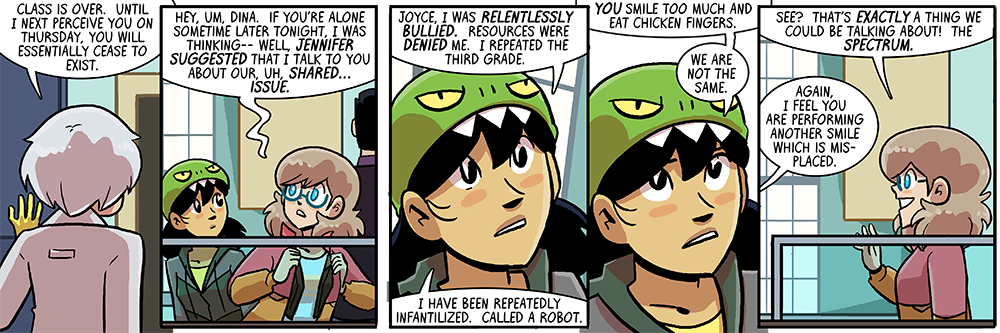
I think people are forgeting who the person who called Dina a robot is. And I’m pretty sure she’s one of the people who’s infantalised her in the past too. Joyce is fucking out of line and there’s no reason to be insulting Dina here.
Nicoleandmaggie
Ditto on the Dina doesn’t need to help someone who called her a robot. Seriously.
Joyce, go find an online forum or something.
Autogatos
I think Marilius’ critique of Dina here is a bit excessively harsh, though I very much understand the emotions behind it. Dina IS being problematic in dismissing Joyce’s experience. It’s a form of lateral ableism, and unfortunately a very common one. This sort of attitude doesn’t help the disability community as a whole, it only furthers stigma and bias that makes it difficult for people with less obvious struggles to be believed/taken seriously, and it especially hurts when it comes from within your own community.
That said, I think it’s a bit of a stretch to judge her as callous and cruel as a whole because of this response. I don’t think Dina’s response is intended to come from a place of apathy or cruelty, but from frustration and resentment. She is a person who has very obviously struggled with how her autism affects most aspects of her life, and has not received any external support (beyond, presumably, that of her awesome parents). That is a very insulating and frustrating thing. It does not *justify* her dismissal of Joyce’s experience here, but it does explain it. I don’t think she would respond the same way if she had a proper support system. In my experience, this kind of resentful lateral ableism is very common among disabled people who feel like they have no recourse, no support, and don’t see their situation changing any time soon despite their best efforts. Dina’s anger is very justified, even if she is misdirecting it and placing it unfairly onto joyce.
That said, I also disagree with the comments that Joyce is out of line for simply asking Dina if she can talk to her about autism. Dina previously inserted her own experience into Joyce’s convo about her referral so it’s not unreasonable for someone to take that as an indicator that person is willing to talk about this issue further.
Additionally Billy/Jennifer told Joyce to do this, and Dina is currently the only person Joyce knows who also likely has autism. Expecting Joyce, who has had a lot of new info dumped on her pretty fast, and who grew up fairly sheltered and without much experience seeking support outside her church community, to know she can go online to find support, is a bit unrealistic.
Joyce and Dina have both been tactless with each other in the past. Dina herself has shown up (while Joyce was not feeling well) to question her pretty critically and intensely about her upbringing, which might also be arguably a violation of boundaries for some people. They’ve never had a frank discussion about their issues with each other. Joyce has been rude and dismissive to Dina about her social issues, Dina has been rude and condescending to Joyce about her religious upbringing. Neither character is perfect. Both have a lot to learn.
Dina is 100% within her rights to set a boundary here. She is by no means obligated to have this conversation with Joyce. But I also can’t blame Joyce for not automatically knowing Dina wouldn’t want to talk about this and I think it’s unfair to say it’s out of line for her to just ask the question. If she kept pushing after Dina said no, that would be out of line (and who knows maybe she will, maybe she won’t) but just asking the one person she knows with autism if they can talk about their likely shared diagnosis is a very normal thing to do.
StClair
Autogatos: I agree.
Psychie
Also speaking as an Autist here, and directly responding to The Wellerman, since the comment alignment format here likely won’t make that clear.
When others are talking about degree, or using the term spectrum, they aren’t discounting the many and varied factors that make all of us on the spectrum different, they are merely referencing a specific one, and arguably the most objective, easily “measured” one. Our level of functioning in society. The two “ends” of the spectrum are low-functioning and high-functioning, and *because* there’s such a large number of ways that each of our cases are different, that’s kind of the only way we *can* be categorized. It’s also, from the perspective of the neurotypical, the most important descriptor that distinguishes us, because it determines how much help we might require (remember, the people to coin this terminology were *doctors*, so they mostly care about what needs to be done to help).
Joyce may be on the spectrum, but she’s on the *high* functioning end, while Dina, while not *especially* low-functioning, is quite clearly lower on that spectrum, and as such it is incredibly frustrating that someone who, from Dina’s perspective, is so incredibly privileged as to be sufficiently high-functioning that nobody noticed until now is coming to *her* for help. The severity is the *root* of her issue here, so it’s only natural that that is the difference that is largely in discussion here.
I get what you’re trying to say, but there’s something really off to me about referring to Dina as being “lower functioning” than Joyce. Or anyone for that matter.
Personally I REALLY hate the high-functioning/low-functioning concept, and many autistic people and activists do as well. Support needs differ WILDLY, and people can be what would be considered ‘high-functioning’ in some areas and ‘low-functioning’ in others simultaneously. We usually say that it’s a spectrum in that there’s such a wide range of traits associated with being autistic (often with associated traits at either extreme of an option – sensory seeking vs aversion, or low empathy and hyperempathy both being considered ‘autistic traits’,) and we all have different toppings from the ice cream buffet of Autism Stuff. Some of us have higher support needs than others, some of us can mask better, but those two things can coexist simultaneously, we’re not “less autistic” if we can mask.
The saying I’ve heard on a few occasions is that “high-functioning” is frequently a term used to deny support (because you don’t REALLY need that accommodation,) where “low-functioning” is used to deny agency (because you can’t POSSIBLY advocate for yourself or hold opinions if you’re nonspeaking, or have an intellectual disability, or need help with tasks of daily living.) Both are significant problems!
Like, it is totally possible to be a nonspeaking autistic who lives independently and can hold a job, or to be capable of masking in public but unable to live independently. There are autistic activists who need full-time aid to help them do things like use the bathroom, but are still perfectly capable of expressing their needs. Autistics with intellectual disabilities who, again, are making themselves heard and can be less heavily impacted in another sphere (and the greater community is not always great about making sure they’ve got a place at the table, too.) We’re all still equal parts autistic as each other, because autism cannot be measured, it simply Is A Thing We Are.
That said, I DO think Dina and Joyce both might be thinking of this under the “more or less autistic” model, because they’re both teenagers who maybe haven’t read up as much on that sort of theory as I, an autistic whose special interests INCLUDE autism, have. Which is an understandable thing for both fictional characters and humans, because it’s not the way current discussions tend to frame things outside our community, but that’s why I’m willing to wade into this 500-something comment section and go into Education Mode. For future reference: A whole lot of us don’t like that because it is not just used to harm us, it is also wildly reductive and wrong! And now you know.
Responding to Regalli (I really wish I could just
click respond to whoever I wanted) – I agree, I read
a post on tumblr about how the high/low functioning label
is a lose-lose situation. I think it had recommended just
labelling the amount of support that someone with autism
needs instead (needs aid, needs nonverbal support,
needs to be removed from overwhelming stimuli, etc.).
Unfortunately, that doesn’t come with a convenient short-hand
label, but that way it doesn’t lead to those choices of losing
support or losing autonomy.
Also, I never liked the stigma that comes with the low functioning
term either, or how some autistic people I read about used
those terms to be condescending, e.g. “I’m not like those autistics, I’m high functioning.”
Responding to Autogatos (really would like to
respond directly still) – I fully agree with your assessment.
Dina is being harsh, but she is still upset with how easily
it was for Joyce to be diagnosed, while she
struggled for diagnosis (and still hasn’t received it). And while
it may not be nice for Dina to not offer conversation with Joyce about
this at this time, she’s well within her rights not to.
I also agree with you that Joyce wasn’t crossing a line or anything
to want to talk with Dina about this. They have both been dismissive
of each other in the past (Joyce regarding her upbringing and beliefs,
Dina for her behaviors and acceptance of evolution), but they still seem
to be on talking terms to me. Acquaintance-level at least, with more
knowledge of each other possibly due to close living spaces.
So in short, your takes are hot and your frontal lobes are huge 😛
davidbreslin101
Having spent some time on autism forums, I’ve noticed we are pretty damned good at annoying each other.
I would ask anyone who is jumping on the DINA IS BENG SUCH AN ASS bandwagon to please imagine it this way:
An unpleasant rival or bully from your own past has just gotten up in your grill all “get this man we have the SAME PROBLEM! We can BOND over this! Isn’t that GREAT??? We’re the same!”
This person isn’t a friend. You kind of hate them. You want them to go away. They have repeatedly mistreated you.
Are you really gonna be all eager to open up to them? Be honest.
Taffy
Dina’s not remotely being an ass and people are being overdramatic about this. You nailed their dynamic perfectly.
Needfuldoer
Exactly! Their lived experiences aren’t relatable.
Joyce would be better off talking with Joe, or maybe an actual psychologist instead of just taking a general practitioner’s hunch as gospel.
thejeff
Sure, but lets be realistic here. Even with referral in hand, talking to an actual psychologist is probably months away. Doesn’t solve her problems now.
Talking to Joe might be good, but it’s not a conversation Joe’s going to be at all comfortable with. Talking to Dina was actually a good idea and one suggested to her earlier. It obviously fell through.
Bleuryder
Maybe not. I might be stretching a bit here, but Joyce even has the upper hand in talking to a psychologist. Since she was involved in the kidnapping incident AND has a referral, the school could front line her to a psychologist ASAP. While Dina wouldn’t have that advantage, as she wasn’t as directly involved in the incident as Joyce was.
Vanessa
Well at least Joyce didn’t wait until Dina was sick and in pain to literally sit on her and demand Dina satisfy her curiosity. What Joyce said to Dina then was rude but Dina richly deserved a tell-off and is lucky Joyce was too sick to violently toss her off the top bunk or punch her in the face.
It’s good Dina is honest here, but she also needs to stop eves-dropping on Joyce, following her around in hopes of seeing some juicy drama, inserting herself into Joyce’s private and fraught conversations, and breaking into her room. No wonder Joyce thought Dina would talk to her.
Chromatic Roses
how does literally everyone not notice that dina got off her. dina was literally doing the social action that she thought joyce wanted- its not her fault joyce isnt communicating to people that she’s changed and doesn’t want those things anymore.
Sol
I don’t think Dina was ever actually sitting on Joyce, either. It looked more like she was hovering over her; arms on either side of Joyce’s body, and possibly legs on either side of Joyce, too, by the looks of some of the panels (we don’t ever get a good look at the composition).
StClair
> how does literally everyone not notice that dina got off her.
Eventually. Joyce said that she was in pain and asked/told Dina to get off her, and Dina’s reply was “not until you answer my question.” Satisfying her curiosity was more important than Joyce’s discomfort or her request.
Chromatic Roses
dang youre like really stuck on dina sitting on joyce, huh. i hope you expend all that energy for the many, many times joyce did the exact same thing dina did to her to other people.
Bryy
Uh, assault is never good.
Ladymissfit
Rude? It’s a slur
Taffy
Don’t you know? People only deserve not to get called slurs (and misgendered, while I’m on this) when you’re not personally irritated with them.
I’d mark this with /s, but most people here are smart enough not to need it.
Autogatos
A think that I think keeps getting left out of this convo is: I’m not sure Dina has ever made it clear how she feels about Joyce. She has been perfectly willing to talk to Joyce about stuff and ask HER questions about her and Becky’s upbringing in the past. She obviously had issues with Joyce’s religious beliefs and how dogmatic and preachy Joyce was about them, but Joyce is changing in that respect. (Granted Joyce has shifted to being dogmatic and preachy about atheism but I don’t really see that bothering Dina).
This comic has been going long enough that it’s hard to remember every interaction but I find it odd everyone is suddenly like “Joyce should know not to talk to Dina because Dina hates her.” They’ve had some tension, on both sides, but to me it’s very unclear where they stand in general and it seems like it can vary from cordial to tense at any given moment.
And while it is very reasonable for Dina to set a boundary when she doesn’t want to talk about something, taking it as far as saying Joyce should know better than to ask her this because of their rivalry, when Dina seems able to set it aside when SHE wants to know something, seems fairly unfair.
Autogatos
*a thing, not a think. Omg why can’t I type today?
Slarstorm
Has Joyce ever actually mistreated Dina in any meaningful way, though? The worst I can remember is her being vaguely dismissive of her, infantized her, maybe?
It seems to me Dina’s just projecting her own bad experiences onto Joyce and antagonizing her because she’s been more fortunate in having her condition identified and acknowledged, but that really isn’t Joyce’s fault at all. If anything, that’s a societal problem or maybe just circumstantial.
You don’t treat people with scorn just because they’re more fortunate or more privileged than you, okay? Those things only become a problem in the first place when they’re used as a justification to mistreat and exploit people.
Dina’s feelings are understandable, but I feel she’s absolutely in the wrong here. If Joyce has anything to learn, it’s to be more aware and considerate of other people’s circumstances, which to be perfectly honest, is a lesson just about anyone else in the comic could stand to learn tbh.
Segnosaur
People have pointed out a few times when Joyce has treated Dina badly ..
– when she first introduced Becky to the floor she was rather dismissive of her beliefs in evolution (and talked about her like she wasn’t there)
– during the dorm party (where Dina and Becky first interacted) she was part of the group who made a comment about how young/underage Dina acts
– most recently she said Dina was like a “robot”
You also have the fact that Becky probably still has romantic feelings towards Joyce
Twitcher
I like Joyce. I think she’s doing her standard innocently insensitive schtick here. That said, I have cerebral palsy, also a spectrum disorder. If Joyce called me a cripple or a retard, even in innocent ignorance, then after that got hit by a semi and ended up paralyzed from the waist down and went, “Hey, samesies?” I would be, like Dina, a bit annoyed.
Dan
It’s understandable, but it’s also a textbook case of not seeing the hidden struggles.
Joyce doesn’t only talk a lot and eat chicken fingers. She has crippling anxiety about numerous things. She has plenty of awkwardness in social situations, but just masks it. She gets hyperfixated on things maybe even more than Dina.
It’s not a contest, of course. But Dina is making the assumption that everything has been peachy keen wonderful for Joyce.
Do you think Dina is being a shit? I think she’s being reasonable with a really difficult topic. Dina feels jealous and complicated, and she doesn’t really want to teach Joyce about Autism. That should be OK.
Xujhan
The implication that Joyce has been playing autism on Easy Mode ™ is a little uncool. It’s completely understandable given everything that’s happened between the two, and a very minor offense in the grand scheme of things, but a little uncool all the same. That said, actually declining the request is completely fair. No one is obligated to have emotionally difficult conversations, and especially not with people they aren’t close to.
ischemgeek
At the same time, from Dina’s POV Joyce HAS.
Dina isn’t close to Joyce and doesn’t see how severely her sensory issues affect her eating, how Dorothy, Sarah and Becky all treat her as a child, or how being autistic certainly affected her upbringing (which is certainly why Joyce smiles all the time, because women aren’t allowed negative emotions).
She just sees that Joyce eats chicken fingers and smiles all the time. And that, unlike her, Joyce was able to fit in and build a strong network of friends whereas Dina still feels very much an outcast.
ischemgeek
None of which is necessarily true, it’s just what Dina has visibility to.
Autogatos
I would argue it’s more than a little uncool. It’s lateral ableism and literally the sort of thing that contributes to abled bias against people with invisible or not readily obvious disabilities. Dina is ironically doing the very same thing to Joyce that has been done to her in the past: assuming things about her struggles and downplaying/dismissing them based on her own biases about who Joyce is and what her life has been like.
That said I agree with everything else. Dina is not obligated to engage Joyce socially if she doesn’t want to. Setting boundaries with someone you don’t like, who has been offensive to you in the past, is completely reasonable.
But it just disturbs me how many people here are agreeing with the idea that Joyce has been doing autism on “easy mode” as you put it here and/or kind of implying that she hasn’t really struggled or that her struggles are somehow less valid than Dina’s.
I completely understand Dina’s resentment. It’s a natural response, and I’ve been in both sides of it: seeing someone who seems to be struggling less get support and acknowledgement you never did really sucks, but at the same time it’s not that person’s fault, and it’s not fair to make those assumptions, as I’ve ALSO been the person told my experiences/complaints are invalid because someone else perceived their struggles as having been worse because they are more obvious and visible and they think being good at “hiding” or “passing” for normal must mean it doesn’t affect me significantly or cause any trauma (which is very very wrong).
Hello
I think another aspect is also that Joyce was completely unaware some of her behavior and struggles could be because of possible autism (because so many people in comments seem to forget she wasn’t actually diagnosed, a gynecologist with an autistic daughter suspected it, that’s hardly someone qualified to diagnose, though certainly to bring up the possibility)
But Joyce tries to reconcile all her behavior with what’s “normal” and lived under the assumption how her life and childhood was just “how it’s supposed to be.” She’s been having to confront with very much very fast how fucked up things were and now there’s a possibility that there was an underlying condition that might have been a factor in that.
I was initially diagnosed with ADHD at 19 in my first appointment with a (male) psychologist so I’ll admit, I never really related to the experience that women have more difficulty being diagnosed. Even so, it was my decision to treat my anxiety and depression over the ADHD because I didn’t think it factored heavily in my life (because info wasn’t as available back then as it was now, so I really thought it was a minor inconvenience kind of thing). The depression turned out to be bipolar, so the worry that a stimulant would essentially turn my depression to bipolar was kind of moot.
I was still 27 when I decided to ask my doctor about starting on adderall because I’d been reading more and realized that literally *every major issue* I had affecting my life aligned with ADHD. I thought there was just something *wrong* with me and I was actually fully capable of doing things and there was no reason I was just not able to. I didn’t know they were all connected until I researched and started medicating and focusing therapy on managing the ADHD instead of the individual behaviors in isolation from each other.
So the fact that Joyce hasn’t had more than what, 2 days? to even learn enough about how being autistic could have affected her behavior or why some things are more difficult or why she has to force herself through things or that any of those things could be connected makes it pretty easy to write her off, and possibly with her agreeing, as having been Easy Mode Autistic based on superficial aspects and not what she’s had to struggle with to both fit the expectations of her religious community and family, but also under the assumption she’s neurotypical.
Samantha
Yes she is. She being petty and bigoted because she feels Joyce had life too easy because her issues are not exactly the same. It’s understandable and she has every right to be pissed about how her race and her appearance led to her issues being dismissed but she’s being as ass still because of it. It reads poorly even if she isn’t incorrect.
RedCat
Definitely. But it’s possible for her to be both reasonable in her rejection AND kinda mean, maybe without meaning to.
No she’s not! What the hell? She asked if they could have a conversation. Dina said no and left. That’s the entirely of this interaction so far.
Vanessa
Dina owes Joyce after breaking into her room and demanding by force that Joyce educate her on abusive evangelical child-rearing practices .
Andy
No, Dina does not owe Joyce. That’s a really shitty and manipulative way to look at things. “You did something mean to me so now you have to do what I want, even if it makes you uncomfortable, to make up for it.”
Bryy
Thanks for putting into words what I’m really just to angry to write coherently.
Shade
You mean where she imitated what Joyce did to people assuming Joyce would be okay with it because its what she does?
Needfuldoer
She left the “WAKEY-WAKEY CHICKEN BAKEY” part out. Next time it might work if she follows the whole procedure.
Autogatos
No one ever “owes” someone else a conversation if they feel uncomfortable with it. Dina is not wrong to set a boundary. EVEN if she violated a boundary for Joyce earlier. 2 wrongs don’t make a right.
Autogatos
That said I strongly disagree that Joyce is “asking dina to do emotional labor.” Joyce’s question is not unreasonable. Dina saying no is not unreasonable, even if I feel her dismissal of Joyce’s experience is problematic. Both these things can be true.
zee
Nah and your takes a just bad my G
Leorale
Cerusee and Sajuuk-Khar: Ask Culture vs Guess Culture?
Cerusee
you’ve left out “alternate universe fanfic I made up in my own head to justify my point of view” culture
Needfuldoer
As someone from an Ask house, Guess Culture is baffling. Can the passive-aggressive beating around the bush and just articulate what you want!
Sajuuk-Khar
She asked if they could have “a conversation” about their potential “shared” autism, which was and is transparently a request for advice/support/coping mechanisms, and is clearly a subject Dina has personally struggled with extremely and has been wounded on in the past.
Like, if that’s not asking Dina to do emotional labor, I don’t know what you’d call it?
Yeah, Dina turned her down immediately (as is her right) and it’s not like Joyce is a criminal, it’s just a bad look (at least from Dina’s perspective) and a bad idea.
Cerusee
I would call if “asking if they could talk about a subject they’d recently mutually realized they might have in common, and that Dina had very, very much showed an interest in talking about with Joyce, even though Joyce didn’t actually bring it up with Dina”.
It’s fine that Dina shut it down, agreed. I vehemently disagree with the characterization that asking was an overstep on Joyce’s part, or that she was asking Dina to perform emotional labor for her by asking if Dina wanted to, essentially, keep up a conversation that DINA STARTED.
Random832
Dina didn’t actually want a conversation. She just wanted to gripe about how much easier it was for Joyce to get a diagnosis (not that she actually has a diagnosis yet or anything, and if it was so fucking easy why didn’t it happen until she was eighteen? at this point all that’s actually happened for Joyce is one (1) non-peer adult has said she might have it. A number which is half what it was for Dina at a younger age.)
Ok I’ve never heard of this but this explains SO much to me. I’m probably more of an asker but also I am often too afraid to ask BECAUSE of getting negative responses from people. But I honestly very much prefer to ask things. For information, for help, for favors, for things. I struggle with finding the line between a good ask and a bad ask. Sometimes when I finally ask the other party is so relieved I finally did and are more than happy to accommodate me and it’s such a bizarre feeling.
Note that as that article states there are things to like – but there are also some rabbit-holes.
As someone who’s AS myself, I know very well that ecstatic feeling when you find a new resource that Explains How Things Work – I just wanted to wave a gentle ‘caution’ flag based on finding that same site for myself in past history.
To be very clear, that not to say it’s not being offered in good faith, nor that I suspect any motives other than wanting to help, it’s just that I’dve wanted to have known some of this, way back when…
That need to be honest gets me in trouble sometimes – let’s see if I’m taken as intended here?
eh, whatever
This article is merely incomplete: yes, as it speculates, ask vs. guess also applies to whole cultures. Perhaps start here.
Strangely, there doesn’t seem to be a Wikipedia article on this topic.
eh, whatever
That particular LessWrong post, I mean, is merely incomplete.
George the Archon
@eh, whatever
It was more of a general caution – and of course I’d say ‘take what’s useful, discard what’s not, check the implicit assumptions – and the sources’ (or something like that, I’m tired) about anything. Because that’s me. ?
Sincere thanks for the link, that’s actively useful. I loved that it mentioned autism as I know autistic folks that swing strongly in both extremes in that model. (Which of those is me, I leave as an exercise to the reader. ?)
On this specific case, I think it’s one of those ‘useful way of looking at things, as a general idea’ like lots of things are, but again, pretty much every model we make is an incomplete ‘map of the actual territory’ – and that is no criticism either! Wisdom is knowing the limits of the map. ?
But now I wander all over the place. Really shouldn’t post while running a temperature. Thanks for engaging!
Becci
For some reason can’t reply lower down the chain, but thanks for your addition! I haven’t read much, and the small amount I have read has seemed good on Less Wrong but this is really useful context for deciding how much to delve further on it
thakoru
I actually really like how the “asking” paradigm frames this strip’s exchange. Joyce made a request of Dina, Dina, in so many words, said no. Neither has does anything wrong. Everyone can chill.

686 thoughts on “Perceive”
Ana Chronistic
my uncle’s gf, “HEY YOU WOULD TOTALLY LIKE KALIFORNIA”
me (unsaid): “wtf this movie is a piece of shit EVEN WITH DUCHOVNY AND PITT”
gf: “WASN’T THAT GREAT???”
Joyce: *EFF YEAH BONDING THROUGH EXTREMELY TENUOUS CONNECTION ONLY I CAN PERCEIVE*
Bryy
It’s ridiculous how that movie was in production before he got The X-Files.
BBCC
Joyce, you should definitely talk to someone who is also autistic about this if it feels like something that could be helpful.
I SERIOUSLY don’t think Dina should be that person right now
Vanessa
Someone who isn’t being a shit.
Thag Simmons
I think Dina’s position is pretty understandable
not someone else
Also correct. Joyce absolutely should speak to someone, but there are differences in kind and degree here that reasonably make Dina… not super capable of helping without hurting herself. And despite Dine being blunt about it, that would not be cool.
The Wellerman
THIS.
We autistics are not only different from neurotypicals, but also each other, hence, neuro-diversity.
For sure Dina has a thorough understanding of neurodivergence and how it works (to say the least), and did a really good job of informing Joyce that they are NOT going to automatically get along better on account of their autism.
MisterJinKC
I don’t think that’s what Joyce was going for. I think Joyce is trying to learn by asking someone who is actually living with the issue. The degree to which they’re affected is very different, but trying to talk to the only person you know with actual experience is reasonable. Dina isn’t a perfect fit,, but she’s the closest available. That said, Dina has no obligation to help her.
The Wellerman
First of all, “degree” seems to imply that the autism experience exists on a single dimension, which it clearly doesn’t. Neurodiversity, including the stripes that fall into the autism category, have many dimensions to how they effect each other in individuals, which is why I find terms like “spectrum” really misleading.
Dina understands that Joyce never put that much effort into her relationship with her, and is evidently only putting in that effort now because she assumes it’s gonna be easier to bond on account that they’re both autistic.
I totally get Dina’s response here, I also hate these kinds of hurtful assumptions, especially when made by someone I would barely call my friend.
marillius
Joyce is asking for help with a problem she has even having trouble accepting about herself, but which would also help her be infinitely more aware of her issues and understand more about herself. If she is also trying to befriend Dina, that is not a problem, that is a natural part of the human existence.
As an autistic who didn’t discover what I was until I was 18, I can flat out tell you that Dina is a fucking conga right now for assuming that Joyce didn’t suffer in ignorance. Being labeled, despite the preconceptions it brings, at least also brings understanding. I went through an extremely troubled youth without ever knowing why I was different and failing to grasp things. Joyce herself was literally brainwashed, and more susceptible to it then most, because of her issues.
Dina is being a bongo, which is sad to see coming from a character that I believe tends to be fairly logical, but the signs were always kind of there that she can be extremely callous and cruel if someone has earned her disfavor.
Proxiehunter
I think people are forgeting who the person who called Dina a robot is. And I’m pretty sure she’s one of the people who’s infantalised her in the past too. Joyce is fucking out of line and there’s no reason to be insulting Dina here.
Nicoleandmaggie
Ditto on the Dina doesn’t need to help someone who called her a robot. Seriously.
Joyce, go find an online forum or something.
Autogatos
I think Marilius’ critique of Dina here is a bit excessively harsh, though I very much understand the emotions behind it. Dina IS being problematic in dismissing Joyce’s experience. It’s a form of lateral ableism, and unfortunately a very common one. This sort of attitude doesn’t help the disability community as a whole, it only furthers stigma and bias that makes it difficult for people with less obvious struggles to be believed/taken seriously, and it especially hurts when it comes from within your own community.
That said, I think it’s a bit of a stretch to judge her as callous and cruel as a whole because of this response. I don’t think Dina’s response is intended to come from a place of apathy or cruelty, but from frustration and resentment. She is a person who has very obviously struggled with how her autism affects most aspects of her life, and has not received any external support (beyond, presumably, that of her awesome parents). That is a very insulating and frustrating thing. It does not *justify* her dismissal of Joyce’s experience here, but it does explain it. I don’t think she would respond the same way if she had a proper support system. In my experience, this kind of resentful lateral ableism is very common among disabled people who feel like they have no recourse, no support, and don’t see their situation changing any time soon despite their best efforts. Dina’s anger is very justified, even if she is misdirecting it and placing it unfairly onto joyce.
That said, I also disagree with the comments that Joyce is out of line for simply asking Dina if she can talk to her about autism. Dina previously inserted her own experience into Joyce’s convo about her referral so it’s not unreasonable for someone to take that as an indicator that person is willing to talk about this issue further.
Additionally Billy/Jennifer told Joyce to do this, and Dina is currently the only person Joyce knows who also likely has autism. Expecting Joyce, who has had a lot of new info dumped on her pretty fast, and who grew up fairly sheltered and without much experience seeking support outside her church community, to know she can go online to find support, is a bit unrealistic.
Joyce and Dina have both been tactless with each other in the past. Dina herself has shown up (while Joyce was not feeling well) to question her pretty critically and intensely about her upbringing, which might also be arguably a violation of boundaries for some people. They’ve never had a frank discussion about their issues with each other. Joyce has been rude and dismissive to Dina about her social issues, Dina has been rude and condescending to Joyce about her religious upbringing. Neither character is perfect. Both have a lot to learn.
Dina is 100% within her rights to set a boundary here. She is by no means obligated to have this conversation with Joyce. But I also can’t blame Joyce for not automatically knowing Dina wouldn’t want to talk about this and I think it’s unfair to say it’s out of line for her to just ask the question. If she kept pushing after Dina said no, that would be out of line (and who knows maybe she will, maybe she won’t) but just asking the one person she knows with autism if they can talk about their likely shared diagnosis is a very normal thing to do.
StClair
Autogatos: I agree.
Psychie
Also speaking as an Autist here, and directly responding to The Wellerman, since the comment alignment format here likely won’t make that clear.
When others are talking about degree, or using the term spectrum, they aren’t discounting the many and varied factors that make all of us on the spectrum different, they are merely referencing a specific one, and arguably the most objective, easily “measured” one. Our level of functioning in society. The two “ends” of the spectrum are low-functioning and high-functioning, and *because* there’s such a large number of ways that each of our cases are different, that’s kind of the only way we *can* be categorized. It’s also, from the perspective of the neurotypical, the most important descriptor that distinguishes us, because it determines how much help we might require (remember, the people to coin this terminology were *doctors*, so they mostly care about what needs to be done to help).
Joyce may be on the spectrum, but she’s on the *high* functioning end, while Dina, while not *especially* low-functioning, is quite clearly lower on that spectrum, and as such it is incredibly frustrating that someone who, from Dina’s perspective, is so incredibly privileged as to be sufficiently high-functioning that nobody noticed until now is coming to *her* for help. The severity is the *root* of her issue here, so it’s only natural that that is the difference that is largely in discussion here.
Needfuldoer
Thank you.
The Wellerman
I get what you’re trying to say, but there’s something really off to me about referring to Dina as being “lower functioning” than Joyce. Or anyone for that matter.
https://www.dumbingofage.com/2015/comic/book-5/03-the-butterflies-fly-away/hypotheses/
Regalli
Personally I REALLY hate the high-functioning/low-functioning concept, and many autistic people and activists do as well. Support needs differ WILDLY, and people can be what would be considered ‘high-functioning’ in some areas and ‘low-functioning’ in others simultaneously. We usually say that it’s a spectrum in that there’s such a wide range of traits associated with being autistic (often with associated traits at either extreme of an option – sensory seeking vs aversion, or low empathy and hyperempathy both being considered ‘autistic traits’,) and we all have different toppings from the ice cream buffet of Autism Stuff. Some of us have higher support needs than others, some of us can mask better, but those two things can coexist simultaneously, we’re not “less autistic” if we can mask.
The saying I’ve heard on a few occasions is that “high-functioning” is frequently a term used to deny support (because you don’t REALLY need that accommodation,) where “low-functioning” is used to deny agency (because you can’t POSSIBLY advocate for yourself or hold opinions if you’re nonspeaking, or have an intellectual disability, or need help with tasks of daily living.) Both are significant problems!
Like, it is totally possible to be a nonspeaking autistic who lives independently and can hold a job, or to be capable of masking in public but unable to live independently. There are autistic activists who need full-time aid to help them do things like use the bathroom, but are still perfectly capable of expressing their needs. Autistics with intellectual disabilities who, again, are making themselves heard and can be less heavily impacted in another sphere (and the greater community is not always great about making sure they’ve got a place at the table, too.) We’re all still equal parts autistic as each other, because autism cannot be measured, it simply Is A Thing We Are.
That said, I DO think Dina and Joyce both might be thinking of this under the “more or less autistic” model, because they’re both teenagers who maybe haven’t read up as much on that sort of theory as I, an autistic whose special interests INCLUDE autism, have. Which is an understandable thing for both fictional characters and humans, because it’s not the way current discussions tend to frame things outside our community, but that’s why I’m willing to wade into this 500-something comment section and go into Education Mode. For future reference: A whole lot of us don’t like that because it is not just used to harm us, it is also wildly reductive and wrong! And now you know.
The Wellerman
Thank you, Regs. This was very much needed. ?
Caro
the comments here seriously need those little lines like tumblr has
Jade
Responding to Regalli (I really wish I could just
click respond to whoever I wanted) – I agree, I read
a post on tumblr about how the high/low functioning label
is a lose-lose situation. I think it had recommended just
labelling the amount of support that someone with autism
needs instead (needs aid, needs nonverbal support,
needs to be removed from overwhelming stimuli, etc.).
Unfortunately, that doesn’t come with a convenient short-hand
label, but that way it doesn’t lead to those choices of losing
support or losing autonomy.
Also, I never liked the stigma that comes with the low functioning
term either, or how some autistic people I read about used
those terms to be condescending, e.g. “I’m not like
those autistics, I’m high functioning.”
Jade
Responding to Autogatos (really would like to
respond directly still) – I fully agree with your assessment.
Dina is being harsh, but she is still upset with how easily
it was for Joyce to be diagnosed, while she
struggled for diagnosis (and still hasn’t received it). And while
it may not be nice for Dina to not offer conversation with Joyce about
this at this time, she’s well within her rights not to.
I also agree with you that Joyce wasn’t crossing a line or anything
to want to talk with Dina about this. They have both been dismissive
of each other in the past (Joyce regarding her upbringing and beliefs,
Dina for her behaviors and acceptance of evolution), but they still seem
to be on talking terms to me. Acquaintance-level at least, with more
knowledge of each other possibly due to close living spaces.
So in short, your takes are hot and your frontal lobes are huge 😛
davidbreslin101
Having spent some time on autism forums, I’ve noticed we are pretty damned good at annoying each other.
The Wellerman
BTW for the record I totally called this months ago:
https://www.dumbingofage.com/2022/comic/book-12/04-dont-stop-billie-ving/prettysolidevidence/#comment-1639246
Sajuuk-Khar
I would ask anyone who is jumping on the DINA IS BENG SUCH AN ASS bandwagon to please imagine it this way:
An unpleasant rival or bully from your own past has just gotten up in your grill all “get this man we have the SAME PROBLEM! We can BOND over this! Isn’t that GREAT??? We’re the same!”
This person isn’t a friend. You kind of hate them. You want them to go away. They have repeatedly mistreated you.
Are you really gonna be all eager to open up to them? Be honest.
Taffy
Dina’s not remotely being an ass and people are being overdramatic about this. You nailed their dynamic perfectly.
Needfuldoer
Exactly! Their lived experiences aren’t relatable.
Joyce would be better off talking with Joe, or maybe an actual psychologist instead of just taking a general practitioner’s hunch as gospel.
thejeff
Sure, but lets be realistic here. Even with referral in hand, talking to an actual psychologist is probably months away. Doesn’t solve her problems now.
Talking to Joe might be good, but it’s not a conversation Joe’s going to be at all comfortable with. Talking to Dina was actually a good idea and one suggested to her earlier. It obviously fell through.
Bleuryder
Maybe not. I might be stretching a bit here, but Joyce even has the upper hand in talking to a psychologist. Since she was involved in the kidnapping incident AND has a referral, the school could front line her to a psychologist ASAP. While Dina wouldn’t have that advantage, as she wasn’t as directly involved in the incident as Joyce was.
Vanessa
Well at least Joyce didn’t wait until Dina was sick and in pain to literally sit on her and demand Dina satisfy her curiosity. What Joyce said to Dina then was rude but Dina richly deserved a tell-off and is lucky Joyce was too sick to violently toss her off the top bunk or punch her in the face.
It’s good Dina is honest here, but she also needs to stop eves-dropping on Joyce, following her around in hopes of seeing some juicy drama, inserting herself into Joyce’s private and fraught conversations, and breaking into her room. No wonder Joyce thought Dina would talk to her.
Chromatic Roses
how does literally everyone not notice that dina got off her. dina was literally doing the social action that she thought joyce wanted- its not her fault joyce isnt communicating to people that she’s changed and doesn’t want those things anymore.
Sol
I don’t think Dina was ever actually sitting on Joyce, either. It looked more like she was hovering over her; arms on either side of Joyce’s body, and possibly legs on either side of Joyce, too, by the looks of some of the panels (we don’t ever get a good look at the composition).
StClair
> how does literally everyone not notice that dina got off her.
Eventually. Joyce said that she was in pain and asked/told Dina to get off her, and Dina’s reply was “not until you answer my question.” Satisfying her curiosity was more important than Joyce’s discomfort or her request.
Chromatic Roses
dang youre like really stuck on dina sitting on joyce, huh. i hope you expend all that energy for the many, many times joyce did the exact same thing dina did to her to other people.
Bryy
Uh, assault is never good.
Ladymissfit
Rude? It’s a slur
Taffy
Don’t you know? People only deserve not to get called slurs (and misgendered, while I’m on this) when you’re not personally irritated with them.
I’d mark this with /s, but most people here are smart enough not to need it.
Autogatos
A think that I think keeps getting left out of this convo is: I’m not sure Dina has ever made it clear how she feels about Joyce. She has been perfectly willing to talk to Joyce about stuff and ask HER questions about her and Becky’s upbringing in the past. She obviously had issues with Joyce’s religious beliefs and how dogmatic and preachy Joyce was about them, but Joyce is changing in that respect. (Granted Joyce has shifted to being dogmatic and preachy about atheism but I don’t really see that bothering Dina).
This comic has been going long enough that it’s hard to remember every interaction but I find it odd everyone is suddenly like “Joyce should know not to talk to Dina because Dina hates her.” They’ve had some tension, on both sides, but to me it’s very unclear where they stand in general and it seems like it can vary from cordial to tense at any given moment.
And while it is very reasonable for Dina to set a boundary when she doesn’t want to talk about something, taking it as far as saying Joyce should know better than to ask her this because of their rivalry, when Dina seems able to set it aside when SHE wants to know something, seems fairly unfair.
Autogatos
*a thing, not a think. Omg why can’t I type today?
Slarstorm
Has Joyce ever actually mistreated Dina in any meaningful way, though? The worst I can remember is her being vaguely dismissive of her, infantized her, maybe?
It seems to me Dina’s just projecting her own bad experiences onto Joyce and antagonizing her because she’s been more fortunate in having her condition identified and acknowledged, but that really isn’t Joyce’s fault at all. If anything, that’s a societal problem or maybe just circumstantial.
You don’t treat people with scorn just because they’re more fortunate or more privileged than you, okay? Those things only become a problem in the first place when they’re used as a justification to mistreat and exploit people.
Dina’s feelings are understandable, but I feel she’s absolutely in the wrong here. If Joyce has anything to learn, it’s to be more aware and considerate of other people’s circumstances, which to be perfectly honest, is a lesson just about anyone else in the comic could stand to learn tbh.
Segnosaur
People have pointed out a few times when Joyce has treated Dina badly ..
– when she first introduced Becky to the floor she was rather dismissive of her beliefs in evolution (and talked about her like she wasn’t there)
– during the dorm party (where Dina and Becky first interacted) she was part of the group who made a comment about how young/underage Dina acts
– most recently she said Dina was like a “robot”
You also have the fact that Becky probably still has romantic feelings towards Joyce
Twitcher
I like Joyce. I think she’s doing her standard innocently insensitive schtick here. That said, I have cerebral palsy, also a spectrum disorder. If Joyce called me a cripple or a retard, even in innocent ignorance, then after that got hit by a semi and ended up paralyzed from the waist down and went, “Hey, samesies?” I would be, like Dina, a bit annoyed.
Dan
It’s understandable, but it’s also a textbook case of not seeing the hidden struggles.
Joyce doesn’t only talk a lot and eat chicken fingers. She has crippling anxiety about numerous things. She has plenty of awkwardness in social situations, but just masks it. She gets hyperfixated on things maybe even more than Dina.
It’s not a contest, of course. But Dina is making the assumption that everything has been peachy keen wonderful for Joyce.
Leorale
Do you think Dina is being a shit? I think she’s being reasonable with a really difficult topic. Dina feels jealous and complicated, and she doesn’t really want to teach Joyce about Autism. That should be OK.
Xujhan
The implication that Joyce has been playing autism on Easy Mode ™ is a little uncool. It’s completely understandable given everything that’s happened between the two, and a very minor offense in the grand scheme of things, but a little uncool all the same. That said, actually declining the request is completely fair. No one is obligated to have emotionally difficult conversations, and especially not with people they aren’t close to.
ischemgeek
At the same time, from Dina’s POV Joyce HAS.
Dina isn’t close to Joyce and doesn’t see how severely her sensory issues affect her eating, how Dorothy, Sarah and Becky all treat her as a child, or how being autistic certainly affected her upbringing (which is certainly why Joyce smiles all the time, because women aren’t allowed negative emotions).
She just sees that Joyce eats chicken fingers and smiles all the time. And that, unlike her, Joyce was able to fit in and build a strong network of friends whereas Dina still feels very much an outcast.
ischemgeek
None of which is necessarily true, it’s just what Dina has visibility to.
Autogatos
I would argue it’s more than a little uncool. It’s lateral ableism and literally the sort of thing that contributes to abled bias against people with invisible or not readily obvious disabilities. Dina is ironically doing the very same thing to Joyce that has been done to her in the past: assuming things about her struggles and downplaying/dismissing them based on her own biases about who Joyce is and what her life has been like.
That said I agree with everything else. Dina is not obligated to engage Joyce socially if she doesn’t want to. Setting boundaries with someone you don’t like, who has been offensive to you in the past, is completely reasonable.
But it just disturbs me how many people here are agreeing with the idea that Joyce has been doing autism on “easy mode” as you put it here and/or kind of implying that she hasn’t really struggled or that her struggles are somehow less valid than Dina’s.
I completely understand Dina’s resentment. It’s a natural response, and I’ve been in both sides of it: seeing someone who seems to be struggling less get support and acknowledgement you never did really sucks, but at the same time it’s not that person’s fault, and it’s not fair to make those assumptions, as I’ve ALSO been the person told my experiences/complaints are invalid because someone else perceived their struggles as having been worse because they are more obvious and visible and they think being good at “hiding” or “passing” for normal must mean it doesn’t affect me significantly or cause any trauma (which is very very wrong).
Hello
I think another aspect is also that Joyce was completely unaware some of her behavior and struggles could be because of possible autism (because so many people in comments seem to forget she wasn’t actually diagnosed, a gynecologist with an autistic daughter suspected it, that’s hardly someone qualified to diagnose, though certainly to bring up the possibility)
But Joyce tries to reconcile all her behavior with what’s “normal” and lived under the assumption how her life and childhood was just “how it’s supposed to be.” She’s been having to confront with very much very fast how fucked up things were and now there’s a possibility that there was an underlying condition that might have been a factor in that.
I was initially diagnosed with ADHD at 19 in my first appointment with a (male) psychologist so I’ll admit, I never really related to the experience that women have more difficulty being diagnosed. Even so, it was my decision to treat my anxiety and depression over the ADHD because I didn’t think it factored heavily in my life (because info wasn’t as available back then as it was now, so I really thought it was a minor inconvenience kind of thing). The depression turned out to be bipolar, so the worry that a stimulant would essentially turn my depression to bipolar was kind of moot.
I was still 27 when I decided to ask my doctor about starting on adderall because I’d been reading more and realized that literally *every major issue* I had affecting my life aligned with ADHD. I thought there was just something *wrong* with me and I was actually fully capable of doing things and there was no reason I was just not able to. I didn’t know they were all connected until I researched and started medicating and focusing therapy on managing the ADHD instead of the individual behaviors in isolation from each other.
So the fact that Joyce hasn’t had more than what, 2 days? to even learn enough about how being autistic could have affected her behavior or why some things are more difficult or why she has to force herself through things or that any of those things could be connected makes it pretty easy to write her off, and possibly with her agreeing, as having been Easy Mode Autistic based on superficial aspects and not what she’s had to struggle with to both fit the expectations of her religious community and family, but also under the assumption she’s neurotypical.
Samantha
Yes she is. She being petty and bigoted because she feels Joyce had life too easy because her issues are not exactly the same. It’s understandable and she has every right to be pissed about how her race and her appearance led to her issues being dismissed but she’s being as ass still because of it. It reads poorly even if she isn’t incorrect.
RedCat
Definitely. But it’s possible for her to be both reasonable in her rejection AND kinda mean, maybe without meaning to.
StClair
I agree with all of the above responses.
notarobot
If I could link to Proxiehunter’s comment from downthread, I would. Did we forget it was Joyce who called Dina a robot?
Sometimes you’re allowed to be a shit. I believe Dina gets a pass here.
Sajuuk-Khar
Joyce is straight up actually asking Dina to do emotional labor on her behalf! It’s not very cool!
Cerusee
No she’s not! What the hell? She asked if they could have a conversation. Dina said no and left. That’s the entirely of this interaction so far.
Vanessa
Dina owes Joyce after breaking into her room and demanding by force that Joyce educate her on abusive evangelical child-rearing practices .
Andy
No, Dina does not owe Joyce. That’s a really shitty and manipulative way to look at things. “You did something mean to me so now you have to do what I want, even if it makes you uncomfortable, to make up for it.”
Bryy
Thanks for putting into words what I’m really just to angry to write coherently.
Shade
You mean where she imitated what Joyce did to people assuming Joyce would be okay with it because its what she does?
Needfuldoer
She left the “WAKEY-WAKEY CHICKEN BAKEY” part out. Next time it might work if she follows the whole procedure.
Autogatos
No one ever “owes” someone else a conversation if they feel uncomfortable with it. Dina is not wrong to set a boundary. EVEN if she violated a boundary for Joyce earlier. 2 wrongs don’t make a right.
Autogatos
That said I strongly disagree that Joyce is “asking dina to do emotional labor.” Joyce’s question is not unreasonable. Dina saying no is not unreasonable, even if I feel her dismissal of Joyce’s experience is problematic. Both these things can be true.
zee
Nah and your takes a just bad my G
Leorale
Cerusee and Sajuuk-Khar: Ask Culture vs Guess Culture?
Cerusee
you’ve left out “alternate universe fanfic I made up in my own head to justify my point of view” culture
Needfuldoer
As someone from an Ask house, Guess Culture is baffling. Can the passive-aggressive beating around the bush and just articulate what you want!
Sajuuk-Khar
She asked if they could have “a conversation” about their potential “shared” autism, which was and is transparently a request for advice/support/coping mechanisms, and is clearly a subject Dina has personally struggled with extremely and has been wounded on in the past.
Like, if that’s not asking Dina to do emotional labor, I don’t know what you’d call it?
Yeah, Dina turned her down immediately (as is her right) and it’s not like Joyce is a criminal, it’s just a bad look (at least from Dina’s perspective) and a bad idea.
Cerusee
I would call if “asking if they could talk about a subject they’d recently mutually realized they might have in common, and that Dina had very, very much showed an interest in talking about with Joyce, even though Joyce didn’t actually bring it up with Dina”.
It’s fine that Dina shut it down, agreed. I vehemently disagree with the characterization that asking was an overstep on Joyce’s part, or that she was asking Dina to perform emotional labor for her by asking if Dina wanted to, essentially, keep up a conversation that DINA STARTED.
Random832
Dina didn’t actually want a conversation. She just wanted to gripe about how much easier it was for Joyce to get a diagnosis (not that she actually has a diagnosis yet or anything, and if it was so fucking easy why didn’t it happen until she was eighteen? at this point all that’s actually happened for Joyce is one (1) non-peer adult has said she might have it. A number which is half what it was for Dina at a younger age.)
Leorale
https://www.lesswrong.com/posts/vs3kzjLhbdKsndnBy/ask-and-guess
Yotomoe
Ok I’ve never heard of this but this explains SO much to me. I’m probably more of an asker but also I am often too afraid to ask BECAUSE of getting negative responses from people. But I honestly very much prefer to ask things. For information, for help, for favors, for things. I struggle with finding the line between a good ask and a bad ask. Sometimes when I finally ask the other party is so relieved I finally did and are more than happy to accommodate me and it’s such a bizarre feeling.
The Wellerman
Yeah, I get overwhelmed like this too. The times I get these kinds of social cues right it always just feels like lucky guesses.
George the Archon
At the risk of causing offence that really isn’t intended, I feel I still need to point out that Lesswrong should be read with a little care.
https://rationalwiki.org/wiki/LessWrong is debatable, but is a starting point.
Note that as that article states there are things to like – but there are also some rabbit-holes.
As someone who’s AS myself, I know very well that ecstatic feeling when you find a new resource that Explains How Things Work – I just wanted to wave a gentle ‘caution’ flag based on finding that same site for myself in past history.
To be very clear, that not to say it’s not being offered in good faith, nor that I suspect any motives other than wanting to help, it’s just that I’dve wanted to have known some of this, way back when…
That need to be honest gets me in trouble sometimes – let’s see if I’m taken as intended here?
eh, whatever
This article is merely incomplete: yes, as it speculates, ask vs. guess also applies to whole cultures. Perhaps start here.
Strangely, there doesn’t seem to be a Wikipedia article on this topic.
eh, whatever
That particular LessWrong post, I mean, is merely incomplete.
George the Archon
@eh, whatever
It was more of a general caution – and of course I’d say ‘take what’s useful, discard what’s not, check the implicit assumptions – and the sources’ (or something like that, I’m tired) about anything. Because that’s me. ?
Sincere thanks for the link, that’s actively useful. I loved that it mentioned autism as I know autistic folks that swing strongly in both extremes in that model. (Which of those is me, I leave as an exercise to the reader. ?)
On this specific case, I think it’s one of those ‘useful way of looking at things, as a general idea’ like lots of things are, but again, pretty much every model we make is an incomplete ‘map of the actual territory’ – and that is no criticism either! Wisdom is knowing the limits of the map. ?
But now I wander all over the place. Really shouldn’t post while running a temperature. Thanks for engaging!
Becci
For some reason can’t reply lower down the chain, but thanks for your addition! I haven’t read much, and the small amount I have read has seemed good on Less Wrong but this is really useful context for deciding how much to delve further on it
thakoru
I actually really like how the “asking” paradigm frames this strip’s exchange. Joyce made a request of Dina, Dina, in so many words, said no. Neither has does anything wrong. Everyone can chill.