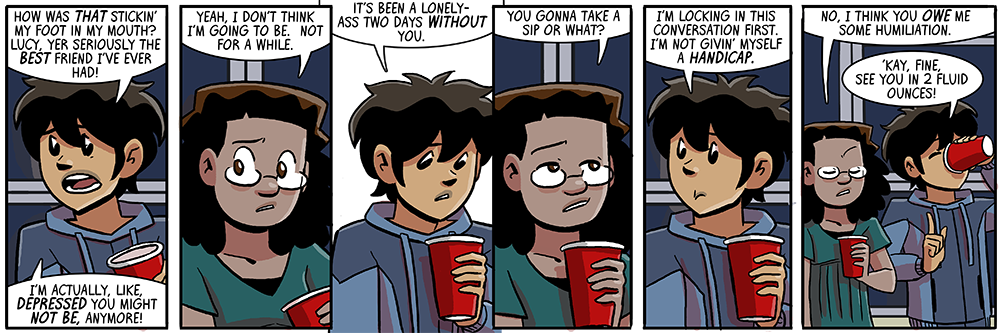
He did genuinely have some kind of feelings for her, even if not Love, he 100% cared about her. They did however not make a good couple, and its smart of him to realize that and only seek a continued Friendship, not anything more.
You know, I have to be with Lucy on this. Mistakes were made on both sides, but if Walky was smart enough to know that Lucy wanted to be more than friends, then he should be smart enough to know it’s too late for the “Let’s just be friends” speech.
Walky and Lucy -never- worked as a couple. She was thirsty, he was…available, I guess, but it always felt kinda gross.
But being -friends-? Sure, why not; they like a lot of the same things and being friends was basically what Walky -always- wanted from the relationship.
Fantastically well put. And also proof that they really shouldn’t have dated in the first place. I hope they can become friends again soon enough. Maybe this drunkeness will see them thru it.
As a correction to myself, when talking of alcohol, in the US, a dram is 1.5 ounces, so 2 fluid ounces would be 1.3333333333… drams
Reltzik
This is the same logic that makes a pound of feathers weigh more than a pound of gold.
GingerMadman
A pound of feathers weighs the same as a pound of gold.
We just like to use dram for 2 different things.
Reltzik
Feathers are weighed with avoirdupois pounds (aka, pounds).
Gold is measured in troy pounds, which weigh less than avoirdupois pounds.
So, same logic.
someone
Fun fact: this kind of bull is the etymological origin of the “double standard” expression. As in, there’s a standard ounce for gold, and a different standard ounce for feathers. Different things get different standards.
Agemegos
Avoirdupois pounds are 7,000 grains, and are divided into 16 ounces, so an avoirdupois ounce is a convenient 437-and-a-half grains. Troy pounds are 5,760 grains and divided into twelve ounces each of 480 grains. A pennyweight is one twentieth of an ounce, which makes a Troy pennyweight 24 grains and an avoirdupois pennyweight 21.875 grains.
Agemegos
But when English pennies were a pennyweight of silver the pennyweight in question was the Tower pennyweight. The Tower pound (obsolete since the time of Henry VIII) was 5,400 grains. It was divided into twelve ounces each of 450 grains, so a Tower pennyweight was 22.5 grains.
GingerMadman
You said pound, not troy pound, when comparing the weight of two different things you would you the same type of measurement.
also, I once again remind everyone that ounces of ALL KINDS are the WORST UNIT. not a worst unit: the worst unit. In modern use. I will reserve space for archaic units being even worse.
I mean, the best (worst) part of oz is that they are actually two different units. Walky of course means fluid oz, that is, 1/8 of a cup. But mass oz (that is, 1/16 of a pound) are an entirely different measurement. That said, 1 fluid oz of water weighs 1 oz. This means that it’s likely that his 2 fluid oz weigh slightly less than 1 oz (since alcohol is lighter than water).
cbwroses
I was today years old…
Agemegos
Sadly, it is slightly worse than that, 1 US fluid ounce of water weighs very nearly, but not exactly, one Avoidupois ounce. You see, the English pint from which the US pint is derived (and which must not be mistaken for the Imperial pint) was designed to be a pound of wine.
Agemegos
Also, “ounces” are more than two units. They are at least five.
There are two different ounces of weight in current use: Avoirdupois ounces and Troy ounces. Troy ounces are 9.7% heavier.
There are three different fluid ounces in use. The Imperial floz. is an Avoirdupois ounce of water. The US Customary floz. is about 4.1% larger (originally supposed to be an Avoirdupois ounce of wine. And then you have the US Food Labelling floz., which is defined as 30 ml and works out to 1.0442 US Customary floz.
For base 21 I think you must be referring to the ‘guinea’.
This monetary lunacy is largely used for things sold to posh gits- race horses, old paintings, expensive sex workers etc. Consider it as a 5% ‘tax’ on said poshies
butting
Ah! That’s the one. I can but plead that I was very sleepy, and that numbers are almost as demented as UK coinage.
Even those of us who still use archaic units like ounces and gallons and… like… pints… quarts… um… cups? teaspoons? tablespoons? have trouble keeping them straight, and god forbid any conversions from one to the other ever need to be done.
pint cup, quater-point nipperkin, half-a-pint, and the brown bowl.
Good luck,good luck to the barley moe.
Fortunately we don’t -actually- use the old pre-reform English system but a slightly reformed one of our own (which is why the US didn’t feel the need to switch to the metric system for commercial reasons; our system was widely enough standardized that it wasn’t a pain point the same way).
StClair
I still remember some of that song, but not nearly as much as I used to.
catch me in the kitchen going “three tisp to the tib, four tibs to the quarter cup”
TCS
To clarify: “tisp” and “tib” are my silly pronunciations of the abbreviations for teaspoon (tsp) and tablespoon (Tbsp), respectively.
Mark
Careful! TiB is also “binary terabytes” — you know: what hard disk buyers think they’re buying, because everything else in a computer is sized by powers of 2, rather than the smaller power-of-10 terabytes that the disk manufacturers use to advertise capacity.
I mean, 12s are divisible by more numbers than 10, so it is easier to get quarters or thirds from them. In that sense, the numerical system we use is more weird in that it is base 10 instead of base 12 or something. I hope back and forth with which is easier to use IRL, with preferring centimeters over inches, feet over meters and Fahrenheit over Celsius. Centimeters and feet are easier for me to figure out or picture over meters and inches, maybe because they are smaller. Fahrenheit is easier for me because there feels like more of a difference to me between 10C and 20C (50F and 68F) than just 10 degrees. I also find it silly that Celsius commonly uses decimal points, like 24.5C to tell an outdoor temperature. I would be more amiable to Celsius if it was 200C for the boiling point of water, rather than just 100, and it would be a more equivalent gradient to Fahrenheit and how we perceive outdoor temperatures (at least imo). Celsius really works better when dealing with larger temperatures, which you might experience while cooking but not for outdoor temperatures, hopefully. Kilometers and miles are both so large that it is hard for me to picture accurately. As for weight and volume, 3 teaspoons in a tablespoon (so you get 1/2 a tablespoon, 1 teaspoon, 1 tablespoon, 1/2 a teaspoon spoons in the store and gives you most of the fractions related to that). Cups, pints, quarts, and gallons are all also easily divisible by eye items (2 cups to a pint, 2 pints to a quart and 4 quarts to a gallon) vs liters and their equivalents. Has anyone actually tried dividing by 10 without using a specific measuring device? Most people can eye about what half of something is when dividing it, but I don’t think that they could easily do a fifth or tenth. Again, imperial units are mostly about practical application and easily finding 3rds or halves vs metric focusing on matching our numerical system. Metric works best in scientific scenarios where exact amounts are needed and a lot of calculations are used.
Thing2
In Australia, it is 4 teaspoons to the tablespoon, and USA teaspoons and etc are a different size to ones in other countries.
In New Zealand shops sell Australian, English and probably USA measuring spoons, without specifying which system they are. Havoc!
Kimi
Interesting. I didn’t know that Australia had a difference. That is good to know.
Lamppost
I see this thing about how Fahrenheit supposedly reflect how we percieve outdoor temperatures more accurately a lot, but the only people I see saying this are the ones who are already used to Fahrenheit ? Like, yeah, 100 is very warm and 0 is very cold makes sense and all, but if you grow up learning that +20 is a nice summer day and -20 is wool o’clock and stay inside, that also makes perfect sense? To me, the metric system works perfectly for measuring outdoor temperature, especially since I live in a colder country..
You can perfectly well divide by halves, quarters and all that using the metric system. We still operate with regular math, it’s just standardised and easier to apply across systems. And since we use it daily, it’s also very intuitive to us. I get incredibly confused with the imperial terms mostly because I’m not used to them.
We also use teaspoons/tablespoons for cooking measurements, I very rarely see units like cl and ml in recipes because there’s no need to be exactly accurate.
I find the imperial system incredibly confusing but I also know that I would find it easier if I grew up using it every day.
eh, whatever
We also use teaspoons/tablespoons for cooking measurements, I very rarely see units like cl and ml in recipes because there’s no need to be exactly accurate.
The shocker here is that Imperial teaspoons and tablespoons are exactly accurate fractions of “cups” or whatever – of course, as mentioned above, not the same fractions in different countries. They have “measuring spoons” with scales on them and shit.
Lamppost
That is wild! A teaspoon is like, whatever goes in the teaspoon you have at hand where I’m from.
Mark
Meanwhile, it seems professional cooks these days eschew all these weird fractions and measure ingredients by weight.

243 thoughts on “Stickin’”
Ana Chronistic
next: Walky shows her his butt
Michael Steamweed
Well, that’s one way to make progress toward the orgy.
(what orgy, you may ask? the one that’s gettin’ suggestions from us one-track-mind types)
Reltzik
Hey now, we’ve got more than one track in our minds.
That’s why Mike’s coming out of witness protection for the orgy.
Michael Steamweed
Why, what a suggestion! Please say more on this novel idea! 😀
CianM1301
I mean, Dina and Becky have made somewhat of a start on that.
ValdVin
Walky’s butt.
darkoneko
-grab popcorn-
pope suburban
Oh lord. Walky no. Not right now, at any rate. Let the poor girl be.
Nono
Was Walky missing Lucy, or just the idea of her being readily accessible?
Thag Simmons
Uh, not entirely sure what you mean by ‘missing the idea of her being readily accessible’.
Switchchris
He did genuinely have some kind of feelings for her, even if not Love, he 100% cared about her. They did however not make a good couple, and its smart of him to realize that and only seek a continued Friendship, not anything more.
Davus
+1, this is good.
DashWallkick
Walky is mature enough at this point to go “yeah we probably should’ve just been friends, dating is where all the bad shit started.”
thejeff
Except that they never really were just friends. The whole thing was built around Lucy’s crush on him all along.
DashWallkick
She was his friend first with an ulterior motive. Those exist.
Steve C.
You know, I have to be with Lucy on this. Mistakes were made on both sides, but if Walky was smart enough to know that Lucy wanted to be more than friends, then he should be smart enough to know it’s too late for the “Let’s just be friends” speech.
Bittersweet
Literally more chemistry here than the entire cumulative sum of when they were together.
Dara
Absolutely true. “No, I think you owe me some humiliation.” Panel 6 is great.
Steelbright
Oh my, You’re right. Positive character development in opposite romantic directions
Jeremiah
Some people really are just better off as friends rather that as a couple.
Coatl
And in fact, they see each other better as friends.
mneme
Yes, this.
Walky and Lucy -never- worked as a couple. She was thirsty, he was…available, I guess, but it always felt kinda gross.
But being -friends-? Sure, why not; they like a lot of the same things and being friends was basically what Walky -always- wanted from the relationship.
Coatl
Although it is sudden to say, this experience will at least allow Lucy to leave the extreme mode of idealization
StClair
Agreed.
GoblinBagsSumo
Fantastically well put. And also proof that they really shouldn’t have dated in the first place. I hope they can become friends again soon enough. Maybe this drunkeness will see them thru it.
…Maaaaaybe an orgy. ?
darkoneko
…how much is “2 fluid ounces” in, like, normal human units like centilitres ?
True Survivor
5.914 centiliters
darkoneko
thank you so much
Michael Steamweed
How much is that in drams?
GingerMadman
16 drams, since it’s 8 drams to the ounce.
GingerMadman
As a correction to myself, when talking of alcohol, in the US, a dram is 1.5 ounces, so 2 fluid ounces would be 1.3333333333… drams
Reltzik
This is the same logic that makes a pound of feathers weigh more than a pound of gold.
GingerMadman
A pound of feathers weighs the same as a pound of gold.
We just like to use dram for 2 different things.
Reltzik
Feathers are weighed with avoirdupois pounds (aka, pounds).
Gold is measured in troy pounds, which weigh less than avoirdupois pounds.
So, same logic.
someone
Fun fact: this kind of bull is the etymological origin of the “double standard” expression. As in, there’s a standard ounce for gold, and a different standard ounce for feathers. Different things get different standards.
Agemegos
Avoirdupois pounds are 7,000 grains, and are divided into 16 ounces, so an avoirdupois ounce is a convenient 437-and-a-half grains. Troy pounds are 5,760 grains and divided into twelve ounces each of 480 grains. A pennyweight is one twentieth of an ounce, which makes a Troy pennyweight 24 grains and an avoirdupois pennyweight 21.875 grains.
Agemegos
But when English pennies were a pennyweight of silver the pennyweight in question was the Tower pennyweight. The Tower pound (obsolete since the time of Henry VIII) was 5,400 grains. It was divided into twelve ounces each of 450 grains, so a Tower pennyweight was 22.5 grains.
GingerMadman
You said pound, not troy pound, when comparing the weight of two different things you would you the same type of measurement.
Dara
59ccs/mls.
Dara
also, I once again remind everyone that ounces of ALL KINDS are the WORST UNIT. not a worst unit: the worst unit. In modern use. I will reserve space for archaic units being even worse.
goddamn i hate ounces
mneme
I mean, the best (worst) part of oz is that they are actually two different units. Walky of course means fluid oz, that is, 1/8 of a cup. But mass oz (that is, 1/16 of a pound) are an entirely different measurement. That said, 1 fluid oz of water weighs 1 oz. This means that it’s likely that his 2 fluid oz weigh slightly less than 1 oz (since alcohol is lighter than water).
cbwroses
I was today years old…
Agemegos
Sadly, it is slightly worse than that, 1 US fluid ounce of water weighs very nearly, but not exactly, one Avoidupois ounce. You see, the English pint from which the US pint is derived (and which must not be mistaken for the Imperial pint) was designed to be a pound of wine.
Agemegos
Also, “ounces” are more than two units. They are at least five.
There are two different ounces of weight in current use: Avoirdupois ounces and Troy ounces. Troy ounces are 9.7% heavier.
There are three different fluid ounces in use. The Imperial floz. is an Avoirdupois ounce of water. The US Customary floz. is about 4.1% larger (originally supposed to be an Avoirdupois ounce of wine. And then you have the US Food Labelling floz., which is defined as 30 ml and works out to 1.0442 US Customary floz.
Needfuldoer
You just have to think in base 8, like dividing inches.
The worst part was reusing names for different size units. Which ounces and gallons are we talking about? Who knows!
Masumi
We should solve this by inventing a new unit system that’s base 12. Sounds much more useful, right?
butting
Base 21 or nothing, you cowards!
The sovereign was a wild piece of coinage even for the poms.
tim Rowledge
For base 21 I think you must be referring to the ‘guinea’.
This monetary lunacy is largely used for things sold to posh gits- race horses, old paintings, expensive sex workers etc. Consider it as a 5% ‘tax’ on said poshies
butting
Ah! That’s the one. I can but plead that I was very sleepy, and that numbers are almost as demented as UK coinage.
PedanticJerkass
Even those of us who still use archaic units like ounces and gallons and… like… pints… quarts… um… cups? teaspoons? tablespoons? have trouble keeping them straight, and god forbid any conversions from one to the other ever need to be done.
Plain Marie
8 ounces to 1 cup, so that must make two ounces to 1/4 cup. That’s all I know.
mneme
pint cup, quater-point nipperkin, half-a-pint, and the brown bowl.
Good luck,good luck to the barley moe.
Fortunately we don’t -actually- use the old pre-reform English system but a slightly reformed one of our own (which is why the US didn’t feel the need to switch to the metric system for commercial reasons; our system was widely enough standardized that it wasn’t a pain point the same way).
StClair
I still remember some of that song, but not nearly as much as I used to.
J.Gawain
GOOD LUCK!
ValdVin
I’m fine with conversions up to hogshead.
TCS
catch me in the kitchen going “three tisp to the tib, four tibs to the quarter cup”
TCS
To clarify: “tisp” and “tib” are my silly pronunciations of the abbreviations for teaspoon (tsp) and tablespoon (Tbsp), respectively.
Mark
Careful! TiB is also “binary terabytes” — you know: what hard disk buyers think they’re buying, because everything else in a computer is sized by powers of 2, rather than the smaller power-of-10 terabytes that the disk manufacturers use to advertise capacity.
Steelbright
As an American, wtf is a centilitre haha. Our measurement system is objectively bad but I’m like nostalgically attached to it.
PedanticJerkass
It is one-hundredth of a liter (or “litre” if prefer), as is implied by the name.
PedanticJerkass
*”if you prefer”
Thing2
A decilitre is one tenth of a litre, not one hundredth. Deci=10th, Centi=100th.
eh, whatever
Read again – the question was about the centilitre; decilitres were nowhere mentioned.
eh, whatever
(But who uses centilitres? Millilitres are a normal unit.)
Agemegos
International Bartender’s Association standard recipes for cocktails list the ingredients in centilitres. Freaks me out.
foamy
what in the name of hylia
Kimi
I mean, 12s are divisible by more numbers than 10, so it is easier to get quarters or thirds from them. In that sense, the numerical system we use is more weird in that it is base 10 instead of base 12 or something. I hope back and forth with which is easier to use IRL, with preferring centimeters over inches, feet over meters and Fahrenheit over Celsius. Centimeters and feet are easier for me to figure out or picture over meters and inches, maybe because they are smaller. Fahrenheit is easier for me because there feels like more of a difference to me between 10C and 20C (50F and 68F) than just 10 degrees. I also find it silly that Celsius commonly uses decimal points, like 24.5C to tell an outdoor temperature. I would be more amiable to Celsius if it was 200C for the boiling point of water, rather than just 100, and it would be a more equivalent gradient to Fahrenheit and how we perceive outdoor temperatures (at least imo). Celsius really works better when dealing with larger temperatures, which you might experience while cooking but not for outdoor temperatures, hopefully. Kilometers and miles are both so large that it is hard for me to picture accurately. As for weight and volume, 3 teaspoons in a tablespoon (so you get 1/2 a tablespoon, 1 teaspoon, 1 tablespoon, 1/2 a teaspoon spoons in the store and gives you most of the fractions related to that). Cups, pints, quarts, and gallons are all also easily divisible by eye items (2 cups to a pint, 2 pints to a quart and 4 quarts to a gallon) vs liters and their equivalents. Has anyone actually tried dividing by 10 without using a specific measuring device? Most people can eye about what half of something is when dividing it, but I don’t think that they could easily do a fifth or tenth. Again, imperial units are mostly about practical application and easily finding 3rds or halves vs metric focusing on matching our numerical system. Metric works best in scientific scenarios where exact amounts are needed and a lot of calculations are used.
Thing2
In Australia, it is 4 teaspoons to the tablespoon, and USA teaspoons and etc are a different size to ones in other countries.
In New Zealand shops sell Australian, English and probably USA measuring spoons, without specifying which system they are. Havoc!
Kimi
Interesting. I didn’t know that Australia had a difference. That is good to know.
Lamppost
I see this thing about how Fahrenheit supposedly reflect how we percieve outdoor temperatures more accurately a lot, but the only people I see saying this are the ones who are already used to Fahrenheit ? Like, yeah, 100 is very warm and 0 is very cold makes sense and all, but if you grow up learning that +20 is a nice summer day and -20 is wool o’clock and stay inside, that also makes perfect sense? To me, the metric system works perfectly for measuring outdoor temperature, especially since I live in a colder country..
You can perfectly well divide by halves, quarters and all that using the metric system. We still operate with regular math, it’s just standardised and easier to apply across systems. And since we use it daily, it’s also very intuitive to us. I get incredibly confused with the imperial terms mostly because I’m not used to them.
We also use teaspoons/tablespoons for cooking measurements, I very rarely see units like cl and ml in recipes because there’s no need to be exactly accurate.
I find the imperial system incredibly confusing but I also know that I would find it easier if I grew up using it every day.
eh, whatever
The shocker here is that Imperial teaspoons and tablespoons are exactly accurate fractions of “cups” or whatever – of course, as mentioned above, not the same fractions in different countries. They have “measuring spoons” with scales on them and shit.
Lamppost
That is wild! A teaspoon is like, whatever goes in the teaspoon you have at hand where I’m from.
Mark
Meanwhile, it seems professional cooks these days eschew all these weird fractions and measure ingredients by weight.